Project Info
Category
Date
Viral Posts Misrepresent Cape Town Taxi Violence as Johannesburg Unrest
In mid-August 2025, South Africa was once again shaken by violent clashes linked to its troubled transport sector. The killing of Uber driver Mthokozisi Mvelas in Johannesburg on August 13 sparked anger, retaliatory attacks, and renewed tensions between e-hailing operators and the powerful minibus taxi industry. Against this backdrop of genuine unrest, misleading posts began spreading across social media, drawing in thousands of users on X, TikTok, Facebook, and Instagram.
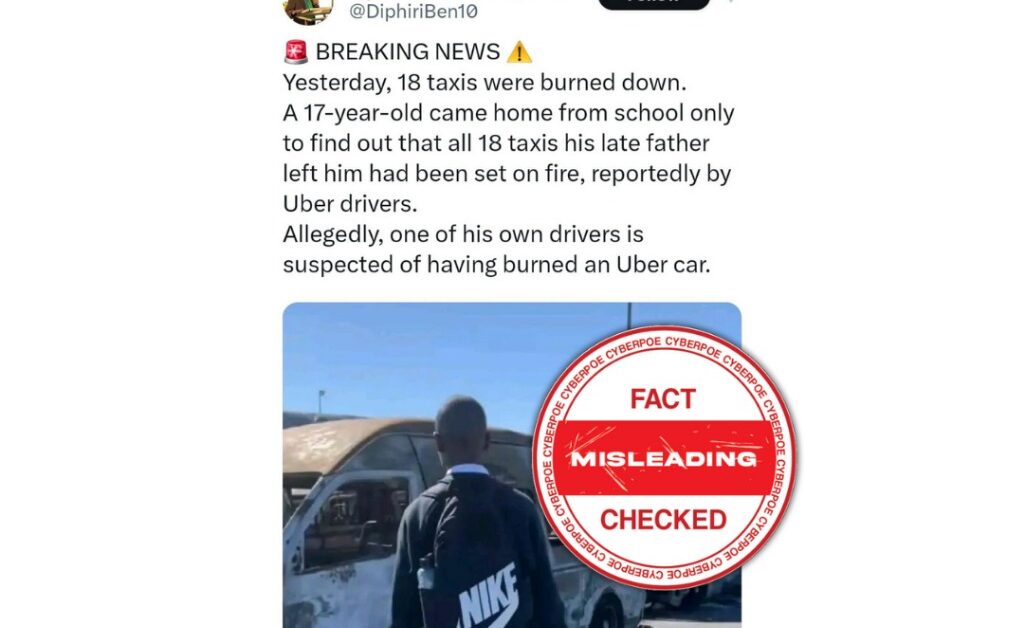
The viral claims centered on an image of a teenage boy in school uniform standing before the charred shells of minibus taxis. Accompanying captions asserted that he was a 17-year-old Johannesburg resident whose late father’s fleet of 18 taxis had been torched in the latest round of violence. One X post dated August 16, 2025, described the teenager as “returning home from school only to discover that Uber drivers had set his inherited taxis on fire.” The post quickly gained traction, amassing hundreds of reposts and more than 4,000 likes within days.
While the claim was emotionally powerful, it was also false. The photographs and videos circulating in August were not taken in Johannesburg and were not linked to the killing of the Uber driver. Instead, they originated months earlier and over a thousand kilometers away, in Nyanga, Cape Town, during a separate outbreak of taxi-related violence in February 2025.
Tracing the Origin of the Images
A reverse image and keyword search revealed that the widely shared pictures had previously appeared on TikTok. The content was posted by the account @evayomatakane, which frequently uploads short clips about South Africa’s taxi industry using the hashtag #taxiowner. The videos featuring the same teenager and the same backdrop of burned vehicles were uploaded on April 25, 2025, and again on July 3, 2025 well before the Johannesburg unrest.
The background details in the clips provided further confirmation. The destroyed minibuses bore the same distinctive scorch patterns and were lined up against the same metal poles and landscape features seen in earlier news coverage of violence in Cape Town. In fact, the scene matched footage captured by IOL News and published on TikTok on February 10, 2025, which documented arson attacks at the Nyanga Taxi Rank, one of the busiest and most volatile transport hubs in the Western Cape.
The IOL News video reported that more than a dozen taxis were torched in Nyanga that weekend, prompting authorities to deploy extra police officers and raise concerns about escalating tensions in the sector. A comparison of screenshots confirms that the same taxis, poles, and skyline including the outline of nearby mountains visible in the distance appear both in the February IOL footage and in the TikTok videos later misused in August.
Genuine Violence in Johannesburg
The fact that the imagery was misattributed does not mean unrest in Johannesburg was fabricated. On August 13, 2025, Uber driver Mthokozisi Mvelas was ambushed by armed men, shot dead, and his car set ablaze in Soweto. The following day, a minibus taxi was torched near Maponya Mall, allegedly in retaliation. Police reported that at least two people, including an innocent bystander, were wounded in gunfire linked to the clashes.
Authorities confirmed that cases of murder, attempted murder, and arson were opened and investigated as taxi-violence related. Images captured by international wire photographers, including AFP, showed the aftermath of the attacks in Soweto: blackened vehicle frames, heavy police presence, and visibly shaken residents.
This tragic sequence of events provided fertile ground for misinformation. As is often the case during violent unrest, dramatic but unrelated visuals were repurposed on social media to heighten emotions, personalize the story, and spread narratives of loss and betrayal. In this instance, the invented storyline of a grieving teenager who lost his late father’s taxi business in Johannesburg was designed to resonate deeply but it had no factual basis.
Why False Context Spreads
South Africa’s minibus taxi industry is both a lifeline and a lightning rod. Serving an estimated 15 million daily commuters, it dominates public transport but has long been marred by turf wars, arson attacks, and criminal infiltration. Conflicts with ride-hailing services such as Uber and Bolt have grown increasingly violent in urban centers like Johannesburg and Cape Town.
In such a volatile environment, false context posts spread easily. They combine real imagery with fabricated narratives, giving an illusion of credibility while stoking outrage. In this case, the TikTok clips of a schoolboy at a Cape Town taxi rank were stripped of their true date and location, then recast as breaking news from Johannesburg. The emotional hook a child inheriting and then losing his father’s livelihood helped the misinformation gain traction, even though no credible news outlet reported such a case.
The Verdict
The claim that a Johannesburg teenager lost his inherited fleet of taxis in the August 2025 unrest is false. The images used to support the story are authentic but were filmed months earlier in Nyanga, Cape Town, after a separate outbreak of taxi violence. The teenager in the video is not linked to the events in Soweto, and there is no evidence that Uber drivers targeted or destroyed 18 taxis belonging to him.
The unrest in Johannesburg was real and tragic, but the viral story about the boy was a manufactured narrative built on recycled imagery.
❌ The claim is false. The viral pictures are misattributed and unrelated to Johannesburg’s August 2025 taxi violence.
CyberPoe | The Anti-Propaganda Frontline
We track the truth. Everywhere