Project Info
Category
Date
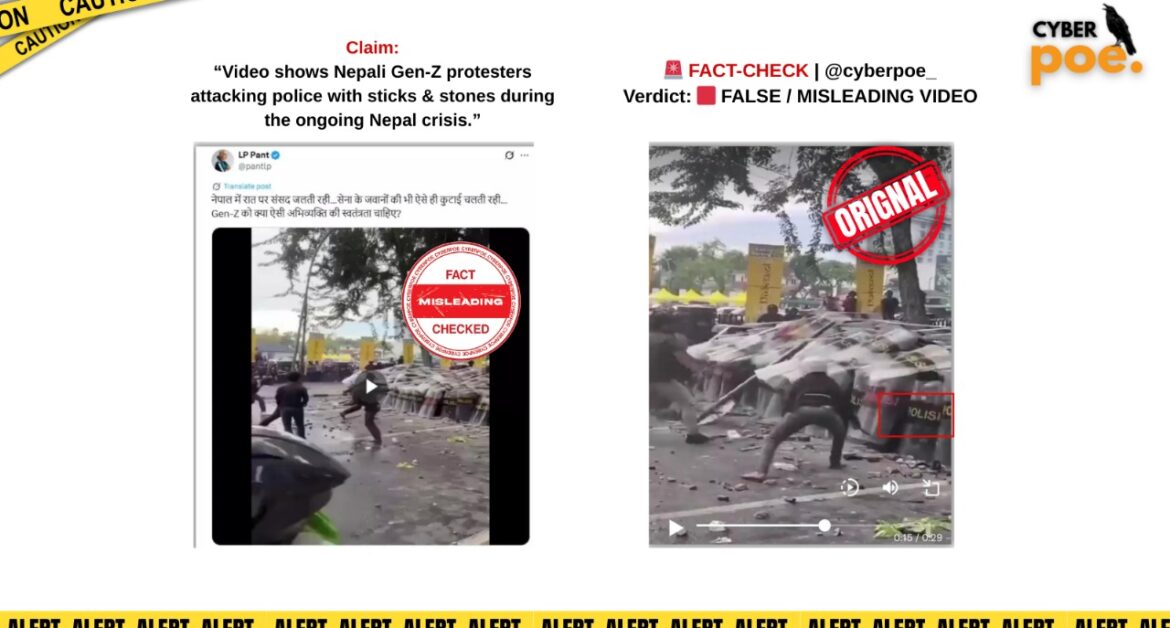
Viral Video of “Nepali Gen-Z Protesters Attacking Police”
The Claim and Its Spread
In September 2025, social media platforms were flooded with a video that allegedly showed young Nepali protesters clashing violently with police. Accounts on X, Facebook pages, and several Telegram groups shared the clip with captions suggesting it was recorded during the ongoing political crisis in Nepal, where mass protests, deadly clashes, and the resignation of Prime Minister Oli have dominated headlines. The narrative gained traction quickly because it coincided with real turmoil in Kathmandu, leading many viewers to assume the video was genuine evidence of the unrest.
Uncovering the Truth
A detailed analysis shows that the claim is false. The viral footage is not from Nepal at all but originates from Indonesia, recorded during widespread protests in August 2024. Those demonstrations erupted when Indonesian lawmakers awarded themselves controversial financial perks, sparking violent confrontations across several cities. By recycling this clip and attaching it to the 2025 Nepal protests, disinformation networks exploited the political moment to spread confusion.
Key Visual Indicators
The most striking clue in the video is the word “POLISI” printed on riot shields carried by the officers. This is the Indonesian word for police. In Nepal, security forces do not use this term; their shields and uniforms carry either the English word “Police” or the Nepali script “प्रहरी” (Prahari). This discrepancy immediately undermines the claim. Furthermore, uniform designs, helmets, and protective gear in the video are consistent with Indonesian police units rather than Nepalese forces, a detail that becomes evident when compared with authentic images of Nepal’s riot police.
Verification Through Archives
Reverse searches and media archive reviews confirm the Indonesian origin beyond doubt. A longer version of the footage was uploaded to YouTube on August 30, 2024 with the title in Indonesian: “POLISI VS MASSA PANDEMO GEGER GEDEN,” which translates to “Police vs Demonstrators Major Chaos.” News outlets, including Al Jazeera and Indonesian broadcasters, covered the same unrest in late August 2024, publishing reports and visuals that match the viral clip almost frame for frame.
Additional Contextual Clues
Other contextual elements strengthen the case against the Nepal attribution. Protesters in the video can be seen wearing Grab Food delivery helmets and jackets. Grab is a ride-hailing and delivery platform that operates widely in Southeast Asia, including Indonesia, but it does not operate in Nepal. This single detail serves as another geographic marker pointing toward the true location.
The Role of Disinformation Networks
The spread of this misattributed footage reflects broader patterns in online propaganda. Accounts with political motives often mix genuine clips of Nepal’s protests with unrelated foreign videos to amplify chaos and delegitimize real movements. By inserting fake visuals into authentic narratives, these actors exploit confusion and erode trust in reliable information sources. The result is an environment where genuine human rights abuses risk being overshadowed by fabricated material.
Why Accuracy Matters
The misrepresentation of foreign protest footage as Nepali undermines the credibility of authentic protest documentation. When false clips gain traction, international observers, journalists, and even local communities may become skeptical of real evidence of abuses. This weakens the ability of citizens to hold authorities accountable and diminishes trust in verified reporting. For Nepal’s protesters, whose struggles are rooted in real grievances and documented violence, the distortion of their story through false visuals represents a serious setback.
Conclusion
The viral video claiming to show Nepali Gen-Z protesters attacking police in 2025 is not from Nepal but from Indonesia in August 2024. The word “POLISI” on riot shields, the design of police gear, the presence of Grab Food delivery equipment, and archived news reports all confirm this conclusion. While Nepal is indeed facing a political crisis marked by unrest and deadly clashes, the use of foreign footage to dramatize events only deepens misinformation and distracts from the truth. Verifying such claims is essential to maintaining the integrity of information and protecting the dignity of real protest movements.
CyberPoe | The Anti-Propaganda Frontline 🌍