Project Info
Category
Date
Misleading Video Claims French Police Targeted Pro-Palestinian Protest in Paris (August 2025)
The Viral Claim
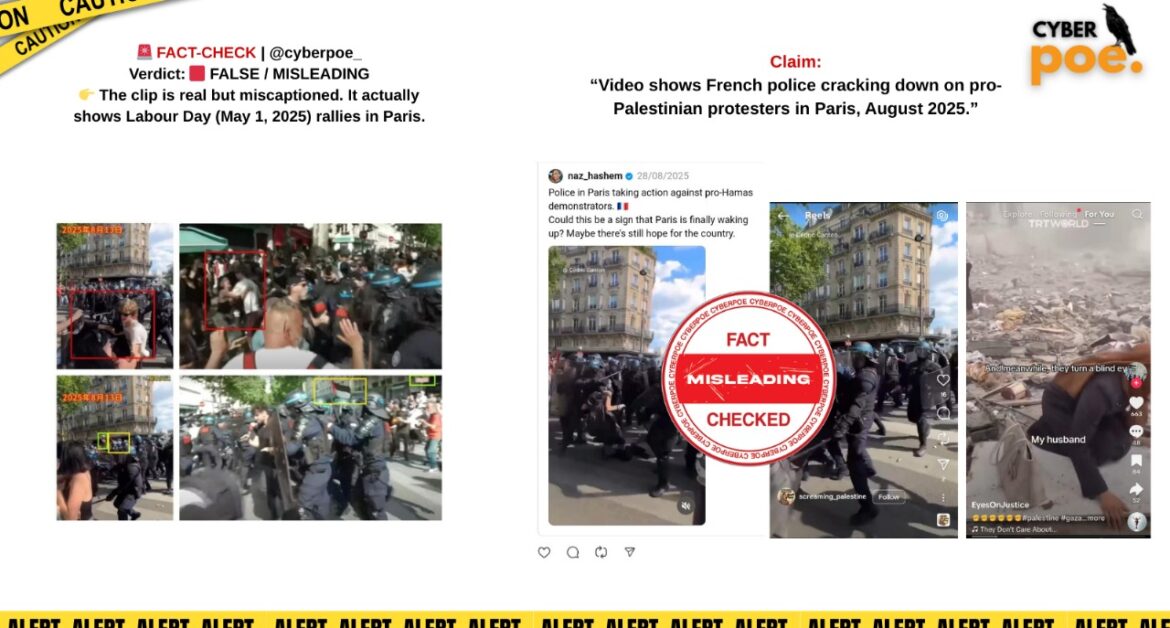
In August 2025, social media platforms were flooded with a dramatic video showing French riot police clashing with demonstrators on the streets of Paris. The footage was quickly captioned and shared as proof that authorities had brutally cracked down on a pro-Palestinian protest in the French capital. Posts carrying this narrative appeared across TikTok, X (formerly Twitter), Facebook, and Douyin, often accompanied by inflammatory captions such as “French police silencing Palestine solidarity in Paris.”
The video showed officers in riot gear aggressively pushing back protesters, making arrests, and striking individuals with batons. The inclusion of Palestinian flags in the crowd seemed to add credibility to the claim. As tensions surrounding global conflicts remain high, especially regarding the Palestinian issue, the clip spread rapidly, with millions of views within days. For many casual observers, the video looked like undeniable proof of French police targeting pro-Palestinian demonstrators.
However, a closer examination reveals that the narrative was misleading. While the video is authentic, its context has been deliberately distorted.
What Really Happened
The viral clip does not come from an August 2025 protest, nor was it linked to Palestine solidarity events. Instead, it was filmed during the International Workers’ Day (Labour Day) rallies on May 1, 2025, when trade unions and activists staged large demonstrations across France.
In Paris, Labour Day marches attracted tens of thousands of people, as is tradition every year. According to union figures, approximately 100,000 people took part, while the French Interior Ministry placed the number at around 32,000. The rallies began peacefully, but as has frequently occurred in past years, the situation escalated when a black bloc contingent joined the march. Clashes soon broke out between masked demonstrators and riot police.
Police forces responded with batons, tear gas, and mass arrests, while protesters set off fireworks, built barricades, and hurled projectiles. The Ministry of Interior confirmed that at least 52 individuals were detained in Paris during the May Day unrest. These events were widely reported by major French and international outlets, including Le Monde, and The Times, with some media organizations livestreaming parts of the clashes.
Verifying the Video
Fact-checking the viral clip provides conclusive evidence that it originated from the May 1 Labour Day rallies rather than any August demonstration. The watermark visible in the upper left-hand corner of the video matches the signature of French videographer Cedric Canton, who later confirmed he filmed the footage on May 1, 2025.
Reverse image searches, keyword analysis, and video-tracing tools such as InVID-WeVerify all link the clip back to early May 2025 posts. Several outlets had also published the same scenes at the time, reinforcing the authenticity of the Labour Day context.
While it is true that Palestinian flags are visible in the video, this is not unusual during French political rallies. May Day demonstrations often include diverse activist groups who bring banners and flags highlighting various causes from climate action to labor rights to international solidarity. The mere presence of Palestinian symbols in the May Day crowd does not prove that the event was a Palestine-focused protest. Crucially, no violent confrontations were reported at Paris’s actual pro-Palestinian rallies in August 2025.
How the False Narrative Spread
The miscaptioned video gained traction through a familiar network of disinformation actors. Pages and accounts on TikTok, Douyin, and Facebook recycled the old clip while presenting it as fresh evidence of France suppressing Palestine solidarity. On Telegram, so-called “breaking news” channels known for posting recycled riot videos amplified the claim further.
The strategy is consistent with wider disinformation patterns: use authentic but outdated footage, strip it of its original context, and repackage it to fit a contemporary controversy. This technique is effective because viewers assume visual evidence speaks for itself, rarely questioning timestamps or provenance.
For many audiences, especially those outside France, the combination of riot police, Paris streets, and Palestinian flags was enough to confirm the false narrative. In reality, these were coincidental overlaps exploited to manipulate perceptions.
Why It Matters
Misrepresenting real footage has broader consequences than a single viral hoax. First, it distorts public understanding of genuine events. By claiming that the clashes were about Palestine when they were not, disinformation actors blur the line between fact and fiction. This undermines the credibility of authentic protest movements and confuses observers trying to follow the situation.
Second, such false claims fuel unnecessary outrage and polarization. By portraying France as violently suppressing Palestine solidarity, disinformation networks stoke anger against French institutions and authorities without evidence. This not only damages France’s reputation but also manipulates the emotions of communities already sensitive to issues of justice and human rights.
Third, the spread of false footage weakens the credibility of legitimate journalism and human rights reporting. When mislabelled protest clips go viral, it becomes harder for audiences to distinguish authentic documentation of abuses from fabricated content. This erosion of trust plays directly into the hands of disinformation networks, whose goal is to create doubt and division.
CyberPoe Conclusion
The video showing French riot police clashing with demonstrators is real, but its caption is false. It does not depict a pro-Palestinian protest in Paris in August 2025. Instead, it comes from Labour Day rallies on May 1, 2025, where black bloc demonstrators clashed with police. The mislabelling of this footage is part of a broader disinformation pattern: recycling old protest videos to fit new political narratives.
CyberPoe’s analysis, backed by watermark verification, reverse image searches, media archives, and eyewitness confirmation, makes clear that this viral claim is misleading. As with countless other cases, the lesson is simple but vital: always verify before sharing. Authentic footage can easily be stripped of its context and weaponized as propaganda.
In today’s digital information battlefield, discerning fact from fiction requires vigilance. Disinformation thrives on speed and emotion; truth demands patience and verification. CyberPoe will continue to investigate, expose, and debunk these manipulative tactics to ensure facts are defended against the tide of propaganda.
CyberPoe | The Anti-Propaganda Frontline 🌍