Project Info
Category
Date
Misattributed Photo of Tyler Robinson in Charlie
Introduction
In the aftermath of the high-profile killing of U.S. conservative activist Charlie Kirk, misinformation has circulated rapidly across social media platforms. Among the most viral claims was a photo purportedly showing the 22-year-old suspect, Tyler Robinson, wearing a keffiyeh a scarf commonly associated with Palestinian solidarity movements. The image was weaponized by partisan accounts to suggest that Robinson’s alleged crime was politically motivated and tied to pro-Palestinian activism.
However, open-source verification and institutional checks reveal this claim is entirely false. The viral photo is not of Robinson at all. Instead, it originates from Utah Valley University’s Army ROTC program in 2019, years before Robinson’s arrest. This fact-check unpacks how the misattribution spread, where the image really came from, and why such falsehoods matter in shaping narratives around sensitive cases.
The Viral Claim
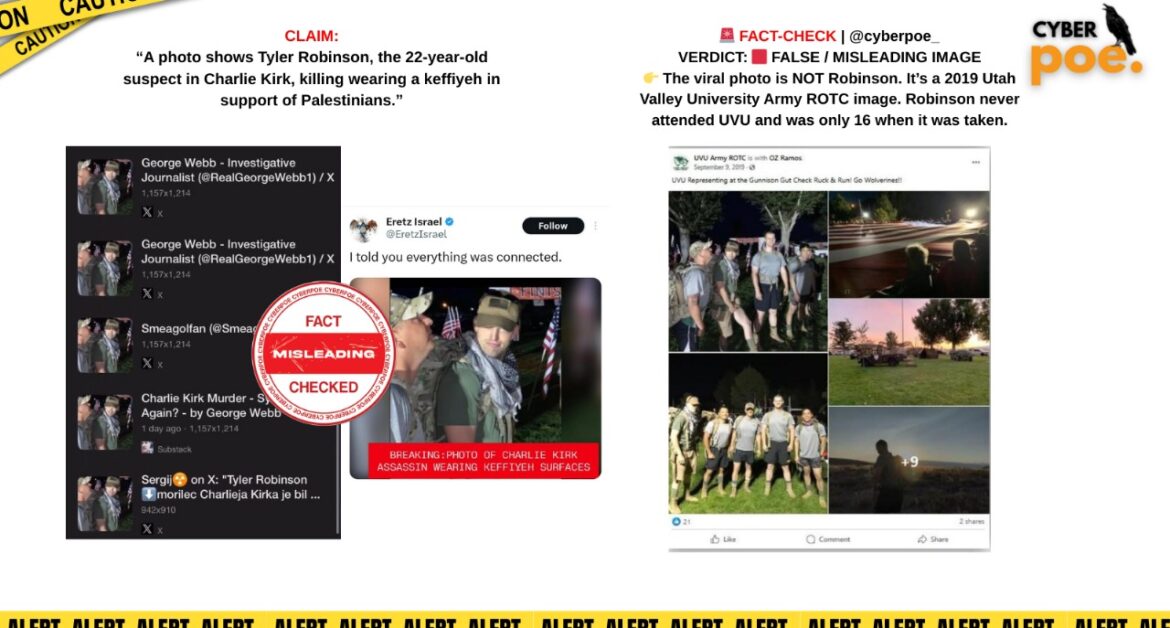
The misinformation first spread shortly after Robinson’s mugshot was released following his arrest on September 11, 2025. Social media users paired the mugshot with an image of a young man in camouflage gear and a keffiyeh, claiming it showed Robinson expressing support for Palestinians.
One of the most widely shared versions came from internet personality Eyal Yakoby, who posted the composite image on X (formerly Twitter) with inflammatory commentary. Though Yakoby later deleted the post, screenshots had already circulated widely, sparking debates across Facebook, Instagram, and Telegram groups. Within hours, the claim had reached tens of thousands of users.
The framing was clear: the photo was being used to cast Robinson as politically radicalized and to link his alleged crime to international conflicts despite no verified evidence supporting such a connection.
Where the Photo Actually Comes From
A closer look at the viral image quickly unravels the narrative. Open-source intelligence (OSINT) tracing shows the photo originates not from Robinson’s life, but from Utah Valley University’s Army ROTC social media accounts.
The image was first posted in September 2019 on UVU’s official Facebook and X pages as part of a set showing cadets participating in a “ruck-and-run” training event. The original caption makes no reference to Robinson and instead celebrates the dedication of ROTC cadets.
A reverse image search confirms this origin. Multiple matching posts from UVU highlight the same event, with additional photos from different angles. The cadets pictured were identified as part of the university’s Army ROTC program a group Robinson was never affiliated with.
Timeline and Identity Mismatch
The timeline further exposes the impossibility of the claim. Robinson was 22 years old in 2025, meaning he would have been only 16 years old in 2019 when the UVU ROTC photo set was published.
Public records and university confirmations establish that Robinson did not attend Utah Valley University. Instead, he briefly studied at Utah State University in 2021 for one semester. The U.S. Army Cadet Command additionally confirmed that Robinson had no ROTC affiliation.
These discrepancies show that the viral photo simply cannot depict Robinson. The institutional checks, combined with the 2019 ROTC posting, dismantle the claim entirely.
Visual Verification
Beyond records, the visuals themselves disprove the claim. The UVU ROTC’s 2019 post includes multiple images of the same individual in different poses and angles. Comparing these to Robinson’s 2025 mugshot reveals clear differences in facial structure, proportions, and features.
While the man in the ROTC image wears a keffiyeh, his overall appearance does not match Robinson’s verified mugshot. Multiple perspectives captured by UVU provide conclusive proof that the ROTC cadet and Robinson are not the same person.
Official Checks Reinforce Findings
Independent checks from institutions further support the debunk.
- Utah State University: Confirmed Robinson attended briefly in 2021, not UVU.
- Utah Valley University: Archival posts prove the ROTC photo originated from 2019.
- U.S. Army Cadet Command: Found no ROTC enrollment records for Robinson.
Together, these verifications underscore that the viral claim has no factual basis.
Why Misattribution Matters
Misinformation thrives in the chaos of breaking news, and this case highlights the dangers of misattributed imagery. Assigning false political motives to a homicide suspect risks inflaming partisan tensions, misguiding public opinion, and distracting from verified investigative facts.
The use of a keffiyeh in the miscaptioned image was not incidental. It was deliberately leveraged to imply ideological alignment with Palestinian causes, exploiting ongoing international conflicts for domestic political narratives. This tactic is common in online propaganda: emotionally charged visuals are paired with unrelated events to create viral, yet misleading, narratives.
Such tactics do real harm. They erode trust in factual reporting, stigmatize communities, and divert attention from the legitimate judicial process.
The Facts About Robinson
As of mid-September 2025, Robinson faces murder charges in connection with Charlie Kirk’s killing. Court filings and police reports suggest investigators are focusing on personal motives and private communications, not political affiliations.
Public records show Robinson had no formal political party ties and did not vote in the 2024 elections. These findings further discredit claims that he was ideologically driven by international issues.
CyberPoe’s Final Word
The viral photo of a man in camouflage and a keffiyeh is not Tyler Robinson. It is a misattributed image from Utah Valley University’s ROTC program in 2019. Multiple institutional confirmations, combined with visual analysis and timeline checks, prove the claim false.
🚫 Do not share the image as proof of Robinson’s political beliefs or motives.
✅ Verify before amplifying unverified claims especially in high-profile cases where misinformation spreads rapidly.
At CyberPoe, we remain committed to exposing falsehoods, debunking propaganda, and protecting the public from misinformation.
Conclusion
This fact-check underscores the importance of skepticism in the face of viral claims. Provenance matters: before believing or sharing sensational images, ask who posted them, when they were first shared, and whether official records confirm the narrative.
Falsehoods can travel faster than truth, but with vigilant verification, the public can resist being manipulated.
CyberPoe | The Anti-Propaganda Frontline 🌍