Project Info
Category
Date
Viral Protest Video Wrongly Linked to Nepal
Introduction
In September 2025, Nepal experienced one of the most turbulent political moments in its recent history. Widespread demonstrations over corruption, economic decline, and governance failures led to violent clashes that eventually toppled the government and left dozens dead. Against this backdrop of genuine turmoil, social media was flooded with unverified videos and images claiming to depict the crisis. Among them, one clip attracted particular attention: a short video showing protesters tearing down the gates of what was alleged to be Nepal’s parliament building. The video spread rapidly across X, Instagram, and Facebook, gaining thousands of shares and comments within days. At first glance, the visuals seemed convincing, especially for audiences already primed by news of Nepal’s unrest. Yet a deeper examination reveals that the footage was not from Nepal at all, but rather from Indonesia, recorded weeks earlier.
The Viral Misattribution
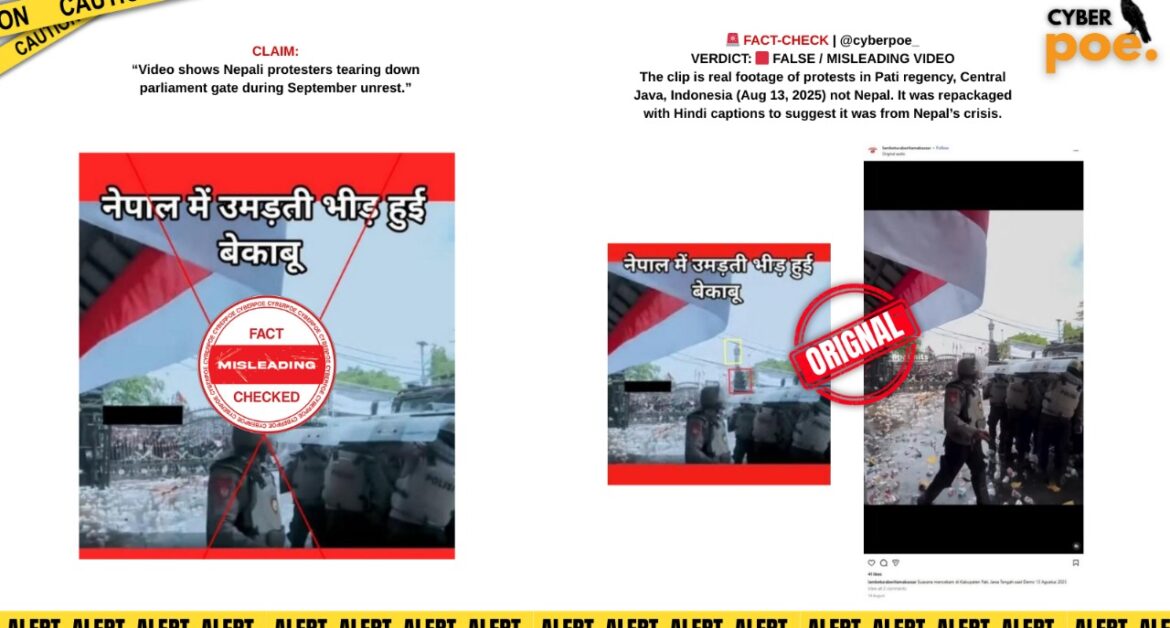
The viral claim began circulating in Hindi-language posts that stated protesters in Nepal had stormed parliament and broken down its gates during the September uprising. The captions explicitly connected the footage to the Nepali political crisis, creating an impression that the situation in Kathmandu had descended into scenes of absolute chaos. For many viewers, especially those following events casually or through partisan social channels, the narrative appeared authentic and aligned with their expectations. This is precisely why such misattributed footage is so potent: it thrives on confirmation bias, where audiences readily accept visuals that seem to validate what they already believe.
Visual Red Flags
Closer inspection of the video quickly revealed inconsistencies with the claim. The most striking detail was the presence of red-and-white flags being carried by demonstrators. Unlike Nepal’s unique double-pennon flag of crimson with blue borders, the red-and-white design is unmistakably Indonesia’s national flag. Equally telling were the surrounding buildings and gate structures, which bore no resemblance to Nepal’s parliamentary precinct in Kathmandu. While the captions encouraged viewers to focus on the alleged political symbolism of the scene, the architectural and symbolic details pointed firmly elsewhere.
Tracing the Source
Investigative tracing through reverse-image searches and keyframe analysis established the actual origin of the footage. A longer version of the same video had been uploaded on Instagram on August 14, 2025, clearly labelled as protests in Pati Regency, Central Java, Indonesia. The post referenced demonstrations from the previous day, August 13, when massive crowds had gathered to oppose a controversial local tax hike. This early source provided strong evidence that the viral clip was unrelated to Nepal’s unrest. The finding was further corroborated by mainstream reporting. Outlets such as Channel News Asia, Kompas, and Tribunnews all covered the Indonesian protests, broadcasting visuals that matched the viral video almost frame for frame.
Corroboration Through Landmarks
To ensure the conclusion was airtight, comparisons were made between the viral video and independent media footage from Indonesia. Live coverage showed the same gates, pillars, and administrative buildings from different camera angles, confirming the location as the Pati regional administration office. Google Street View imagery of the area revealed identical architectural features, reinforcing the verification process. Taken together, these multiple layers of evidence eliminated any doubt: the events captured in the viral clip took place in Indonesia, not Nepal.
The Real Context in Pati
Closer inspection of the video quickly revealed inconsistencies with the claim. The most striking detail was the presence of red-and-white flags being carried by demonstrators. Unlike Nepal’s unique double-pennon flag of crimson with blue borders, the red-and-white design is unmistakably Indonesia’s national flag. Equally telling were the surrounding buildings and gate structures, which bore no resemblance to Nepal’s parliamentary precinct in Kathmandu. While the captions encouraged viewers to focus on the alleged political symbolism of the scene, the architectural and symbolic details pointed firmly elsewhere.
Tracing the Source
Investigative tracing through reverse-image searches and keyframe analysis established the actual origin of the footage. A longer version of the same video had been uploaded on Instagram on August 14, 2025, clearly labelled as protests in Pati Regency, Central Java, Indonesia. The post referenced demonstrations from the previous day, August 13, when massive crowds had gathered to oppose a controversial local tax hike. This early source provided strong evidence that the viral clip was unrelated to Nepal’s unrest. The finding was further corroborated by mainstream reporting. Outlets such as Channel News Asia, Kompas, and Tribunnews all covered the Indonesian protests, broadcasting visuals that matched the viral video almost frame for frame.
Corroboration Through Landmarks
To ensure the conclusion was airtight, comparisons were made between the viral video and independent media footage from Indonesia. Live coverage showed the same gates, pillars, and administrative buildings from different camera angles, confirming the location as the Pati regional administration office. Google Street View imagery of the area revealed identical architectural features, reinforcing the verification process. Taken together, these multiple layers of evidence eliminated any doubt: the events captured in the viral clip took place in Indonesia, not Nepal.
The Real Context in Pati
Understanding the true background of the footage is critical to dismantling misinformation. On August 13, 2025, Pati Regency witnessed mass demonstrations against a local regent’s decision to introduce a new tax scheme. The policy was widely seen as unfair and burdensome, prompting a turnout of up to 100,000 people. Tensions quickly escalated when crowds attempted to storm the regional office complex. Protesters hurled stones and other projectiles, while police deployed tear gas and water cannons in response. The clashes were chaotic and dramatic, producing the kind of visuals that could easily be repurposed in another political setting.
Why It Was Reframed as Nepal
The decision to repackage the Pati footage as Nepali unrest was no accident. Social media manipulators frequently recycle old or unrelated clips during crises to inflame emotions and distort public perception. In this case, the timing was crucial. The Nepal government’s collapse and the deaths of protesters provided a fertile ground for disinformation. By adding Hindi captions and framing the video as “Nepal’s parliament under attack,” propagandists exploited regional audiences’ heightened sensitivity to instability. This tactic reflects a broader trend in disinformation: the strategic reuse of existing visuals to amplify narratives of chaos and dysfunction in politically fragile states.
The Dangers of Misattribution
Although such a video may seem like a simple misrepresentation, the consequences can be far-reaching. Misattributed footage distorts the public’s understanding of actual events, painting a picture that is more extreme or violent than reality. This, in turn, can exacerbate political divides within Nepal, as citizens react to false portrayals of their own crisis. It also risks fueling hostility across borders, since foreign audiences may view the situation through a distorted lens. Most dangerously, the spread of recycled footage erodes trust in legitimate reporting. When fake visuals dominate online discourse, factual journalism struggles to regain authority, leaving room for further manipulation and rumor-mongering.
Conclusion: Verify Before You Share
The viral gate-tearing video is not from Nepal, despite claims to the contrary. It was filmed in Pati Regency, Central Java, Indonesia, on August 13, 2025, during protests against a local tax policy. Its circulation as evidence of Nepal’s unrest is a textbook example of how misinformation exploits real crises by attaching unrelated but dramatic visuals. The lesson for audiences is straightforward yet essential: always examine details such as flags, language, architecture, and credible media reporting before accepting a viral video at face value.
At CyberPoe, we remain committed to identifying, exposing, and debunking such disinformation campaigns. By combining open-source intelligence (OSINT) tools, cross-verification with media outlets, and contextual analysis, we aim to equip readers with the awareness needed to resist propaganda. In an era of rapid-fire social media consumption, vigilance is the strongest defense.
CyberPoe | The Anti-Propaganda Frontline 🌍