Project Info
Category
Date
Deepfake Politics: Fact-Checking the Viral Video of Museveni’s “Final Term” Claim
Introduction
In the age of synthetic media, disinformation has evolved into one of the most pressing challenges to political stability. Deepfakes and AI-generated manipulations are no longer fringe phenomena but central tools in modern information warfare. They blur the lines between truth and fabrication, allowing falsehoods to spread with alarming credibility. A recent example emerged in September 2025, when a video circulated across social media platforms claiming that Ugandan President Yoweri Museveni had announced his 2026 presidential bid would be his final term in office. The clip, which spread rapidly on TikTok, Facebook, Instagram, X, and YouTube, triggered heated debate within Uganda and drew international attention.
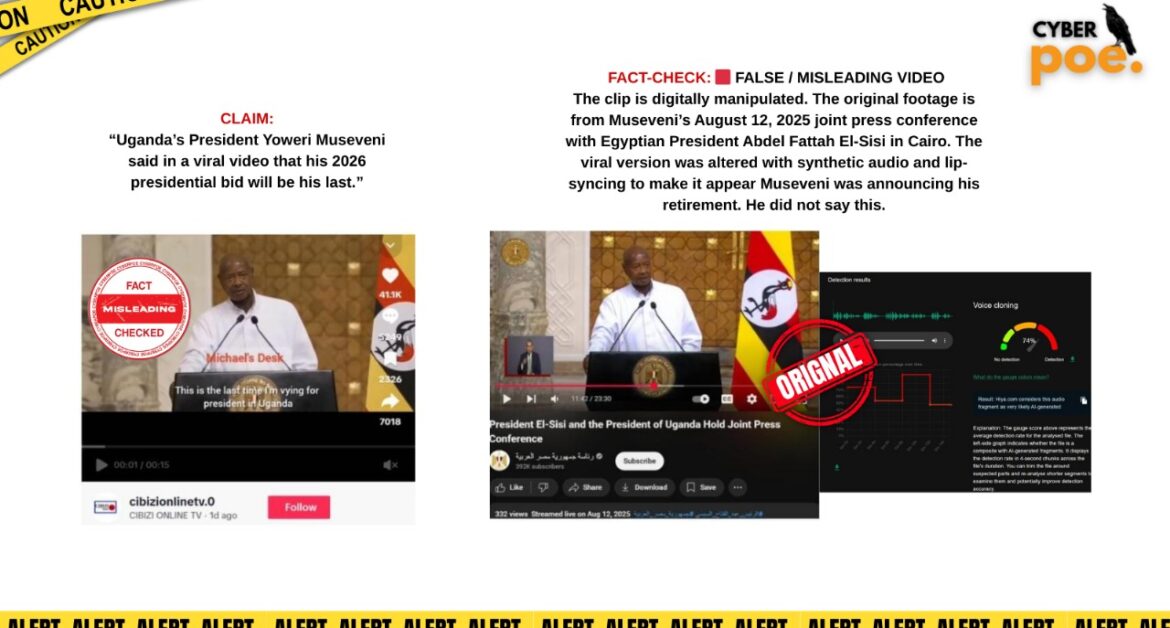
However, the claim turned out to be false. Investigations supported by CyberPoe’s independent analysis, confirmed that the video was doctored using deepfake technology. The original footage was taken from Museveni’s joint press conference with Egyptian President Abdel Fattah El-Sisi in Cairo on August 12, 2025. In reality, Museveni made no such statement. Instead, the viral video was manipulated with synthetic voice cloning and lip-syncing technology to mislead viewers. This fact-check explores how the video was fabricated, what Museveni actually said in Cairo, and why such disinformation poses grave risks in Uganda’s sensitive political landscape.
The Viral Claim
The video in question first appeared on TikTok on September 16, 2025, before quickly migrating to other platforms. It showed Museveni standing behind a lectern bearing the Egyptian presidential seal, apparently declaring that the upcoming election would be his final run for office. The manipulated audio featured Museveni saying: “This is the last time I’m vying for president in Uganda… vote for me for the very last time.” The statement, if true, would have been groundbreaking, as Museveni has held power since 1986 and repeatedly signaled his intention to remain president indefinitely. The video resonated widely in a region where his long tenure is often a subject of both criticism and fascination. Some Kenyan media outlets even amplified the clip before it was debunked.
Yet the claim was immediately at odds with established political realities. Museveni had already secured the endorsement of his party, the National Resistance Movement (NRM), for the January 2026 elections. There was no precedent in his recent statements to suggest he was considering stepping down. The viral claim was not only misleading but strategically timed to coincide with heightened political activity in the lead-up to Uganda’s elections.
Museveni’s Real Position
At 81 years old, Yoweri Museveni remains one of Africa’s longest-serving leaders. Over the years, he has systematically reshaped Uganda’s constitutional framework to ensure his continued rule. In 2005, presidential term limits were abolished, and in 2017, the constitutional age cap of 75 for presidential candidates was removed. These legal changes effectively cleared the way for Museveni to contest elections indefinitely. In June 2025, the NRM formally endorsed him for a seventh term, and he has repeatedly signaled his intention to continue leading the country. His speeches, party documents, and official communications all reinforce this stance. At no point has he made a public commitment to retire after the 2026 race. The viral video therefore presented a narrative completely detached from political reality.
The Original Footage
CyberPoe investigators traced the manipulated clip to its original source: the official YouTube channel of the Egyptian Presidency. On August 12, 2025, Museveni stood alongside President El-Sisi at a joint press conference in Cairo. The event focused on cooperative initiatives between Uganda and Egypt. Museveni discussed Nile Basin water security, the importance of expanding intra-African trade, and strengthening public health systems through vaccine production and medical infrastructure. His remarks were consistent with Uganda’s regional priorities, and nowhere in the footage did he reference retirement, elections, or a political “final term.” The viral video was a selective manipulation of this authentic press conference.
Signs of Manipulation
A closer analysis of the viral video reveals telltale signs of AI-driven fabrication. Museveni’s lip movements were slightly out of sync with the audio, a common flaw in lip-sync deepfake techniques. The voice track itself exhibited the uneven pacing and artificial tonal quality characteristic of synthetic speech. Forensic analysis using tools such as InVID-WeVerify confirmed the likelihood of cloned audio, layered over genuine visuals. This hybrid approach authentic video paired with manipulated speech represents a particularly deceptive form of disinformation. Casual viewers are less likely to question the content because the visuals are genuine, even as the audio has been altered.
The Dangers of Deepfake Disinformation
The implications of such manipulations extend far beyond one misleading video. Deepfakes erode trust in political communication and destabilize democratic processes. In Uganda’s case, a false claim that Museveni was preparing to step down could influence voter behavior, opposition strategy, and even diplomatic perceptions abroad. It could create a false sense of transition, diverting attention from genuine debates over governance, accountability, and civil rights.
Deepfakes also undermine trust in authentic communication. When audiences cannot be sure whether a video or speech is genuine, they may dismiss even legitimate messages as fabrications. This environment of distrust is fertile ground for authoritarian manipulation, conspiracy theories, and social division. Moreover, in a politically charged region like East Africa, where Museveni faces challengers such as Bobi Wine, disinformation can inflame existing tensions and destabilize both domestic and regional politics.
CyberPoe Final Word
The viral video of Yoweri Museveni allegedly declaring his final presidential bid in 2026 is a textbook example of deepfake disinformation. It hijacked authentic footage from a Cairo press conference and altered it with synthetic audio to create a false narrative. The reality is clear: Museveni remains firmly positioned as the NRM’s candidate, with no indication that he intends to relinquish power.
In an era defined by information warfare, fact-checking has become more than a safeguard it is a civic duty. Disinformation thrives on speed, emotion, and repetition, but verification demands patience, cross-checking, and reliance on credible sources. As Uganda approaches a pivotal election, voters, journalists, and policymakers must remain vigilant against AI-driven propaganda. Not every viral video is what it appears to be.
Stay alert. Stay informed. Stay with CyberPoe The Anti-Propaganda Frontline.