Project Info
Category
Date
The Viral Claim About Brazilian Protests Demanding Bolsonaro’s “Execution”
Introduction
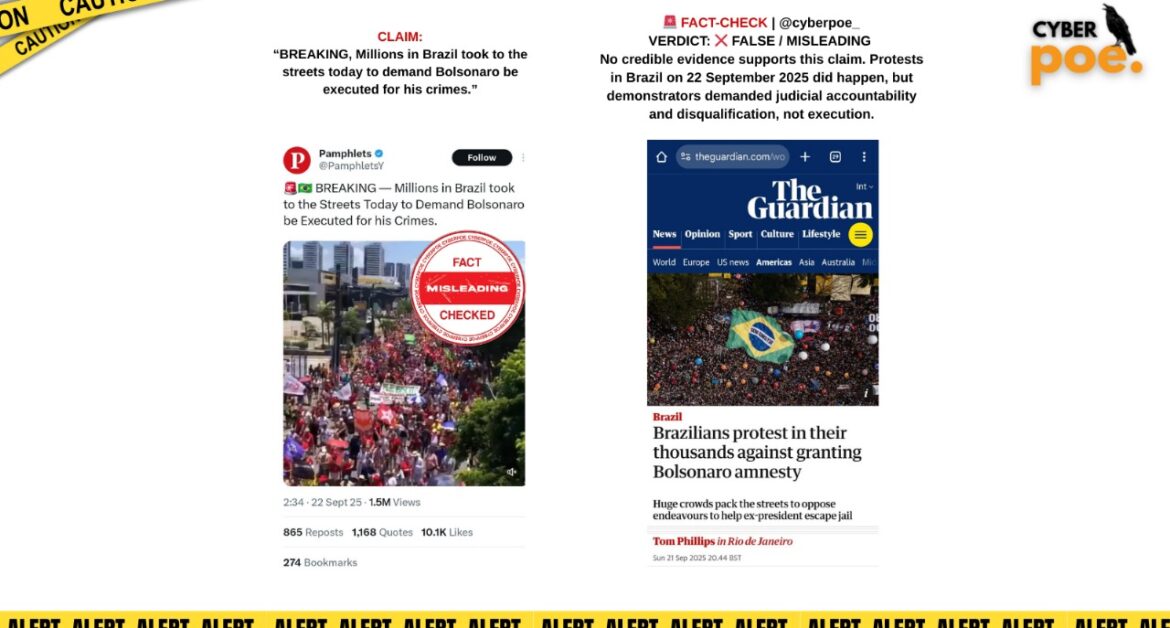
Disinformation thrives during politically charged moments, especially in countries with polarized societies and high-stakes legal battles. Brazil is no exception. In September 2025, a viral claim began circulating across X, Facebook, TikTok, and WhatsApp, alleging that “millions” of Brazilians had taken to the streets to demand former president Jair Bolsonaro’s execution for his crimes. The posts were accompanied by sensationalist headlines, misleading videos of large demonstrations, and hashtags linking the story to ongoing judicial proceedings against Bolsonaro. While the protests were real, the claim about calls for execution was entirely false. Careful verification shows that demonstrators did not demand Bolsonaro’s death but instead sought legal accountability, disqualification from office, and solutions to Brazil’s ongoing economic challenges.
The Viral Narrative
The story gained traction on September 22, 2025, after videos of massive crowds in São Paulo and Brasília began to circulate. Misleading captions framed the protests as a collective demand for Bolsonaro to face execution. Certain partisan pages amplified the claim, presenting it as proof of Brazil’s public turning decisively against the former president. Within hours, the claim was reshared thousands of times across Latin America and even picked up by international commentators eager to paint Brazil as spiraling into chaos. The emotional framing of “millions demanding execution” made the narrative attractive to both Bolsonaro’s critics and his defenders, each side using it either to highlight his unpopularity or to portray him as a victim of mob justice.
What Really Happened
On September 22, 2025, Brazil did indeed witness large-scale demonstrations. Tens of thousands of people marched in São Paulo, Rio de Janeiro, and Brasília, with smaller protests in other state capitals. The rallies were organized by unions, civil society groups, and opposition parties, and were part of a broader mobilization demanding accountability for Bolsonaro’s actions. Protesters called for his prosecution in relation to the January 2023 Brasília riots, when Bolsonaro supporters stormed government buildings in an attempt to challenge the legitimacy of Luiz Inácio Lula da Silva’s election. Demonstrators also raised concerns about inflation, rising unemployment, and austerity measures that had cut into public services.
At no point, however, did the protests call for Bolsonaro’s execution. Verified reports from Brazilian outlets such as Folha de S. Paulo, O Globo, and Estadão, alongside coverage by Reuters and the Associated Press, confirmed that the demands centered on judicial punishment, disqualification from future office, and prison terms where legally applicable. No chants, placards, or official speeches made reference to the death penalty.
Legal and Political Context
The claim that Bolsonaro’s opponents were demanding his execution collapses under basic scrutiny of Brazil’s legal framework. The country abolished the death penalty for ordinary crimes decades ago. Brazil’s 1988 constitution allows capital punishment only in cases of war crimes during declared wartime, a clause with no relevance to domestic political corruption or riots. In practice, the judiciary has no mechanism to order the execution of a civilian figure such as Bolsonaro. The legal battles facing him concern disqualification from public office and possible prison time, not capital punishment.
By ignoring this constitutional reality, the viral posts sought to sensationalize legitimate protests. They transformed lawful, democratic demonstrations into something more violent and extreme, thereby undermining the credibility of the protest movement itself.
How the False Claim Spread
The claim spread in part through the repurposing of old footage. Several viral videos used clips from earlier demonstrations in 2022 and 2023, when massive crowds gathered either to support or oppose Bolsonaro. These recycled videos were paired with captions suggesting that the footage was current and that the crowds were chanting for execution. The tactic is common in disinformation campaigns: repackage existing material, attach a new caption, and release it during a moment of heightened political attention. On platforms like TikTok and WhatsApp, where short clips circulate quickly without context, such manipulation can easily mislead large audiences.
Why the Truth Matters
The fabrication that “millions demanded Bolsonaro’s execution” is not a harmless exaggeration. It actively distorts the narrative of Brazil’s democratic protests. By framing demonstrators as bloodthirsty mobs, disinformation undermines the legitimacy of civic activism and hands Bolsonaro’s defenders a narrative of persecution. Conversely, by exaggerating crowd sizes into “millions,” the claim inflates opposition strength in a way that misrepresents the actual scale of mobilization. Both distortions weaken democratic accountability by replacing verifiable facts with sensational fiction.
The circulation of such narratives also reveals how disinformation operates in polarized societies. Rather than debate actual grievances unemployment, inflation, judicial accountability the conversation is hijacked by false claims that provoke outrage but add nothing constructive. In Brazil’s case, with an election cycle approaching and court cases still unfolding, such fabrications can fuel division, increase mistrust in institutions, and even provoke violence.
CyberPoe Final Word
The September 22, 2025 protests in Brazil were real, significant, and newsworthy. But they did not call for Jair Bolsonaro’s execution, nor did they involve “millions” of people. Verified evidence from leading Brazilian and international media shows that the demonstrations were focused on demanding accountability for Bolsonaro’s role in the January 2023 riots, seeking his disqualification from politics, and pushing for broader economic and social reforms. The viral claim of “execution demands” was a fabrication, supported by recycled footage and misleading captions.
Disinformation thrives on exaggeration and distortion, especially in moments of political tension. Fact-checking restores clarity by anchoring narratives in verified evidence and constitutional realities. As Brazil navigates its turbulent political landscape, it is essential for citizens and observers alike to remain vigilant against viral falsehoods.
CyberPoe | The Anti-Propaganda Frontline 🌍