Project Info
Category
Date
Old Earthquake Photos Falsely Linked to DPWH Corruption Scandal in the Philippines
Introduction
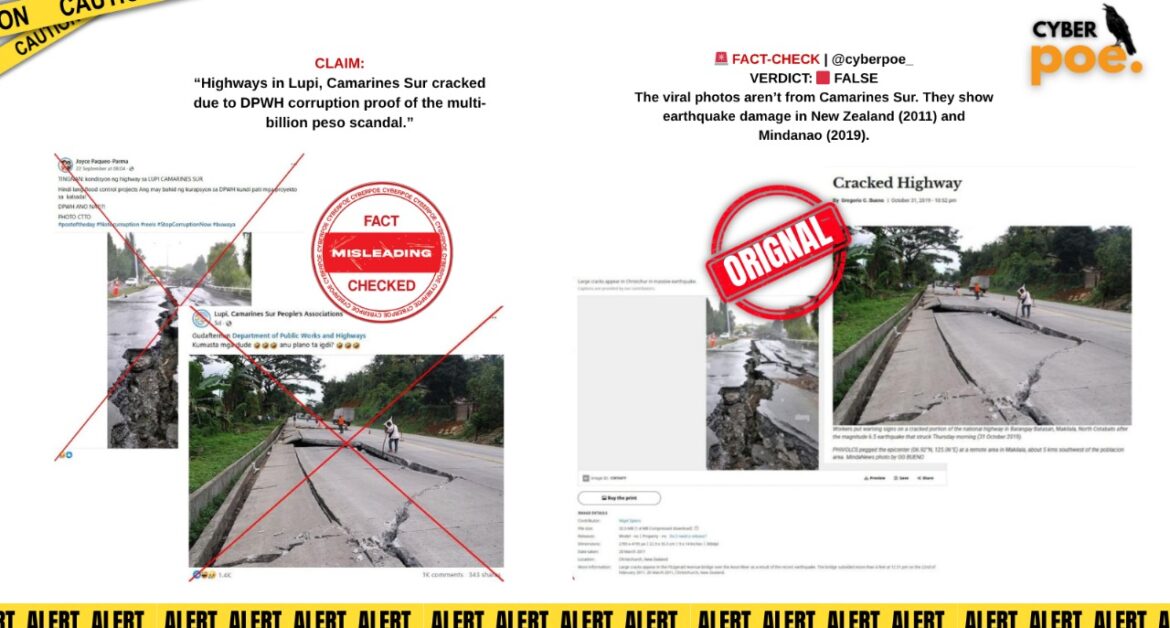
In September 2025, a set of alarming images began circulating widely on social media in the Philippines. Posts on Facebook alleged that newly cracked highways in Lupi, Camarines Sur exposed massive corruption within the Department of Public Works and Highways (DPWH). The viral narrative suggested that roads had already collapsed due to substandard construction tied to the department’s multi-billion peso corruption scandal. The photos showed highways split by wide fissures and broken asphalt, presented as shocking evidence of failed infrastructure.
Yet, a detailed fact-check shows that these claims are false and misleading. The images being shared are not recent at all. One was taken in New Zealand after the devastating Christchurch earthquake of 2011, while the other is from the 2019 Mindanao earthquake in the Philippines. Neither has anything to do with ongoing projects in Camarines Sur or the DPWH scandal.
The Viral Claim and Public Anger
The posts gained significant traction because they played into a very real political context. The DPWH has been under fire in 2025 after revelations of widespread corruption, particularly in bogus flood-control projects. Investigations revealed billions of pesos lost to ghost projects and collusion between contractors and officials. On September 21, 2025, thousands of Filipinos rallied in Manila in peaceful demonstrations demanding accountability. Against this backdrop of outrage, opportunistic actors online seized the chance to amplify anger by attaching unrelated but dramatic visuals to the scandal.
One viral caption read: “LOOK: The highway’s condition at Lupi, Camarines Sur… It’s not only flood-control projects tainted with corruption at the DPWH; even the road projects are.” This framing made the photos seem like fresh and undeniable proof of DPWH negligence, which is why they spread so quickly. But this was precisely the manipulation using unrelated disaster imagery to strengthen a political narrative.
Context Behind the Scandal
The DPWH corruption scandal itself is real. Flood-control projects worth billions of pesos were exposed as fraudulent or non-existent. Public anger has been fueled by the perception that the agency, tasked with building the nation’s infrastructure, has instead become a hub of patronage and self-enrichment. The outrage culminated in mass protests that were largely peaceful but carried a strong message of accountability.
However, misinformation has begun to blur the line between genuine evidence and fabricated narratives. By recycling old disaster photos and presenting them as proof of corruption, disinformation actors not only distort reality but also risk undermining the credibility of legitimate protest movements.
Tracing the Photos
A closer examination reveals the true origins of the viral images. The first photo, showing a road split wide with jagged cracks, is from Christchurch, New Zealand. A reverse image search links it to photo archives dated March 2011, following the catastrophic 6.3 magnitude earthquake that struck on February 23, 2011. The image shows damage to Fitzgerald Avenue bridge over the Avon River, one of the worst-hit areas of the city. It has no connection whatsoever to the Philippines.
The second photo, depicting workers placing warning signs on a cracked highway, was traced to a MindaNews article from October 2019. It shows earthquake damage in Barangay Batasan, Makilala, North Cotabato, following the third in a series of strong earthquakes that devastated Mindanao that year. The photo is authentic, but it documents natural disaster damage, not corruption or poor road construction.
A Broader Pattern of Misuse
This incident is part of a wider trend observed during the September 2025 protests. Fact-checkers, have already flagged multiple instances where unrelated visuals have been repurposed to fuel outrage. Videos from clothing advertisements were reframed as supposed proof of “paid protesters.” Old disaster footage resurfaced as fabricated evidence of failed infrastructure. The circulation of these materials demonstrates a deliberate effort by disinformation actors to escalate tensions by using emotional triggers.
Such patterns of misuse are dangerous. By mixing genuine grievances with false evidence, they blur reality and give officials an easy excuse to dismiss legitimate public concerns as propaganda. This is why fact-checking and verification are critical during politically charged moments.
The Verified Reality
It is important to distinguish between the real and the fabricated. The DPWH corruption scandal is genuine and deserves full accountability. Billions in taxpayer money are at stake, and the scale of the alleged fraud is deeply concerning. However, the viral road photos that circulated in September 2025 are not part of this scandal. They come from entirely different contexts a devastating earthquake in New Zealand over a decade ago, and an earthquake in Mindanao six years ago.
By recycling old visuals, disinformation actors attempted to weaponize public anger. In doing so, they not only misled citizens but also risked weakening the impact of legitimate anti-corruption advocacy.
Conclusion
The claim that cracked highways in Lupi, Camarines Sur expose new DPWH corruption is false and misleading. The photos being shared are old images from natural disasters, not evidence of infrastructure collapse. The first image is from the 2011 Christchurch earthquake in New Zealand, while the second is from the 2019 Mindanao earthquakes in the Philippines.
The DPWH scandal remains a real and pressing issue, but its exposure should be based on verified facts rather than recycled misinformation. CyberPoe reminds readers that viral outrage often feeds on shock visuals, but a quick reverse image search can reveal the truth. Verification is not just a journalistic duty it is a civic responsibility in the age of disinformation.
CyberPoe | The Anti-Propaganda Frontline