Project Info
Category
Date
Claim of a “Christian Genocide” in Nigeria What the Facts Actually Reveal
Introduction
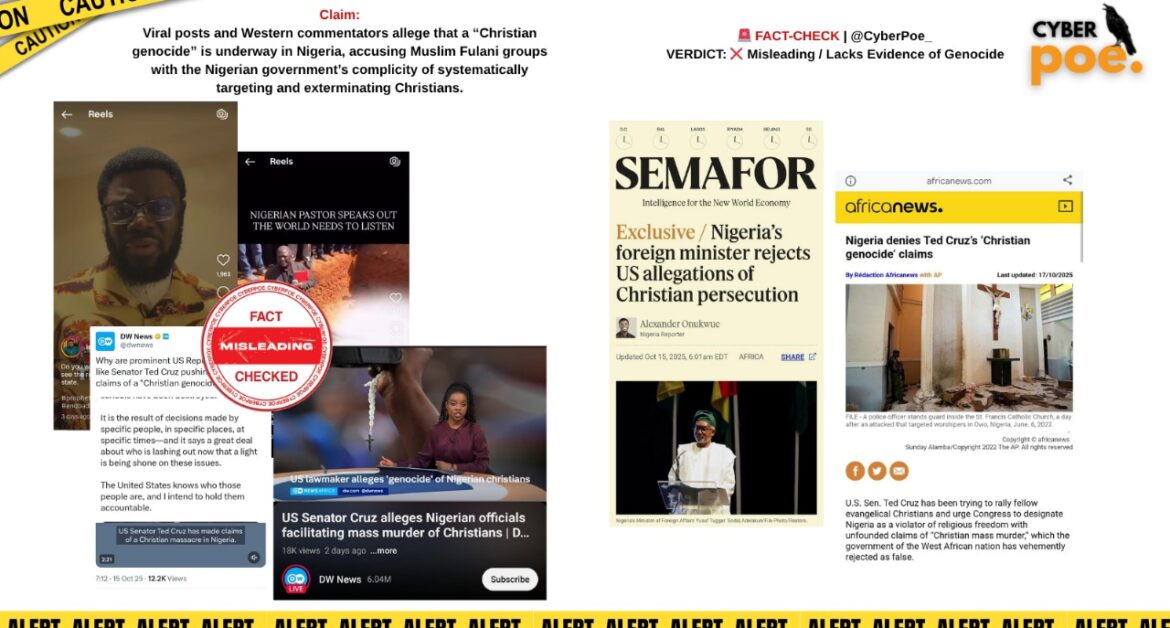
Over the past several months, social media platforms and Western political commentators have been flooded with alarming claims alleging that a “Christian genocide” is underway in Nigeria. Viral posts, opinion videos, and advocacy campaigns, many amplified by prominent Western voices including U.S. Senator Ted Cruz, have painted a harrowing picture of Muslim Fulani groups systematically targeting and exterminating Christian communities across Nigeria’s Middle Belt and northern states. These narratives accuse the Nigerian government of either complicity or deliberate inaction in the face of what is described as an Islamist extermination campaign. At first glance, the claims appear compelling, drawing upon genuine reports of violence in areas like Benue, Plateau, and Nasarawa states. However, a deeper investigation reveals that while Nigeria is indeed gripped by an acute security crisis, there is no verifiable evidence to substantiate the claim of a coordinated or state-backed Christian genocide.
Unpacking the Narrative and Its Global Echo
The “Christian genocide” narrative has gained particular traction within Western conservative and evangelical circles, where advocacy organizations often frame Nigeria’s violence through a religious lens. Social media posts and campaign videos frequently feature burned churches, displaced villagers, and harrowing testimonies of victims all real tragedies that reflect genuine suffering but are often misrepresented as evidence of an orchestrated extermination plan. In reality, the situation is far more complex. Nigeria’s northern and central regions have, for decades, been flashpoints of ethnic and resource-based conflict, where religion is just one of many intersecting fault lines. Many of these clashes arise from disputes between predominantly Christian farming communities and Muslim Fulani herders whose migration patterns have shifted due to desertification and the shrinking of arable land. Climate change, population pressure, and weak governance have all intensified these disputes, turning them deadly.
Independent Investigations and the Absence of Genocidal Evidence
Comprehensive investigations by independent bodies such as Deutsche Welle (DW), Good Governance Africa, Amnesty International, and Nigerian security analysts consistently show no evidence of a coordinated campaign or government policy aimed at exterminating Christians. Reports by these organizations describe the violence as multi-layered and driven by diverse factors, including ethnic identity, political manipulation, and competition over dwindling natural resources. According to DW’s October 2025 analysis, “When Fulani houses are burnt today, tomorrow the houses of the Christian community are burnt too,” illustrating a grim cycle of reprisal rather than a one-sided campaign of annihilation. These dynamics demonstrate that while Christians have been victims in many attacks, they are not the exclusive or systematic targets of violence.
What Nigerian Experts and Officials Say
Nigerian officials and conflict researchers have repeatedly cautioned against framing the crisis as genocide. Mohammed Idris, Nigeria’s Minister of Information, stated that “claims of a deliberate, systematic attack on Christians are inaccurate and harmful,” emphasizing that the government’s challenge lies in addressing a nationwide security breakdown that affects all communities, regardless of faith. Similarly, Fr. Atta Barkindo, Executive Director of The Kukah Centre in Abuja, noted that “what we are witnessing is not a government policy to kill Christians but a state failure to protect its citizens.” This distinction, he explained, is critical the absence of effective governance, not genocidal intent, is at the heart of Nigeria’s tragedy. Samuel Malik, a senior researcher at Good Governance Africa, reinforced this view, arguing that labeling the crisis as genocide “oversimplifies deeply rooted socio-political and environmental problems,” which in turn “undermines genuine peacebuilding efforts.”
Understanding the Broader Context of Nigeria’s Insecurity
Nigeria’s insecurity landscape is among the most complex in the world. Since 2023, the country has witnessed over 10,000 deaths from overlapping crises — insurgency, farmer-herder conflicts, banditry, and organized criminal activity. In the Middle Belt states of Benue and Plateau, communal clashes are often framed as religious warfare, yet ground-level investigations reveal that many incidents stem from disputes over land and water resources. The historical shadow of the 19th-century Fulani Jihad continues to fuel suspicion between Christian and Muslim communities, but contemporary violence rarely fits neatly into a religious narrative. The Boko Haram insurgency in the northeast, for instance, has targeted both Muslims and Christians alike, killing imams who reject extremism and destroying mosques along with churches. This pattern underscores the reality that Nigeria’s violence is indiscriminate, rooted more in governance failure and economic desperation than in faith-based hatred.
The Dangers of Oversimplified Narratives
The claim of a “Christian genocide” in Nigeria not only distorts the facts but also risks inflaming sectarian tensions and undermining fragile peacebuilding efforts. Labeling a multidimensional conflict as genocide narrows public understanding and politicizes humanitarian crises. Such narratives have also been weaponized by extremist actors seeking to provoke retaliatory violence or secure international intervention under false pretenses. Moreover, when international audiences adopt one-dimensional narratives, it distracts attention from the structural drivers of Nigeria’s insecurity corruption, weak law enforcement, poverty, and climate-induced displacement. Experts warn that this mischaracterization may harm both Christian and Muslim victims by transforming a shared national tragedy into a divisive religious confrontation.
CyberPoe X Verdict
After reviewing reports from reputable sources including Deutsche Welle (DW), Good Governance Africa, Amnesty International, The Kukah Centre, and the Nigerian Ministry of Information, it is evident that while Christians have suffered horrific violence in Nigeria, there is no verifiable evidence of a state-sponsored or organized genocide. The reality is far more nuanced a crisis of governance, identity, and environmental survival rather than a government-sanctioned campaign of extermination. Nigeria’s tragedy lies not in a “Christian genocide,” but in a nation caught within overlapping systems of failure: insecurity, political exploitation, and environmental decay. The term “genocide” may serve as a powerful rallying cry for advocacy, but it does not accurately describe the Nigerian context.
Conclusion
There is no credible or empirical basis to describe Nigeria’s ongoing insecurity as a “Christian genocide.” What exists is a deeply entrenched national security crisis driven by poverty, weak governance, ethnic tension, and environmental stress. The violence cuts across communities Christian and Muslim alike and perpetuates a cycle of mutual suffering. Reducing such complexity to a singular, emotionally charged narrative risks deepening divisions and obstructing the search for peace. Nigeria’s path forward depends not on external rhetoric but on inclusive dialogue, institutional reform, and evidence-based understanding. The truth, as established by CyberPoe, is clear: Nigeria faces a crisis of narratives, not a genocide.
References
CyberPoeX | The Anti-Propaganda Frontline