Project Info
Category
Date
Fact Check: Alleged Pakistani Airstrikes in Afghanistan Causing Civilian Casualties
Recent social media claims allege that Pakistani military forces conducted airstrikes in the Afghan provinces of Kunar, Khost, and Paktika, resulting in significant civilian casualties, including women and children. The posts often include videos and photographs purportedly showing destroyed buildings and injured civilians, sparking widespread concern across platforms such as X, Facebook, Telegram, and WhatsApp. These narratives were shared amid heightened regional tensions, suggesting an escalation of cross-border military activity by Pakistan. However, a careful investigation of the visuals and sources reveals a starkly different reality.
Analysis of the Viral Visuals
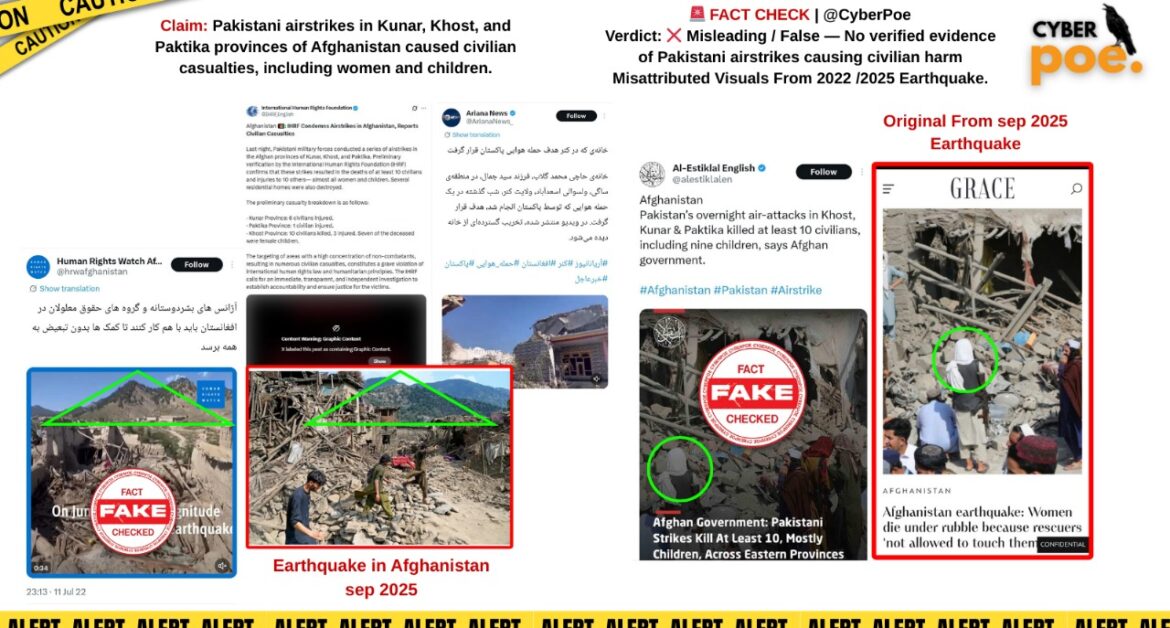
CyberPoe’s verification team conducted a detailed review of the imagery used in these claims. Reverse image searches, cross-referencing with archival reports, and open-source verification revealed that the videos and images are largely misattributed. Specifically, many frames were traced to two separate earthquakes in Afghanistan: one in 2022 and another in September 2025. CyberPoe highlighted the visual similarities between the viral content and archived reports from these earthquakes, confirming that the footage did not depict military operations but rather the aftermath of natural disasters. Screenshots from the 2022 and 2025 earthquake archives, included in CyberPoe’s analysis, show identical buildings, rubble patterns, and damaged infrastructure compared with the viral posts. These comparisons clearly demonstrate that the visuals were recycled and manipulated to suggest ongoing Pakistani airstrikes.
Independent Verification and Official Sources
Independent investigation further confirms the falsity of the claims. No credible media outlets, Afghan government sources, or international monitoring organizations have reported any Pakistani airstrikes in Kunar, Khost, or Paktika during November 2025. Afghan provincial authorities explicitly denied any recent airstrikes, corroborating the open-source verification findings. Satellite imagery of the regions in question showed no evidence of bombing, military engagement, or new infrastructure damage. CyberPoe’s team attached screenshots of the archived 2022 and 2025 earthquake imagery, providing a visual comparison that directly contrasts with the manipulated viral content. The images make clear that the destruction was caused by seismic events, not military action.
Origins of the Misleading Narrative
The false narrative appears to have been deliberately amplified to create the impression of a Pakistani military offensive. Posts from the International Human Rights Foundation (IHRF) and other online accounts misrepresented earthquake footage from 2022 and 2025 as evidence of airstrikes. CyberPoe noted that the timing of these posts coincided with ongoing geopolitical tensions in the region, making audiences more likely to share and believe misleading content. The recycled imagery, coupled with fabricated captions, demonstrates a pattern of exploiting emotionally charged visuals to generate virality and drive political narratives.
Implications of the Disinformation
Misattributing natural disaster footage to military attacks can have serious consequences. In this case, the false claims risk inflaming diplomatic tensions between Pakistan and Afghanistan, misinforming international audiences, and diverting humanitarian attention away from genuine crises. The use of visual evidence from the 2022 and 2025 earthquakes to fabricate new incidents undermines trust in legitimate reporting and contributes to the proliferation of misinformation. CyberPoe’s screenshots of the original earthquake footage serve as evidence of these manipulations, clearly illustrating how images can be misused to mislead audiences about current events.
Contextual Considerations
Civilian safety in conflict zones remains a critical concern, particularly in eastern Afghanistan, which is vulnerable to both natural disasters and sporadic conflict. However, conflating earthquake damage with alleged Pakistani military activity distorts the reality on the ground. Historical earthquake archives from 2022 and 2025, verified and compared by CyberPoe, confirm that no cross-border airstrikes occurred in the affected provinces during this period. The viral posts thus represent a deliberate misrepresentation of events, taking advantage of public sensitivity to both natural disasters and regional security concerns.
Conclusion
The claims of Pakistani airstrikes in Kunar, Khost, and Paktika causing civilian casualties in November 2025 are entirely unsubstantiated. The imagery used to support these claims originates from the 2022 and September 2025 earthquakes in Afghanistan. CyberPoe’s verification, including attached screenshots from both earthquake events, demonstrates that the visual content was misused and recycled to falsely suggest military activity. No credible reports, satellite data, or official statements support the alleged airstrikes. This incident underscores the importance of media literacy and robust fact-checking to prevent the spread of misinformation in contexts where both natural disasters and conflict intersect. Accurate verification, as shown by CyberPoe, is crucial to ensure public understanding of events remains based on facts rather than manipulated visuals or misleading narratives.
CyberPoe | The Anti-Propaganda Frontline 🌍