Project Info
Category
Date
Viral Chilean Firefighting Footage Misrepresented as Hong Kong Blaze
Introduction
Introduction
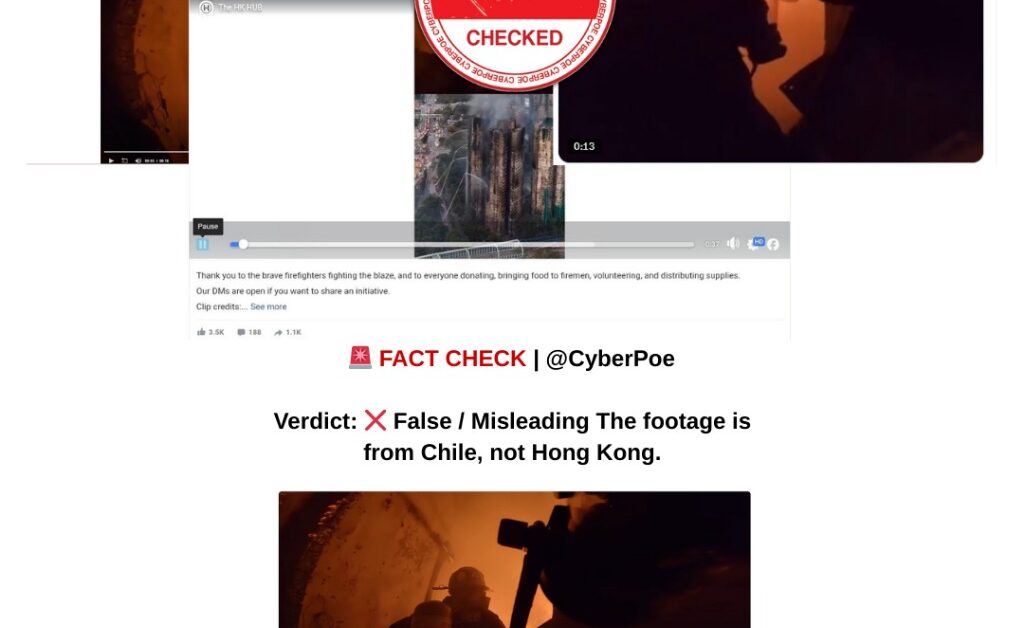
In November 2025, a video circulated widely on social media platforms, including X[1], Facebook[2], Instagram[3], and international forums[4], claiming to show Hong Kong firefighters responding to the deadly Wang Fuk Court residential fire in Tai Po. Captions accompanying the video praised Hong Kong’s emergency responders and suggested the footage was taken from bodycams worn by firefighters on the scene. The clip quickly gained traction, going viral due to its emotionally compelling depiction of rescue efforts. However, CyberPoe’s verification team found that the footage is misrepresented. It does not depict Hong Kong, but instead originates from Chile over a year earlier.
Original Source of the Video
Reverse image searches and metadata analysis traced the original source of the video to a GoPro recording [1] uploaded on November 8, 2024. The footage shows firefighters from the Third Fire Company of Ñuñoa, a district in Santiago, Chile, responding to a house fire. The video was filmed by firefighter Joseth Abel Espinosa to document the operational risks faced by local firefighters. It was publicly shared with the intent of highlighting the dedication and professionalism of Santiago’s emergency services. The content appeared in Chilean media outlets and on GoPro’s official channels, making the original context clear: it was intended to showcase local firefighting operations and bears no connection to Hong Kong or the Wang Fuk Court fire.
Timeline Discrepancies
The timeline confirms that the viral video predates the Hong Kong incident by over a year. The Wang Fuk Court fire occurred in November 2025[1], whereas the Chilean footage was
filmed in November 2024. This temporal mismatch clearly indicates that the video cannot depict events in Hong Kong. Visual elements such as the structure of the buildings, the street layout, and firefighting equipment align with Chilean practices rather than Hong Kong’s urban high-rise environment. Uniforms, helmets, and hose handling methods further confirm the South American origin of the footage.
Visual Inconsistencies and Misrepresentation
Online posts falsely labeled the video as Hong Kong bodycam footage. In reality, the GoPro used by the Chilean firefighter provides a first-person perspective, which was misrepresented as official Hong Kong documentation. Differences in architecture, emergency equipment, and environmental context make the misattribution evident. The viral captions and shares amplified the misleading narrative, convincing audiences unfamiliar with Chilean firefighting infrastructure that the video captured Hong Kong firefighters in action.
Social Media Amplification
The misattributed video was widely shared across multiple platforms, gaining millions of views due to its dramatic visual content. Audiences were drawn to the heroic depiction of firefighters in life-threatening situations, which reinforced the belief that it showed Hong Kong’s emergency response. The video’s virality demonstrates how authentic footage from one context can be repurposed to create false narratives in another, often exploiting emotional responses to high-stakes events.
Verification by Authorities
CyberPoe cross-referenced the viral footage with reports from Hong Kong Fire Services Department and local media covering the Wang Fuk Court fire. No official footage or media reports matched the viral video. Press releases and eyewitness accounts confirmed that documentation of the Hong Kong fire was limited to media crews and internal recordings, none resembling the Chilean video. These findings further corroborate that the viral content is unrelated to Hong Kong.
Implications of Misattribution
This case highlights the challenges of misinformation in the digital age. Videos of emergency situations are often recycled across borders, mislabelled, and presented as evidence of unrelated events. Misrepresentation can misinform the public, diminish trust in authentic reporting, and inadvertently exploit the efforts of first responders in other countries. In this instance, Chilean firefighters’ work was co-opted to fabricate a false narrative about Hong Kong’s emergency response.
Conclusion
The viral video circulating in November 2025 does not depict the Hong Kong Wang Fuk Court fire. Instead, it shows Chilean firefighters from Ñuñoa responding to a house fire in Santiago in November 2024. The misrepresentation arises from misleading captions, erroneous geographic labeling, and social media amplification. CyberPoe’s analysis emphasizes the need for careful verification, particularly during crisis events. Audiences are encouraged to consult verified sources, scrutinize viral footage, and avoid sharing content without corroborating evidence. The Chilean origin, visual inconsistencies, and timeline discrepancies confirm that the circulating video is misattributed and should not be considered authentic documentation of Hong Kong’s firefighting response.
CyberPoe | The Anti-Propaganda Frontline 🌍