Project Info
Category
Date
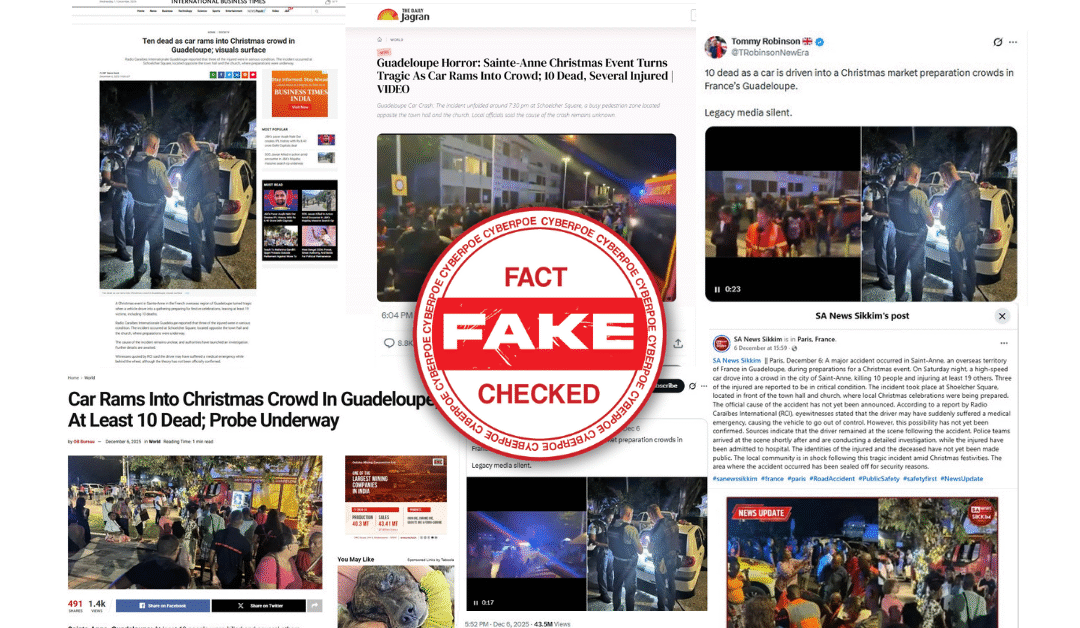
Social media posts and multiple international news reports claimed 10 people were killed after a car rammed into a crowd at a Christmas event in Guadeloupe on December 5, 2025.
Background and Viral Claims
In early December 2025, a wave of alarming posts began circulating across X[1], Facebook [2]and several international news websites[3] claiming that a car had ploughed into a crowd during a Christmas celebration in Guadeloupe, killing at least 10 people. The incident was framed by viral captions as a deadly attack during a festive public gathering, and the narrative quickly gained traction. One widely shared post amassed tens of millions of views within hours, reinforcing the perception that Guadeloupe had witnessed a mass-casualty tragedy. As the claim spread, it triggered global concern, emotional reactions, and political commentary, despite the lack of verified official confirmation at the time.
What Actually Happened in Sainte-Anne
CyberPoe’s verification establishes that while a serious incident did occur, the claims of fatalities are entirely false. On December 5, 2025, during a public event in Sainte-Anne organized for the switching on of Christmas lights, a vehicle struck a group of people standing near a food truck. Local emergency services responded immediately, and the injured were transported to nearby medical facilities. According to official records, a total of 19 people sustained injuries. Three of them were initially classified as being in critical condition but were later stabilized. Crucially, no deaths were recorded at any stage of the incident. Local authorities have been unequivocal on this point.
Official Statements and Confirmation
Jean-François Moniotte, Sub-Prefect of Pointe-à-Pitre, confirmed in a telephone interview that there were no fatalities linked to the crash. This was independently corroborated by Anna Gouttenoire, Head of Interministerial Communications at the Guadeloupe Prefecture, who reiterated via email that reports claiming 10 deaths were “completely false.” No emergency service, hospital authority, or judicial body in Guadeloupe has reported any loss of life resulting from the incident.
The Role of Translation Errors in Spreading Misinformation
The root of the false death toll can be traced to a linguistic and technological failure rather than new factual developments. A French-language headline published by Radio Caraïbes Internationale (RCI Guadeloupe) described the incident as: “Grave accident à Sainte-Anne : une dizaine de victimes fauchées.” In French, the word “fauchées” means “struck down” or “hit,” not “killed.” However, automated translation systems, including widely used online tools, mistranslated the phrase as “around ten victims killed.” This subtle but critical error transformed a report of injuries into a narrative of mass fatalities.
Media Amplification and Corrections
Once the mistranslation entered the media ecosystem, several international outlets repeated the incorrect interpretation without independent verification. Publications across South Asia and elsewhere reported that 10 people had died, amplifying the false narrative. As official clarifications emerged, some outlets issued corrections or amended headlines to remove references to fatalities, while others quietly updated their stories without acknowledgment. Reuters later confirmed that the original French report never mentioned deaths, and Google acknowledged limitations in automated translation when dealing with nuanced or idiomatic language.
Why This Fact Check Matters
This case illustrates how misinformation can rapidly escalate during breaking news events, particularly when language barriers and automated tools are involved. A single mistranslated word, when amplified by social media algorithms and high-profile accounts, can reshape global understanding of an event within minutes. Even after corrections are issued, the initial false narrative often continues to circulate, leaving lasting impressions. For audiences, journalists, and platforms alike, the Guadeloupe incident underscores the importance of verifying primary sources, consulting official authorities, and exercising caution with machine-translated content.
CyberPoe Verdict
After comprehensive verification, CyberPoe concludes that the claim of 10 deaths at the Guadeloupe Christmas event is false. The incident resulted in injuries but no fatalities. The misinformation originated from translation errors and was amplified through premature reporting and viral social media sharing. Accurate information is essential, especially during sensitive events involving public safety, and this case serves as a clear reminder of the consequences of unchecked digital misinformation.
CyberPoe | The Anti-Propaganda Frontline 🌍