Project Info
Category
Date
Outdated Greece Footage Falsely Presented as Violent U.S. Protest
Introduction: A Familiar Pattern Reemerges
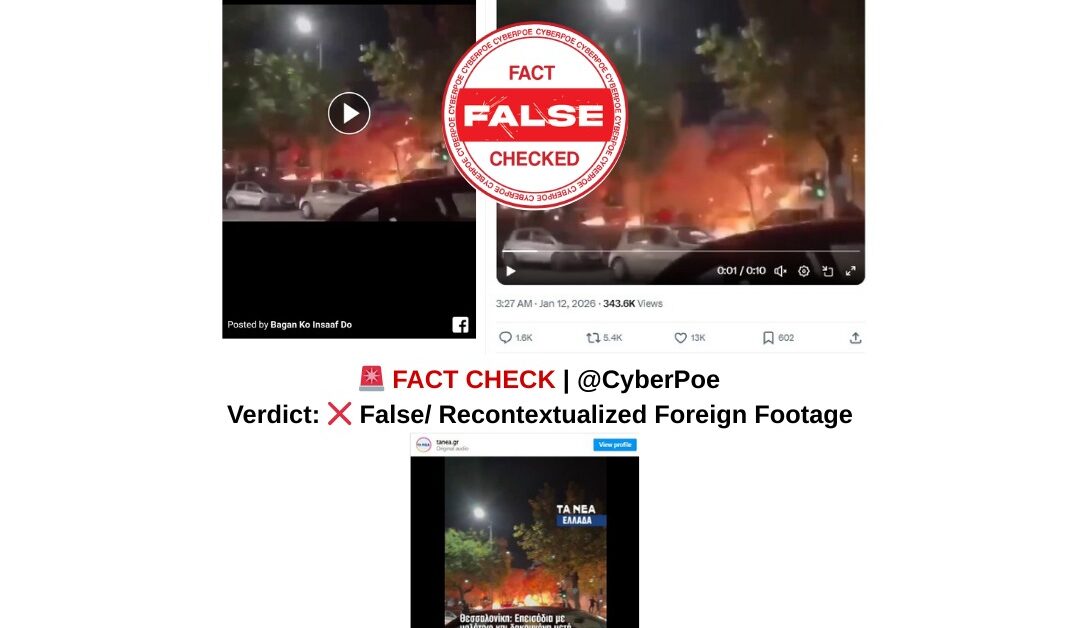
In January 2026, amid heightened political tension in the United States following the fatal January 7 shooting of a woman in Minneapolis by a U.S.[1] Immigration and Customs Enforcement agent, social media platforms once again became fertile ground for misinformation. As real demonstrations unfolded across multiple cities, a dramatic video began circulating online, presented as visual proof that the United States was descending into widespread violent unrest. The footage, showing individuals throwing Molotov cocktails amid flames, smoke, and nighttime chaos, was framed as evidence of mass riots sweeping the country in response to President Donald Trump’s policies. In parallel, the same video was recycled to support an entirely different narrative, with some users claiming it depicted protests in Iran against the country’s clerical leadership. CyberPoe examined these claims in detail and found them to be false.
The Viral Claim and Its Strategic Timing
The timing of the video’s resurgence played a critical role in its acceptance. In the days following the Minneapolis shooting, demonstrations were widely reported by reputable media outlets, and images of protests were circulating globally. Against this backdrop, the Molotov cocktail footage was introduced as “breaking evidence” of escalating violence. Posts on X,[1] and Facebook,[2] used alarmist language, warning that America was “spiraling out of control” and that millions were allegedly taking to the streets. The same imagery was simultaneously repurposed in Arabic-language posts to suggest large-scale unrest in Iran. This dual use of a single video to support contradictory geopolitical narratives is a hallmark of opportunistic disinformation.
Why the Footage Appeared Convincing
The video’s visual intensity made it particularly effective. Firebombs, burning buildings, and police confrontations align closely with public expectations of what violent protests look like, especially for audiences primed by years of viral unrest imagery. During moments of genuine crisis, viewers often rely on visual cues rather than verification, assuming that dramatic scenes must reflect current events. The presence of real protests in the United States further lowered skepticism. For many users, the leap from “protests are happening” to “this video shows those protests” felt intuitive, even though it was factually incorrect.
CyberPoe’s Verification Process
CyberPoe conducted a systematic verification using open-source intelligence methods, including reverse-image searches, timestamp analysis, and cross-referencing with established media archives. This process quickly revealed that the video did not originate in January 2026. Identical footage appeared online as early as November 2, 2025,[1] more than two months before the Minneapolis shooting. One of the earliest verified sources was an Instagram post by Ta Nea, a major Greek newspaper, which shared the video in a clearly unrelated context. Additional confirmation came from Greek outlet Kathimerini and from Newsflare, a professional video-licensing platform hosting multiple angles of the same incident.
The Real Event Behind the Video
In its original context, the footage documents violent clashes in Thessaloniki, Greece, in November 2025. According to Greek media reporting, unrest erupted following a rap concert, during which groups of individuals threw Molotov cocktails and confronted police forces. Authorities responded with tear gas, and Greek police later confirmed that 18 arrests were made in connection with the clashes. The location, language, policing style, and surrounding infrastructure visible in the video all align with Thessaloniki and do not match U.S. or Iranian settings. Independent visuals from different vantage points further corroborate the event’s time and place.
How Recontextualization Turned Truth into Misinformation
The misleading claims did not rely on fabricated footage. Instead, they employed a subtler and often more effective tactic: recontextualization. Authentic video was stripped of its original date, location, and explanation, then reintroduced online with emotionally charged captions tied to unrelated political events. By attaching the footage to ongoing protests in the United States or, alternatively, to unrest in Iran users were able to manufacture credibility without altering the visuals themselves. The fact that the same clip was used to support opposing narratives underscores how disconnected the imagery became from any factual grounding.
The Broader Impact of Such Misrepresentation
Mislabeling foreign or outdated footage has serious consequences. It inflates perceptions of violence, distorts public understanding of real demonstrations, and undermines trust in legitimate journalism. In politically sensitive moments involving immigration enforcement and law enforcement actions, such distortions can deepen polarization and escalate fear. When audiences are repeatedly exposed to recycled crisis imagery, it becomes increasingly difficult to assess the true scale and nature of events unfolding in real time.
Conclusion: Context Is Not Optional
CyberPoe’s investigation confirms that the viral video showing individuals throwing Molotov cocktails does not depict protests in the United States or Iran. It is authentic footage from November 2025 in Thessaloniki, Greece, falsely repackaged to misrepresent unrelated events in
January 2026. This case highlights a recurring disinformation pattern in which visuals are treated as interchangeable symbols of unrest rather than as records tied to specific moments and places. Verification of origin, date, and context remains essential before drawing conclusions from viral imagery.
CyberPoe | The Anti-Propaganda Frontline 🌍