Project Info
Category
Date
AI-Generated “Satellite Images” Falsely Claim U.S.–Israeli Pilots Bombed Iranian Aircraft Decoys
The Claim
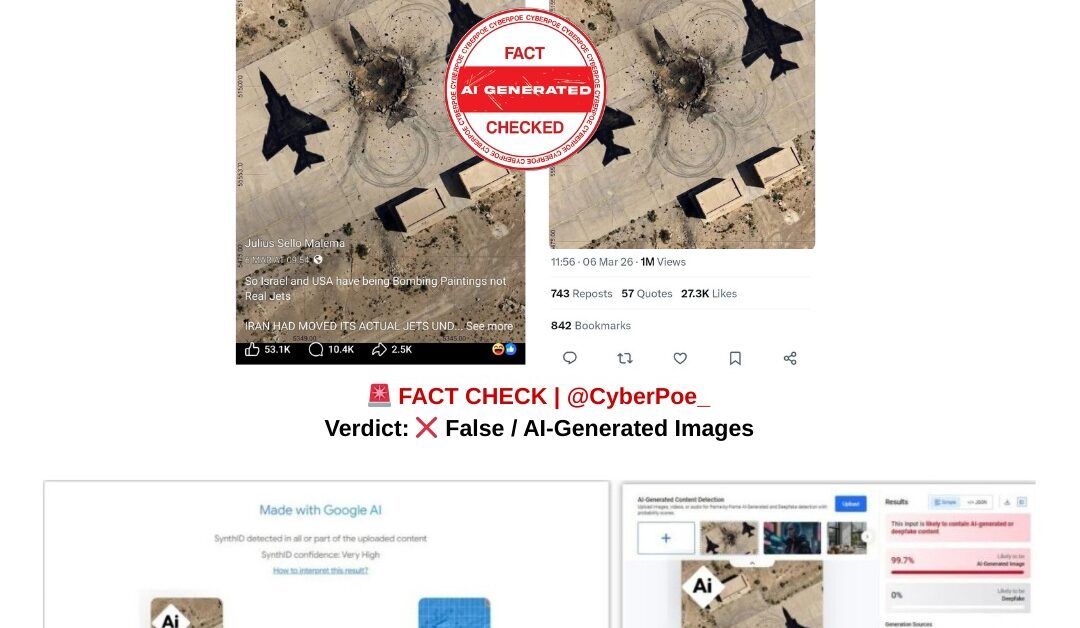
Amid the ongoing regional conflict involving Iran, the United States, and Israel, a set of images began circulating widely across social media platforms[1] claiming to show satellite photographs of Iranian airbases after recent airstrikes. The visuals appeared to depict large bomb craters positioned next to painted silhouettes of fighter jets on a runway, suggesting that attacking aircraft had mistakenly targeted decoys rather than real military assets.
Posts sharing the images framed the situation as a strategic embarrassment for Western forces. One widely circulated caption read: “Israel and USA have been bombing paintings, not real jets. Iran moved its real aircraft underground before the war began.” The images quickly spread across Facebook,[2] and X[3] appearing in several languages including Spanish,[4] Greek,[5] Bulgarian,[6] and Romanian.
Because the visuals resembled high-resolution satellite reconnaissance imagery, many users assumed they represented genuine evidence from Iranian airbases. In the context of a rapidly evolving war, the claim appeared plausible to audiences unfamiliar with how satellite images are produced and verified. However, closer examination reveals that the images are not authentic satellite photographs.
What CyberPoe Verified
Detailed analysis of the circulating images shows multiple inconsistencies that strongly indicate the visuals were generated using artificial intelligence tools rather than captured by real satellite systems.
One of the most obvious issues involves the coordinates printed along the borders of the images. Satellite imagery normally displays geographic coordinates using standardized formats that correspond to real locations on Earth. In the viral images, however, the coordinate markings appear inconsistent and do not match any recognized mapping format.
Another anomaly appears in the directional compass marker, where the letter “E” for east appears in a position typically reserved for “N” indicating north. Such labeling mistakes are unusual in genuine satellite products but frequently appear in synthetic images generated by AI systems attempting to imitate cartographic graphics.
The aircraft silhouettes painted on the runway also raise questions. Each silhouette appears perfectly identical in shape and spacing, suggesting digital duplication rather than hand-painted decoys. In addition, the silhouettes appear disproportionately large compared with nearby structures, creating unrealistic scale relationships for an operational military airbase.
Unrealistic Explosion Patterns
The blast crater visible in the images presents another clue. Real airstrike damage typically produces irregular patterns, with debris scatter and uneven impact zones depending on the angle of the strike and the terrain.
In contrast, the crater shown in the viral image appears almost perfectly circular, surrounded by symmetrical markings that resemble stylized graphics rather than genuine blast damage. The image also appears unusually sharp and clean, lacking the minor atmospheric distortions and sensor noise commonly found in real satellite imagery captured from orbit.
AI Detection Results
Further verification using specialized AI detection systems confirms the synthetic origin of the images. Google’s SynthID[1] detection tool, which identifies invisible watermarks embedded in media created by Google’s generative AI models, indicated that the visuals were likely produced using Google-based AI image generation technology.
A separate analysis conducted using the Hive Moderation AI detection system[2] produced similar results, estimating a 99 percent probability that the images were AI-generated. Additional variations of the same claim including images depicting helicopter decoys returned comparable results when analyzed using multiple detection platforms.
[1] https://support.google.com/gemini/answer/16722517?visit_id=639087535605525506-2278980144&p=synthid&rd=1
[2] https://hivemoderation.com/ai-generated-content-detection
Context: Military Decoys and Information Warfare
Iran has historically used decoy equipment and deception tactics in military strategy, including radar-reflecting floating decoys during the Iran–Iraq war of the 1980s. However, there is no credible evidence that the viral images depict real Iranian airbases or confirmed airstrikes during the current conflict.
Researchers studying online misinformation warn that AI-generated satellite imagery is becoming an increasingly common tool in information warfare. Because such visuals appear technical and authoritative, they can easily mislead audiences during periods of geopolitical tension.
CyberPoe Verdict
The viral “satellite images” claiming that U.S. and Israeli pilots bombed painted aircraft decoys in Iran are synthetic visuals created using artificial intelligence. Multiple technical indicators including visual inconsistencies and AI detection analysis confirm the images were digitally generated and do not represent real satellite reconnaissance.
CyberPoe Verdict ❌ False / AI-Generated Images