Project Info
Category
Date
Edited Graphic Falsely Claims Australia Has Only 18 Days of Petrol Reserves
The Viral Claim
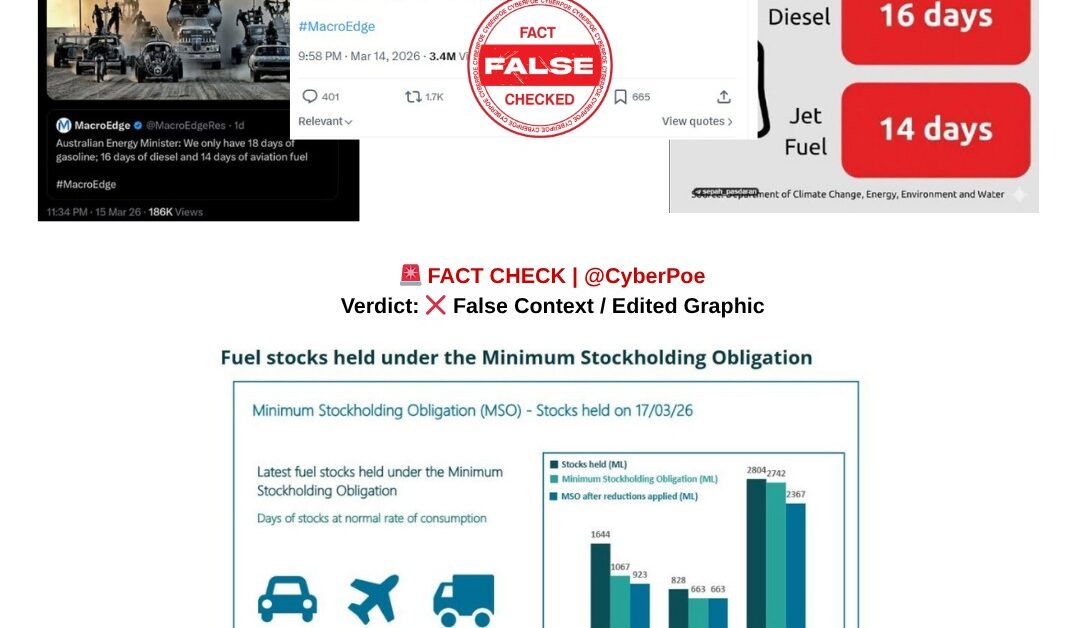
A graphic circulating widely on Facebook[1] and other social media platforms[2] in March 2026 claimed that Australia was on the brink of a severe fuel crisis, alleging that the country had only 18 days of petrol remaining in its national reserves. The image appeared highly credible at first glance because it carried the branding[3] of the Australian broadcaster SBS News and cited figures supposedly sourced from the Department of Climate Change, Energy, Environment and Water.
According to the viral graphic, Australia’s fuel stock levels were critically low. It claimed petrol reserves had dropped to 18 days, diesel reserves to 16 days, and jet fuel supplies to 14 days. The alarming numbers prompted widespread concern online, with many users warning that the country could soon face fuel rationing, transport disruptions, and even airline shutdowns.
Some social media posts amplified the claim further, suggesting that Australia’s aviation sector could be grounded within two weeks if the reserves were not replenished. The graphic spread quickly across platforms during a period of heightened anxiety about global energy markets following the escalation of the Middle East conflict,[4] which disrupted shipping routes and pushed oil prices upward.
However, closer examination reveals that the circulating graphic was manipulated and does not reflect Australia’s actual fuel reserve levels.
What CyberPoe Verified
Verification shows that the viral image was altered from an authentic SBS News graphic published on March 14, 2026.[1] The original graphic reported significantly different figures from those seen in the manipulated version shared online.
In the legitimate SBS report, Australia’s petrol reserves were shown to be approximately 36 days, not 18 days as claimed in the viral image. The altered graphic appears to have replaced the original figures with dramatically lower numbers, likely to exaggerate fears about fuel shortages.
Official statements from the Australian government further contradict the viral claim. Speaking at a press conference on March 14, Energy Minister Chris Bowen confirmed that Australia had
around 1.6 billion litres of petrol in reserve, equivalent to roughly 37 days of supply under normal consumption levels.
Bowen also reported that Australia had about 30 days of diesel reserves and approximately 29 days of jet fuel supply, figures that closely match official stock data published by the Department of Climate Change, Energy, the Environment and Water.
Weekly stock reports released by the department show that petrol reserves were around 38 days during the period when the graphic was circulating online, providing further evidence that the viral claim was inaccurate.
Origins of the Manipulated Graphic
Reverse image searches indicate that the edited graphic was circulated by Tasnim News Agency,[1] a semi-official Iranian outlet. The version shared online included a watermark linked to Google’s Gemini AI tool, suggesting that the image may have been digitally modified before spreading across social media.
SBS News later confirmed that the broadcaster did not create the version of the graphic being shared online and that its branding had been misused in the manipulated image.
The altered graphic demonstrates a common misinformation tactic: taking authentic news visuals and editing key details to produce a more alarming narrative. Because the design closely resembled a legitimate news graphic, many users assumed the information was accurate.
Expert Analysis of Fuel Supply
Energy experts say claims that Australia is close to running out of petrol are significantly exaggerated.
Lurion de Mello, an energy specialist at Macquarie University, explained that shipping data shows oil tankers continue to arrive regularly at Australian ports. While global tensions have increased fuel prices and created temporary supply disruptions in some areas, the country’s fuel imports have not stopped.
Tony Wood, senior fellow for energy and climate policy at the Grattan Institute, also noted that some reported shortages are primarily driven by panic buying rather than actual supply depletion.
In several regional areas, motorists began purchasing extra fuel after the Middle East conflict triggered fears of shortages. However, Wood emphasized that this fuel remains within the broader supply chain rather than being consumed immediately, meaning the national supply situation is not as dire as suggested by viral posts.
To help stabilize local supply conditions, the Australian government also temporarily reduced the Minimum Stockholding Obligation, allowing additional reserves to be released into the market if necessary.
CyberPoe Verdict ❌
The viral graphic claiming that Australia has only 18 days of petrol reserves is manipulated and misleading.
The original SBS graphic shows approximately 36–37 days of petrol supply, consistent with official government data. Experts also confirm that fuel shipments are continuing to arrive in Australia and that fears of the country imminently running out of petrol are greatly overstated
CyberPoe Verdict
The website circulating on social media claiming to offer registration for Sri Lanka’s National Fuel Pass QR code is fraudulent. Authorities have confirmed that the platform is not affiliated with the government and is designed to collect personal information from users.
Motorists seeking to register for the fuel pass system should only use the official government portal at fuelpass.gov.lk and avoid submitting personal details on unverified websites.