Project Info
Category
Date
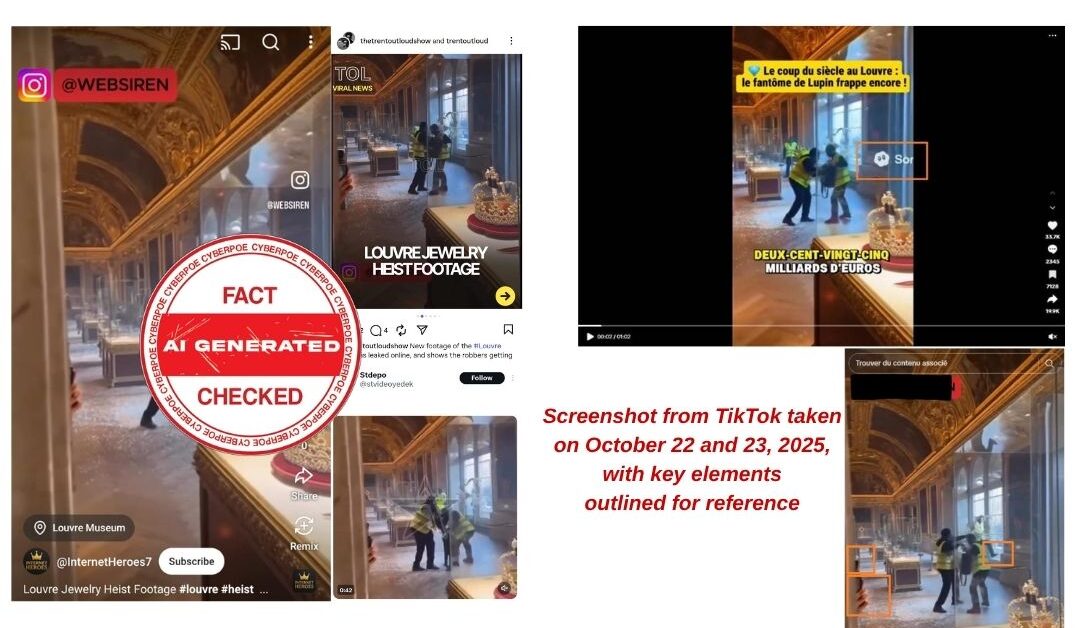
A viral video shows two men stealing jewels from the Louvre Museum’s Apollo Gallery during the October 19 Paris heist.
The Louvre Heist and the Rise of AI-Generated Misinformation
A video recently went viral across Instagram, TikTok, X (formerly Twitter), and YouTube, claiming to show two men stealing jewels from the Apollo Gallery of Paris’s Louvre Museum during the real-life heist that took place on October 19, 2025. In the alleged clip, two figures dressed in yellow vests are seen hurriedly placing valuables into a black bag as alarms blare in the background. The camera pans over shards of glass scattered across the floor, revealing a display case and a crown that appears untouched. The video concludes with the supposed thieves climbing through a window into the night. Within hours, the clip was being reshared by millions of users, often accompanied by captions asserting that it was “exclusive footage” from inside the Louvre. However, a detailed forensic review conducted by CyberPoe’s verification desk confirms that the circulating video is entirely fake and AI-generated, not authentic footage from the actual crime scene.
Dissecting the Reality Behind the Viral Clip
While it is true that the Louvre Museum was targeted by real burglars on October 19 an operation that saw the theft of eight pieces of jewelry valued at approximately $102 million no video footage of the incident has been released by either the museum or French law enforcement agencies. The viral clip, therefore, represents a dangerous case of synthetic misinformation capitalizing on a legitimate event. Upon conducting a reverse image search and metadata analysis, CyberPoe investigators identified a version of the same video uploaded on French TikTok accounts bearing a faint watermark: “Sora.” This watermark corresponds to OpenAI’s experimental video-generation model, widely used for creating synthetic visual content. The discovery of this signature conclusively establishes that the circulating Louvre clip was generated using AI and was never part of any authentic surveillance footage.
Visual Evidence of Fabrication and Neural Artifacts
A closer examination of the viral footage exposes several visual inconsistencies typical of generative AI videos. The supposed cameraman’s reflection appears in midair rather than on a physical surface, suggesting that the video was created through compositional layering rather than natural filming. One of the “burglars” steps onto what seems like an invisible platform, defying the gallery’s actual architectural layout. Furthermore, when compared with verified visual material from the Louvre’s official YouTube tour of the Apollo Gallery, the placement and design of the display cases in the viral video do not match the real setting. These structural errors are consistent with distortions produced by diffusion-based video generation models, which struggle to maintain spatial coherence and real-world physics in dynamic environments.
Official Sources Confirm Limited Real Footage
Contrary to the viral claims, French media outlet BFMTV published the only verified footage of the October 19 heist. This legitimate video, captured from a distant CCTV angle, shows a single suspect entering the gallery through a window not two burglars filmed at close range. French authorities have confirmed that no other recordings have been made public due to the ongoing investigation. They further revealed that the perpetrators gained access using an extendable ladder attached to a stolen movers’ truck, employed cutting tools to breach the security frame, and escaped on scooters after dropping a diamond-and-emerald crown during their exit. The museum remained closed for three days after the incident, reopening on October 22, though the Apollo Gallery continues to be cordoned off pending forensic analysis.
Conclusion: The Anatomy of a Digital Deception
The viral “Louvre Heist Video” is a textbook case of AI-assisted misinformation a false narrative constructed from real-world tragedy to exploit social media virality. By blending fragments of truth with synthetic visuals, it successfully blurred the line between documentary evidence and digital fiction. The presence of the “Sora” watermark, the evident rendering flaws, and the absence of corroborating official footage collectively debunk the authenticity of the video.
The event underscores a growing threat in the digital information age: the weaponization of generative AI to manipulate public perception in real time. As deepfake technology becomes more accessible, such synthetic forgeries will continue to infiltrate major news cycles.
CyberPoe reiterates that while a genuine theft occurred at the Louvre, no authentic video of the burglars inside the Apollo Gallery exists. The viral clip is an AI-generated hoax designed to deceive. Readers are urged to rely only on verified sources, official police statements, and credible investigative outlets before sharing unverified visual content online.
CyberPoeX | The Anti-Propaganda Frontline