Project Info
Category
Date
AI-Generated Drone Show Video Falsely Claims Taiwanese Flag Displayed in Shanghai
The Claim
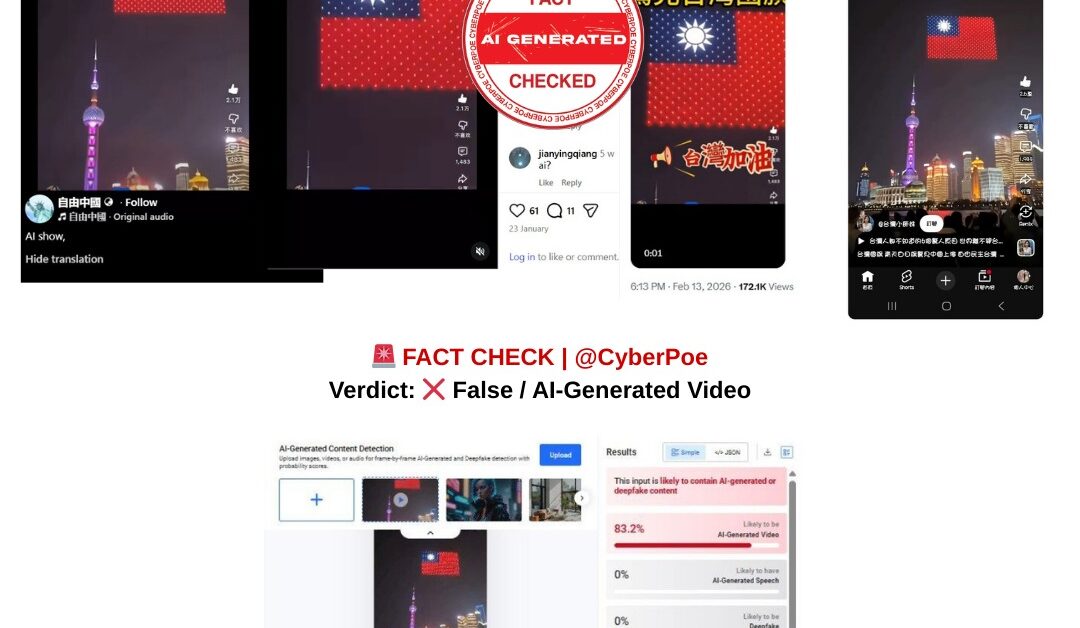
In February 2026, a video began circulating widely across social media platforms including X,[1] Facebook,[2] Instagram[3] and thread[4] claiming to show a drone light show in Shanghai displaying the Taiwanese flag above the city skyline. The clip shows hundreds of illuminated drones forming what appears to be Taiwan’s national flag while flying over a night view of the Bund waterfront with the Oriental Pearl TV Tower visible in the background.
Posts accompanying the video suggested that the display occurred during a public drone performance in Shanghai and framed it as a surprising political moment. In the footage, people can be heard reacting with excitement and mentioning Taiwan while praising the display. Some captions described the scene as a drone show that had “unexpectedly” featured the Taiwanese flag in China’s largest financial hub.
The clip quickly gained traction online and accumulated hundreds of thousands of views across platforms. Many users expressed disbelief that such a display could occur in mainland China, while others interpreted the footage as a symbolic act of defiance. The narrative spread particularly quickly because of the ongoing political tensions surrounding relations between China and Taiwan.
Beijing considers Taiwan a breakaway province and has repeatedly stated that it will not rule out the use of force to bring the self-governing island under its control. Taiwan, however, maintains its own democratic government, military, and political system. Because of this highly sensitive geopolitical context, the idea that a public drone show in Shanghai would openly display the Taiwanese flag immediately attracted widespread attention.
What CyberPoe Verified
Digital analysis and source tracing indicate that the viral video is artificially generated and does not show an authentic drone performance in Shanghai.
A reverse image search of frames from the circulating footage leads to an earlier version of the same clip uploaded to YouTube on January 18, 2026.[1] The platform includes a notice warning viewers that the content contains altered or synthetic media. The scene shown in the YouTube upload matches the visuals in the viral posts that later spread across social networks.
This discovery establishes that the footage originated as manipulated content rather than as documentation of a real public event in Shanghai.
Further examination of the video reveals several visual anomalies commonly associated with AI-generated imagery. As the camera moves closer to the formation of the Taiwanese flag, the tip of the Oriental Pearl TV Tower briefly appears to bend and distort. Architectural structures rendered by generative AI systems frequently exhibit such warping because the models struggle to maintain precise geometry during motion.
Additional discrepancies appear when the skyline in the video is compared with verified images of Shanghai. Certain buildings appear blurred or slightly misshapen, while others are missing entirely. One notable absence is the Museum of Art Pudong, a large rectangular structure located along the waterfront that should be clearly visible from the vantage point shown in the video.
The absence of this landmark strongly suggests that the skyline in the clip was generated rather than captured by a real camera.
Technical Indicators of Synthetic Media
Independent analysis tools also support the conclusion that the video is synthetic.
The footage was analyzed using Hive Moderation’s AI detection system, which evaluates digital content for signs of generative manipulation. The tool determined that the clip is highly likely to contain AI-generated or deep fake material. Detection systems like this examine subtle indicators such as pixel inconsistencies, lighting behavior, and motion artifacts that commonly appear in synthetic visuals.
Another indicator lies in the appearance of the drone formation itself. In genuine drone light shows, each drone operates as a single point of light. When arranged together, these points form shapes that resemble constellations composed of hundreds of individual dots.
In the viral video, however, the Taiwanese flag appears as a continuous glowing surface with filled-in color areas rather than a pattern of separate lights. This visual style does not match how real drone performances appear in photographs or recordings.
For comparison, footage from a legitimate drone display published by Taiwanese broadcaster CTV in 2022 shows the Taiwanese flag formed by clusters of distinct lights rather than a solid illuminated panel. The difference highlights the artificial nature of the viral clip.
Why the Video Spread
The rapid spread of the video is closely linked to the geopolitical environment surrounding China and Taiwan.
In recent years, China has increased military pressure on the island, including large-scale naval and air exercises around Taiwan. In late 2025, Beijing conducted military drills that simulated a blockade of the island following U.S. arms sales to Taipei and comments from Japanese officials suggesting that Tokyo might respond militarily if Taiwan were attacked.
At the same time, Taiwan’s president Lai Ching-te has emphasized the need to strengthen national defenses amid rising regional tensions.
Within this context, dramatic imagery involving national symbols can easily attract attention and provoke strong reactions. AI-generated visuals often exploit these political sensitivities by presenting fabricated scenes that appear plausible enough to circulate widely before verification occurs.
CyberPoe Verdict
The video claiming to show a drone show in Shanghai displaying the Taiwanese flag is false.
Technical analysis reveals visual distortions and skyline inconsistencies consistent with AI-generated imagery. Reverse searches also trace the footage to earlier uploads labeled as altered or synthetic content. No credible evidence indicates that such a drone performance took place in Shanghai.
As generative AI tools become increasingly capable of producing realistic visuals, fabricated footage can quickly spread online during moments of political tension. Careful verification of both technical indicators and real-world context remains essential to prevent synthetic media from misleading audiences.
CyberPoe | The Anti-Propaganda Frontline 🌍