Project Info
Category
Date
AI-Generated Image Falsely Claims Justin Trudeau Addressed an Empty Room at Davos 2026
The Viral Claim and Its Framing
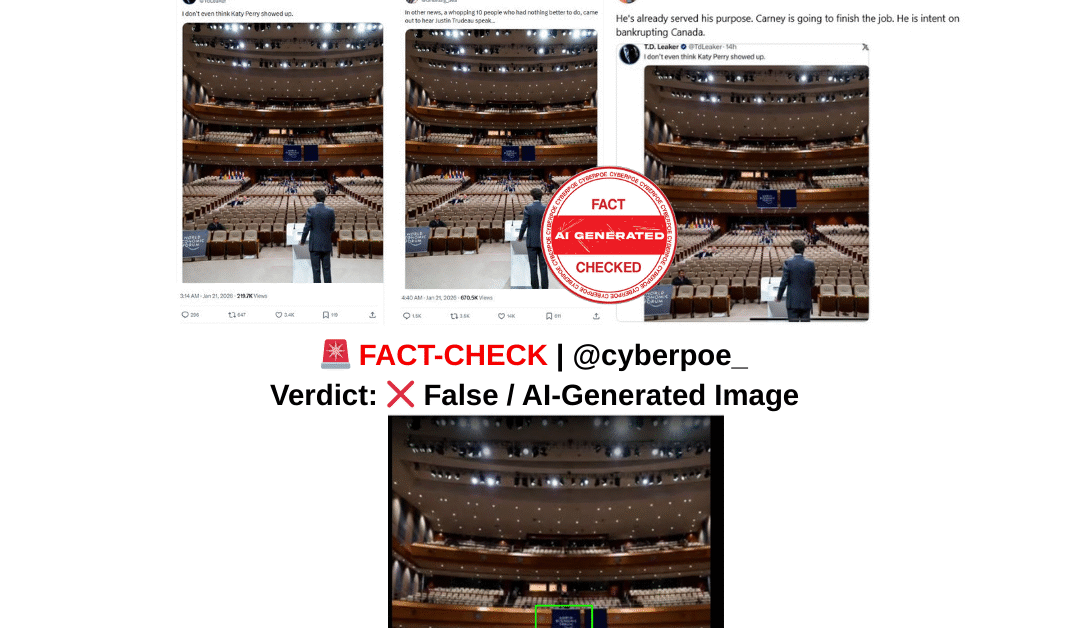
In late January 2026, an image began circulating widely across X,[1] Facebook,[2] Threads,[3] and several regional platforms,[4] purporting to show former Canadian prime minister Justin Trudeau delivering a speech at the World Economic Forum in Davos to an almost empty conference hall. The image was shared alongside mocking captions portraying Trudeau as politically irrelevant after his resignation in January 2025. One widely repeated line sarcastically claimed that “not even Katy Perry showed up,” referencing his reported relationship with the American singer. The visual was presented as definitive proof that Trudeau’s appearance at Davos had failed to attract interest or legitimacy.
The image spread rapidly in multiple languages, including German, Spanish, and Chinese, amplifying a narrative of decline and public rejection. Given Davos’ reputation as a symbolic gathering point for global political and economic elites, the implication that a former G7 leader had been sidelined carried strong emotional and political weight. The image’s apparent simplicity and visual clarity made it highly shareable, especially among audiences already skeptical of global institutions or critical of Trudeau’s political legacy.
Context: Justin Trudeau and Davos 2026
Justin Trudeau served as Canada’s prime minister for nearly a decade before stepping down amid domestic political pressures.[1] Despite leaving office, he remained a recognizable international figure and was formally invited to speak at the 2026 World Economic Forum. His session focused on the concept of “soft power,” a theme closely associated with his tenure in global diplomacy and multilateral engagement.
Trudeau’s participation was publicly announced in advance, listed in the official WEF program, and covered by accredited international media outlets. His appearance was neither informal nor marginal. Any claim that he addressed an empty room therefore depends entirely on the authenticity of the circulated image rather than on any dispute about whether the event itself occurred.
Visual Forensic Analysis of the Image
CyberPoe conducted a detailed forensic examination of the viral image. Multiple visual anomalies indicate that the image was generated using artificial intelligence rather than captured by a camera at Davos. The audience members visible in the image display blurred and indistinct facial features, lacking the natural variation, depth, and sharpness characteristic of professional event photography. Such facial distortion is a common artifact of AI-generated imagery, particularly in scenes depicting crowds.
Background elements further undermine the image’s credibility. Text resembling World Economic Forum branding appears irregular and garbled, failing to match the organization’s standardized typography and logo usage. A group of national flags is awkwardly positioned within the seating area rather than along the stage or perimeter, and several flags appear inconsistently rendered. Lighting and spatial logic within the hall are also inconsistent, producing a synthetic appearance that does not align with known Davos venues.
Taken together, these features strongly indicate that the image is not an authentic photograph but a fabricated visual constructed to resemble a real-world setting.
Contradiction by Verified Footage and Reporting
Independent verification decisively contradicts the viral narrative. Authentic photographs and video footage published by the Canadian Press and other accredited outlets show Trudeau’s Davos address taking place on January 20, 2026, in a bright conference room with large windows and substantial natural light. The audience in verified footage is visibly full, with attendees seated throughout the venue.
Crucially, the same reporting confirms that Katy Perry was present at the event, directly refuting one of the most widely repeated claims attached to the fake image. The setting, lighting, audience density, and camera angles in legitimate coverage bear no resemblance to the dim, sparsely populated hall depicted in the circulating visual.
Disinformation Patterns Around Davos
This case fits a broader and well-documented pattern of disinformation targeting figures associated with the World Economic Forum. Davos has long been a focal point for conspiracy narratives and politically motivated misinformation. High-profile attendees are frequently portrayed as either omnipotent elites or irrelevant failures, depending on the narrative being advanced.
The strategy is consistent: generate or circulate a striking but false visual, attach it to an existing storyline of political decline or humiliation, and allow it to spread during a moment of heightened public attention. Advances in generative AI have made this tactic easier and faster, enabling fabricated images to achieve viral reach before verification catches up.
Why This Matters
AI-generated political imagery represents a growing threat to information integrity. When fabricated visuals are used to rewrite recent, well-documented events, they can distort public understanding even in the presence of reliable journalism. In this instance, a legitimate, well-attended speech was reframed as a public embarrassment through a single false image.
Such manipulation does more than mislead. It erodes trust in authentic reporting, blurs the line between documentation and propaganda, and conditions audiences to accept synthetic media as factual evidence. Over time, this undermines the shared reality necessary for informed public discourse.
CyberPoe Conclusion
The image claiming to show Justin Trudeau addressing an almost empty room at the 2026 World Economic Forum is not authentic. Visual inconsistencies clearly indicate that it was generated using artificial intelligence, and it directly contradicts verified footage and reporting from Davos. Trudeau’s speech took place as scheduled, in a full venue, with documented attendance.
CyberPoe | The Anti-Propaganda Frontline 🌍