Project Info
Category
Date
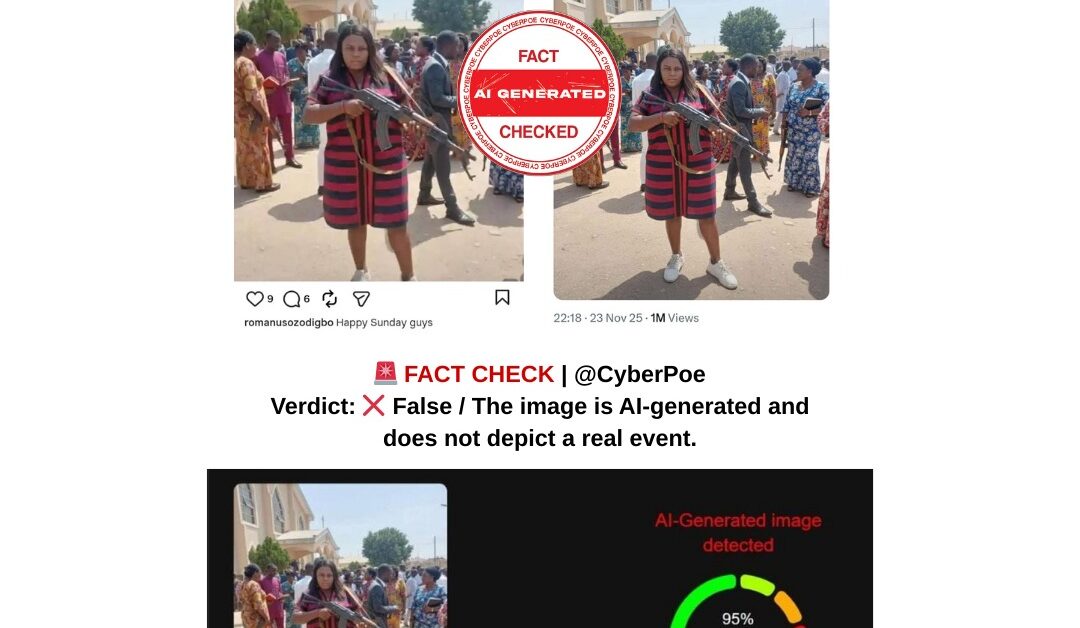
AI-Generated Image Falsely Depicting Armed Churchgoers in Nigeria
Background and Spread of the Viral Image
In the wake of renewed security concerns in Nigeria, particularly following violent attacks on churches and civilians in parts of the country including Kwara State, a striking image began circulating widely on social media platforms in late 2025. Shared across X[1], Facebook[2], Instagram[3], and WhatsApp, the image purported to show Nigerian churchgoers attending a Sunday service while openly carrying assault rifles. Captions accompanying the image claimed that worshippers had armed themselves in response to repeated attacks, framing the scene as a desperate but real adaptation to worsening insecurity. Given Nigeria’s long-standing struggle with insurgency, banditry, and sectarian violence, the image resonated emotionally with audiences and spread rapidly, often without scrutiny.
The narrative accompanying the image suggested a dramatic collapse of state authority and implied that churches had effectively transformed into armed zones. This framing amplified fear, anger, and speculation, especially among international audiences unfamiliar with local realities. However, despite its viral reach and emotional impact, the image does not depict a real event.
Visual and Technical Examination of the Image
A detailed visual analysis of the image immediately raises serious red flags. Architectural elements inside the church do not align with realistic spatial logic. Columns appear tilted at conflicting angles, walls intersect unnaturally, and depth perception is inconsistent, creating a distorted sense of space that would not occur in genuine photography. Human figures within the image also display significant anatomical anomalies. One woman in the foreground appears to have six fingers on one hand, while other hands are misshapen or asymmetrical. Several rifles appear to be improperly rendered, with straps that abruptly vanish instead of looping naturally, and at least one firearm appears to float without being physically supported by any individual.
Further inspection reveals overlapping bodies in the background, where faces partially merge into other figures, and clothing elements appear randomly layered rather than worn coherently. Facial expressions lack natural variation, and skin textures appear overly smooth and artificial. These visual defects are consistent with known limitations of AI image generation systems, particularly when rendering complex scenes involving crowds, architecture, and detailed objects like weapons.
AI Detection and Forensic Verification
Beyond visual inspection, CyberPoe conducted forensic verification using advanced AI detection tools. Google’s SynthID detector identified embedded digital markers consistent with images generated using Google’s artificial intelligence models. Independently, the InVID-WeVerify synthetic image detection system assessed the image and returned a probability score of approximately 95 percent indicating that the content was AI-generated. The convergence of results from multiple independent tools strongly confirms that the image was not captured by a camera but created synthetically.
These findings eliminate the possibility that the image represents documentary evidence of real-world events. Instead, it belongs to a growing category of AI-generated misinformation that blends realistic visual cues with subtle distortions, making it persuasive to untrained viewers.
Real Security Context in Nigeria
Nigeria does face genuine and severe security challenges. Since 2009, Boko Haram and related extremist groups have been responsible for tens of thousands of deaths, particularly in the northeast.[1] In other regions, armed banditry, kidnappings, and communal violence have continued to destabilize rural and urban communities alike. Attacks on religious institutions, including churches, have occurred and are widely reported by credible media and human rights organizations. These realities create an environment in which sensational claims can easily gain traction.
However, despite extensive reporting on insecurity, there is no credible evidence that Nigerian church congregations have begun attending services armed with rifles. No verified photographs, videos, or eyewitness accounts from reputable local or international news organizations support such a scenario. Nigerian law strictly regulates civilian firearm possession, and the presence of assault rifles inside a church would almost certainly prompt immediate national and international attention if it were real.
Why the Image Is Misleading and Harmful
The viral image exploits real fear and suffering to construct a false narrative. By presenting a fabricated scene as reality, it distorts public understanding of Nigeria’s security situation and risks inflaming sectarian tensions. It also undermines legitimate reporting by blending fact and fiction in ways that are difficult to untangle once widely shared. AI-generated misinformation of this kind is particularly dangerous because it leverages emotional shock to bypass critical thinking, encouraging rapid sharing rather than verification.
Such content also has broader implications. It can reinforce harmful stereotypes, misinform policy debates, and erode trust in authentic journalism. In conflict- affected societies, misinformation can escalate tensions and contribute to real-world harm.
Conclusion and CyberPoe Assessment
The image claiming to show Nigerian churchgoers carrying rifles during a Sunday service is entirely fabricated. It is an AI-generated creation that does not document any real event. Visual inconsistencies, forensic AI detection, and the absence of corroborating evidence from credible sources all confirm that the claim is false. While Nigeria continues to grapple with serious security challenges, this image should not be used as evidence of conditions on the ground.
CyberPoe concludes that this is a clear case of AI-generated misinformation designed to sensationalize a real crisis. Audiences are urged to approach emotionally charged visuals with caution, verify sources rigorously, and remain aware that advances in artificial intelligence are increasingly being used to create convincing but false representations of reality.
CyberPoe | The Anti-Propaganda Frontline 🌍