Project Info
Category
Date
AI-Generated Images Falsely Portrayed as Evidence of Deadly Philippine Ferry Disaster
The Claim Circulating Online
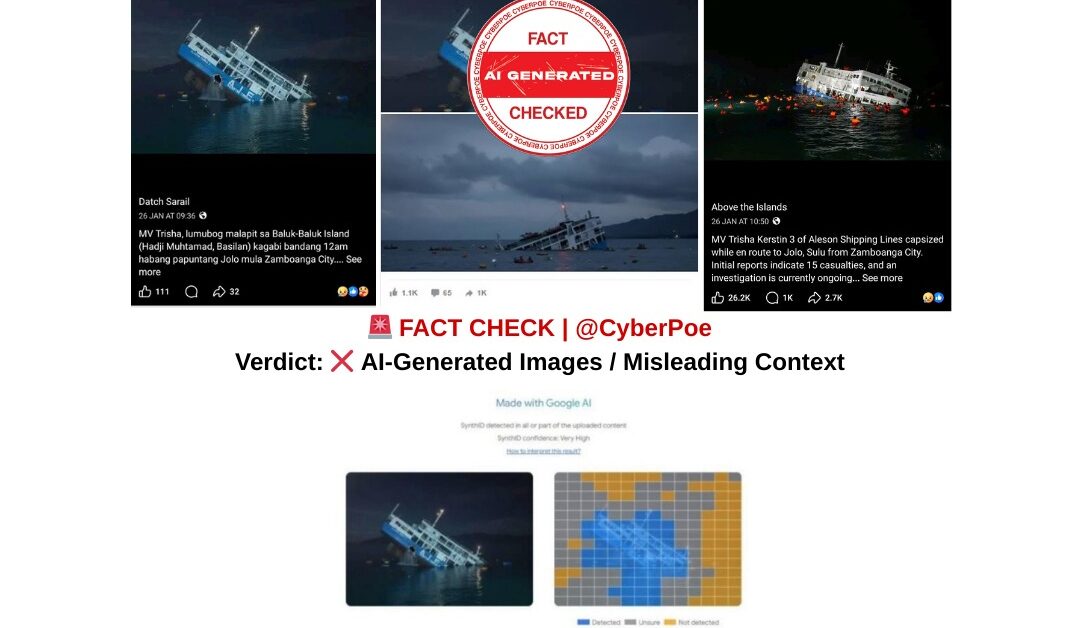
In the immediate aftermath of a tragic maritime disaster off the southern Philippines, social media platforms were flooded with images allegedly showing the ferry MV Trisha Kerstin 3 partially submerged at sea,[1] its hull torn open as passengers floated nearby. Shared widely on Facebook[2] and other platforms[3] on January 26, 2026, the images were framed as visual documentation of the vessel’s final moments after it sank near the Basilan island chain. Captions urged prayers for the victims and suggested that a massive hole in the ship’s side explained the scale of the loss of life.
The images spread rapidly, amassing thousands of shares and comments. Many users accepted them as authentic, reacting emotionally to what appeared to be clear, well-lit scenes of the disaster at sea. However, CyberPoe’s verification confirms that these visuals are not real photographs from the incident. They are AI-generated images that misrepresent both the appearance of the vessel and the circumstances of the tragedy.
What Actually Happened
The real incident unfolded in the early hours of January 26, 2026, when MV Trisha Kerstin 3, a triple-decker passenger ferry en route from Zamboanga City to Jolo Island, issued a distress signal around 1:50 a.m.[1] The vessel sank approximately five kilometres east of Baluk-Baluk Island, part of the Basilan island chain. According to the Philippine Coast Guard, at least 42 people lost their lives.[2]
Official video released by the Coast Guard shows survivors being rescued from the water in darkness and receiving emergency medical attention. Survivor accounts indicate that the ferry capsized rapidly, giving passengers little time to react. Contrary to the circulating images, the ship did not remain partially afloat. It is believed to have sunk quickly and now lies at a depth of roughly 76 metres. Rescue and recovery operations involved divers flown in from Manila and the use of unmanned underwater vehicles to locate the wreckage.
Forensic Analysis of the Viral Images
CyberPoe examined the images using Google’s SynthID detector,[1] a tool designed to identify AI-generated content. The analysis returned a “very high” confidence rating that the visuals were created using Google’s AI tools. This technical assessment alone casts serious doubt on their authenticity.
Visual inspection further reinforces this conclusion. The images contain inconsistencies typical of AI-generated material. In one widely shared picture, the vessel’s name is incorrectly rendered as “Kerstin Trisha,” rather than its correct designation, MV Trisha Kerstin 3. This mislabeling does not match verified photographs of the ship available on maritime tracking platforms such as MarineTraffic, where the vessel’s name appears clearly beneath its operator’s name, Aleson Shipping Lines.
Lighting conditions also contradict reality. The AI images depict a brightly illuminated scene, whereas the real rescue took place in near-total darkness, as confirmed by Coast Guard footage and survivor testimony. The portrayal of the ship as still partially above water further conflicts with accounts indicating that it capsized and sank almost immediately.
Why the Misinformation Spread
The rapid circulation of these AI-generated images highlights how easily synthetic visuals can exploit moments of public shock and grief. In the absence of immediate, widely available photographs from the scene, emotionally charged images filled the information vacuum. Their apparent clarity and dramatic composition gave them a false sense of credibility, leading many users to share them without verification.
Such misrepresentation does more than mislead. It risks distorting public understanding of what happened, fueling speculation about causes that have not been established, and diverting attention from verified information released by authorities.
CyberPoe Verdict
The images claiming to show MV Trisha Kerstin 3 partially submerged after the January 26, 2026 disaster are not authentic. They were generated using artificial intelligence and do not accurately depict the incident or its conditions.
CyberPoe | The Anti-Propaganda Frontline 🌍