Project Info
Category
Date
AI-Manipulated Video Falsely Claims Minneapolis Shooting Victim Mocked Charlie Kirk’s Assassination
Background of the Viral Claim
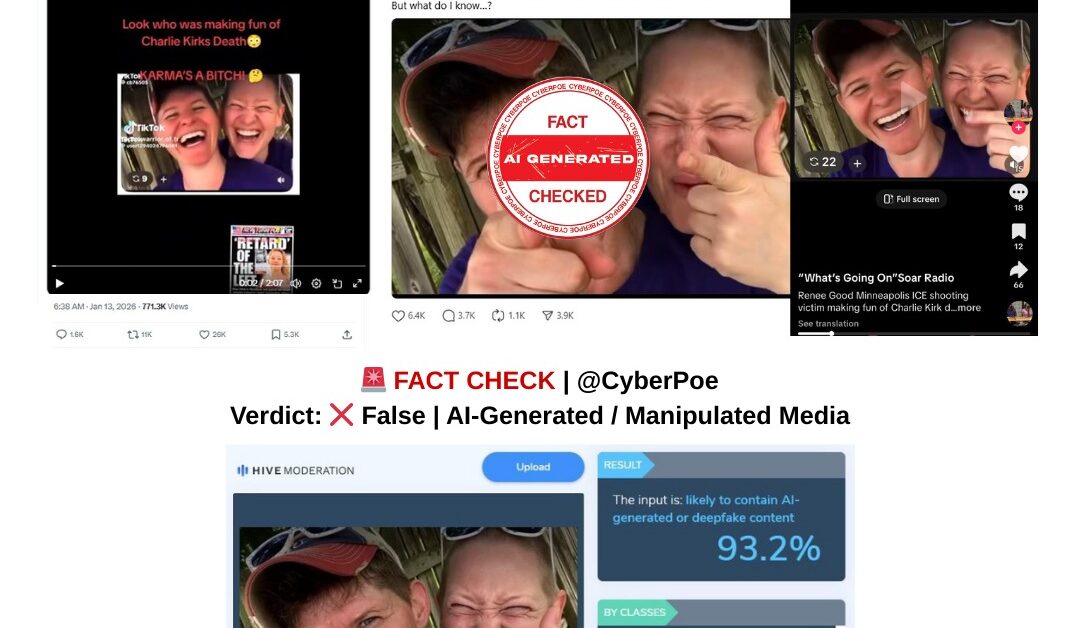
In the days following the fatal January 7, 2026 shooting of 37-year-old Minnesota mother Renee Nicole Good by a U.S. Immigration and Customs Enforcement agent in Minneapolis,[1] a disturbing piece of content began circulating widely across social media platforms. Posts on X,[2] Threads,[3] Facebook,[4] TikTok[5], and in multiple languages claimed that Good had previously mocked the assassination of conservative activist Charlie Kirk, who was killed in September 2025. The allegation was accompanied by a short video that purported to show Good and her wife, Becca Good, laughing at the camera and making finger-gun gestures. Captions framed the clip as proof of moral cruelty, political extremism, or hypocrisy, with some users explicitly presenting good’s killing as deserved retribution.
The timing of the claim was critical to its spread. The video emerged almost immediately after confirmation of Good’s death, ensuring high visibility at a moment when emotions were raw and verification was minimal. In several posts, the clip was paired with language urging viewers to “remember who she really was,” an appeal designed to reshape public sympathy in real time. The content quickly migrated across platforms, amplified by accounts that specialize in outrage-driven political narratives.
Why the Allegation Resonated Online
The false narrative gained traction because it intersected with multiple unresolved political and emotional fault lines. Renee Good’s death itself had already become a flashpoint. The Trump administration asserted that the ICE agent acted in self-defense, while independent visual analyses, including reporting by the New York Times based on bystander footage, suggested that Good’s car was turning away from the officer when shots were fired. This divergence left the public sharply divided, creating fertile ground for narratives that attempted to morally discredit the victim rather than engage with the facts of the shooting.
At the same time, Charlie Kirk’s assassination months earlier had profoundly shaken conservative communities. In the aftermath of his death, online spaces had repeatedly seen doxxing, harassment, and unsubstantiated accusations against individuals alleged to have mocked or trivialized the killing. Against that backdrop, a video seemingly implicating Good offered a convenient emotional
shortcut. It allowed some users to retroactively justify hostility toward her and blunt public outrage over her killing by reframing her as undeserving of sympathy.
CyberPoe’s Verification and Forensic Review
CyberPoe conducted a detailed forensic examination of the circulating clip, combining frame-by-frame visual analysis, reverse searches, and AI-detection tools. This review conclusively establishes that the video is not authentic footage of Renee Good or her wife engaging in the behavior alleged. Instead, it is an artificial intelligence–generated manipulation derived from a benign, static photograph.
The original image shows Renee Good and Becca Good smiling casually at the camera. There are no gestures, no finger guns, and no mocking expressions present. The circulating “video” is a fabricated animation layered onto that still image, giving the illusion of motion and intent that never existed. The transformation from photograph to moving clip is entirely synthetic.
Clear Indicators of Artificial Manipulation
Several visual markers confirm the use of AI generation rather than real video. Most strikingly, the figure meant to represent Becca Good appears to have two thumbs on one hand, an anatomical impossibility that remains a common artifact of AI-generated imagery. Such distortions are widely documented in synthetic media, particularly in short, low-resolution clips optimized for social media sharing rather than scrutiny.
Additional inconsistencies appear in facial motion and hand movement, which exhibit unnatural transitions inconsistent with genuine recorded footage. These elements collectively indicate image-to-video generation rather than a camera-captured moment.
Independent confirmation further supports this conclusion. A still frame from the clip was analyzed using Hive Moderation’s AI-detection system, which assessed the content as likely containing AI-generated or deepfake media. This technical assessment aligns fully with CyberPoe’s visual findings.
Part of a Broader Smear Pattern
This incident does not exist in isolation. Multiple fact check outlets have previously documented coordinated online campaigns in which AI-manipulated images were used to sexualize, dehumanize, or falsely implicate individuals misidentified as Renee Good. The fabricated “Charlie Kirk mockery” video follows the same pattern: deploying synthetic media to manufacture moral guilt and redirect public anger during moments of national trauma.
Such tactics are increasingly common because AI tools allow malicious actors to rapidly generate emotionally persuasive content without the constraints of reality. The result is a powerful but dangerous illusion of evidence, capable of reshaping narratives faster than traditional verification can respond.
Reality Versus the Fabricated Narrative
What is known, and what remains contested, about Renee Nicole Good’s death is still under active public scrutiny. What is not supported by any credible evidence is the claim that she or her wife mocked the assassination of Charlie Kirk or celebrated political violence in any form. The viral clip does not document real speech, real intent, or real behavior. It is a synthetic construction designed to malign a woman who can no longer defend herself.
Why This Matters
The weaponization of AI-generated media against victims of violence represents a serious escalation in disinformation tactics. By fabricating evidence of moral wrongdoing, such content seeks to influence how audiences interpret real-world use-of-force incidents and to normalize harassment, indifference, or justification of death. As political allegiance increasingly shapes perception, deepfakes threaten to erode any shared baseline of reality.
CyberPoe Conclusion
The video claiming to show Renee Nicole Good and her wife mocking the assassination of Charlie Kirk is not real. It is an AI-generated manipulation created from a harmless photograph and falsely presented as authentic footage. The claim forms part of a broader pattern of posthumous smear campaigns amplified during moments of extreme political polarization. Verification of source, context, and authenticity remains essential as synthetic media becomes more pervasive.
CyberPoe | The Anti-Propaganda Frontline 🌍