Project Info
Category
Date
Bust of “St. Kian Delos Santos” at Philippine Senate Exhibition Is an AI-Altered Image
The Viral Claim
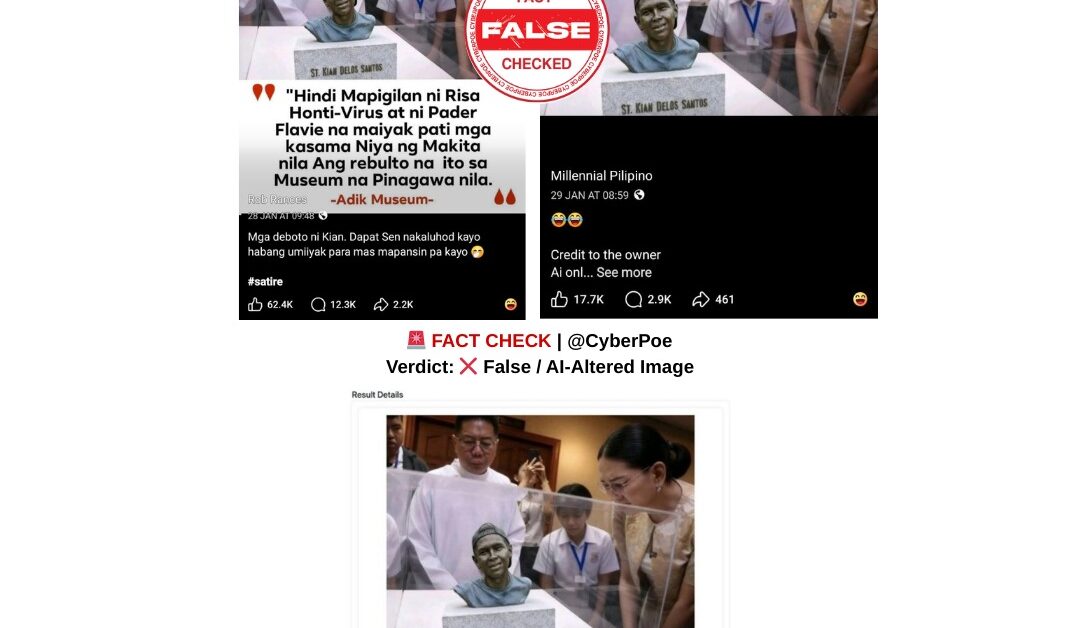
In late January 2026, an image circulated widely on Facebook[1] claiming that a bust of “St. Kian Delos Santos” had been placed inside a glass case at an exhibition in the Philippine Senate honoring victims of extrajudicial killings under former president Rodrigo Duterte’s war on drugs. The image shows Senator Risa Hontiveros and Catholic priest Flaviano Villanueva standing before what appears to be a sculpted bust of a young man labeled “St. Kian Delos Santos,” invoking religious symbolism and martyrdom. The caption accompanying the post read, “Saint Kian Delos Santos ‘the runner’ in museum. Have mercy on us sinners,” framing the exhibit as both political and devotional in nature.
The post gained traction rapidly, fueled by the emotional weight of Kian delos Santos’ case and ongoing debates surrounding accountability for abuses during Duterte’s anti-drug campaign. However, CyberPoe’s verification establishes that the image is not an authentic representation of the exhibition and was digitally manipulated using artificial intelligence.
Context of Kian delos Santos and the Drug War
Kian delos Santos was a 17-year-old student killed by police officers in Manila in 2017.[1] Authorities initially alleged he was armed and involved in drug trafficking, but CCTV footage later contradicted this account, showing the unarmed teenager being dragged into an alley while pleading for his life moments before his death. The case became a turning point in public opinion against the drug war after three police officers were convicted and sentenced to lengthy prison terms, marking the first such convictions linked directly to the campaign.[2]
Human rights groups estimate that thousands were killed during Duterte’s war on drugs, many under disputed circumstances. Duterte himself is now awaiting trial at the International Criminal Court in The Hague over alleged crimes against humanity related to the campaign. Against this backdrop, exhibitions commemorating victims carry significant political and emotional resonance, making them vulnerable to manipulation and misinformation.
What the Exhibition Actually Displayed
The exhibition referenced in the viral post was launched inside the Philippine Senate on January 26, 2026. It was organized by the AJ Kalinga Foundation, which operates a mobile museum
documenting victims of extrajudicial killings. According to Dther Gutierrez, the foundation’s communications and media officer, the glass case shown in the image did not contain any artifact belonging to Kian delos Santos.
Instead, the display held the shirt of Myca, a three-year-old child who was shot and killed during the drug war.[1] Gutierrez confirmed that, at present, the mobile museum does not possess or display any personal artifact connected to Kian delos Santos. The photograph of Senator Hontiveros and Father Villanueva was indeed taken during the exhibition launch, but the object inside the case was misrepresented in the circulating image.
Evidence of AI Manipulation
CyberPoe conducted a reverse image search, which led to an original photograph published by Philippine news outlet Inquirer.net on the same day as the exhibition launch. In the authentic image, the glass case clearly contains a small blue shirt, and no bust or school-uniformed figure is present. The viral version replaces this shirt with a sculpted bust and adds a child figure beside Senator Hontiveros, altering the emotional tone of the scene.
Visual analysis further reveals inconsistencies typical of AI-assisted manipulation. Facial features of individuals in the altered image appear distorted, proportions are subtly off, and reflections on the glass case still faintly show the blue shirt beneath the fabricated bust. These artifacts suggest generative editing rather than simple photo retouching.
To corroborate this, the image was analyzed using the DeepFake-o-meter tool developed by the University at Buffalo.[1] The tool assessed the image as having a 94.2 percent likelihood of being AI-generated or AI-altered, reinforcing the conclusion that the image is not genuine.
Why the Misinformation Matters
The transformation of a real exhibition artifact into a fabricated religious icon is not a neutral act. It reframes a human rights memorial into a symbolic canonization, potentially inflaming political and religious sentiment while distorting the factual record. Such manipulations exploit genuine trauma and grief to amplify narratives that may not reflect reality, undermining trust in documentation of abuses and in legitimate advocacy efforts.
In environments already polarized by debates over accountability, AI-altered imagery poses a serious risk by blurring the line between commemoration and fabrication. When false visuals circulate unchecked, they can delegitimize authentic evidence and provide ammunition to those seeking to dismiss real human rights claims as exaggerated or staged.
CyberPoe Verdict
The image claiming to show a bust of “St. Kian Delos Santos” at a Philippine Senate exhibition is digitally altered using AI. The actual display featured the shirt of a three-year-old victim, not a bust of Kian delos Santos, and no such artifact exists in the exhibition.
CyberPoe | The Anti-Propaganda Frontline 🌍