Project Info
Category
Date
CyberPoe Fact-Check: Sweden’s Alleged “Edible Beet-Extract Road Salt”
Introduction
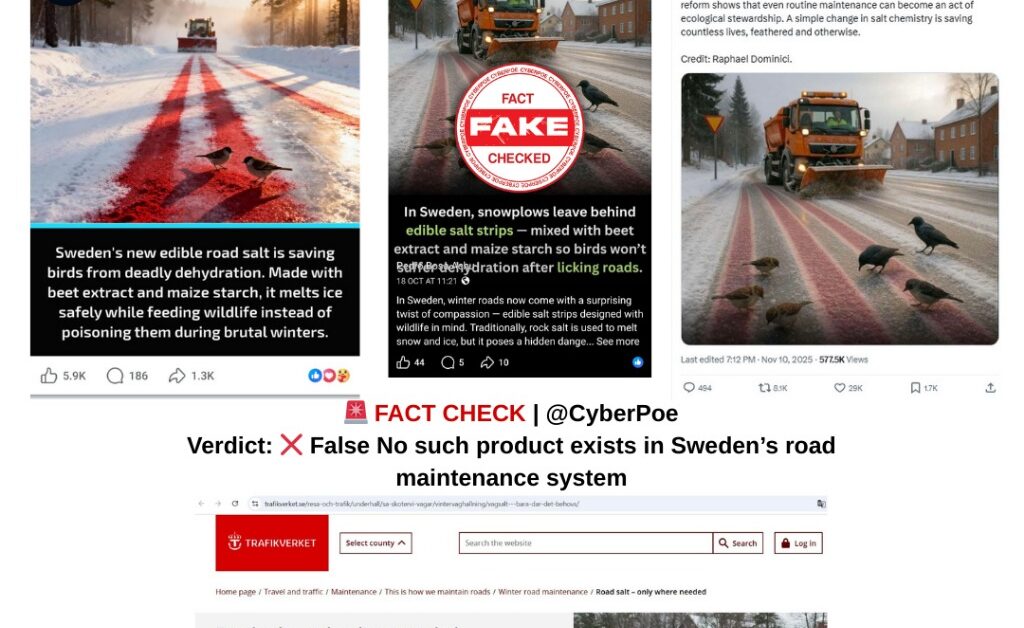
In late 2025, a series of viral posts on X, Facebook, and Instagram claimed that Sweden had replaced traditional winter road salt with a so-called “edible mixture” composed of beet extract and maize starch. According to these posts, the new formulation not only melted ice efficiently during harsh Nordic winters but also allegedly nourished birds, preventing dehydration and mortality that conventional sodium chloride salt might cause. Graphics accompanying the posts depicted birds consuming the salt from roadsides, alongside captions implying that Sweden had innovated a wildlife-friendly de-icing solution. The posts gained considerable traction, receiving tens of thousands of shares and likes, and were treated by some social media users as evidence of Sweden’s environmental progressiveness and ethical approach to winter road maintenance.
Verification of the Claim
A thorough review by CyberPoe’s verification team shows that these claims are entirely false. Sweden’s Transport Administration (Trafikverket), the government agency responsible for road management and winter maintenance, has officially confirmed that no such “edible” de-icing product exists. Press Communications Officer Katarina Wolffram stated unequivocally that Sweden continues to rely on ordinary sodium chloride (NaCl) with a purity of at least 97% for winter road safety. She emphasized that alternative substances such as beet extract, maize starch, or any edible salt substitutes are not currently in use or planned for implementation. According to official guidelines, salting is applied sparingly and only in locations where other anti-slip methods are insufficient, such as major highways, steep slopes, or areas with high traffic and rapid freeze-thaw cycles.
Origins of the Rumor
The rumor appears to have originated from misinterpretations of experiments in North America, where certain cities have trialed beet juice or beet-enhanced brine in limited areas. These additives are intended to improve adhesion of the salt to road surfaces and slightly lower the freezing point of water, making de-icing more efficient. Such experiments, however, are unrelated to Sweden’s practices. Reports indicate that approximately two decades ago, Sweden briefly tested a salt–sugar mixture on a small scale, but this project ended long ago and never evolved into a national or systematic application. The viral posts conflated these minor experimental efforts with ongoing Swedish winter maintenance policies, creating the impression of a modern, edible road salt for birds.
Scientific and Environmental Assessment
Experts in ornithology and environmental science also reject the claims. Niklas Aronsson, a spokesman for BirdLife Sweden, told CyberPoe that there is no evidence supporting the notion that beet extract or maize starch would provide a measurable benefit or be safe for birds along roadways. He highlighted that traditional road salt does contribute to bird mortality, particularly among small songbirds exposed to salted runoff and traffic hazards, but emphasized that no credible study has ever suggested edible alternatives as a viable mitigation strategy. A 2005 study referenced by Aronsson confirmed the negative impacts of sodium chloride on bird populations but did not recommend replacing it with plant-based or edible substitutes. Consequently, the online narratives suggesting Sweden had implemented a wildlife-friendly salt regimen are scientifically unverified and misrepresent both research and policy.
Misinformation Dynamics
The viral spread of these posts illustrates broader patterns of disinformation and the way social media can amplify minor misunderstandings into seemingly credible claims. By pairing persuasive imagery with misleading captions, the content leveraged viewers’ interest in ethical environmental practices and their concern for animal welfare. The claim was particularly effective because it appeared plausible: Sweden has a well-documented reputation for environmental stewardship, innovation, and care for wildlife. However, this context made the posts more deceptive rather than truthful, encouraging users to share content without fact-checking or consulting official sources. The timing of the posts also coincided with the onset of Sweden’s peak winter season, further enhancing the impression of urgency and authenticity
Official Response and Public Reality
Trafikverket has reiterated that all winter road maintenance relies on sodium chloride, applied in measured quantities to balance traffic safety with environmental concerns. The agency maintains a cautious approach to salting due to the known ecological impacts, such as soil and water contamination, as well as hazards to flora and fauna. The organization actively monitors the effectiveness of traditional salt and studies potential alternatives, but no edible or plant-based salts are in formal use. Additionally, Sweden publishes annual reports on road maintenance and environmental impact assessments, none of which mention beet extract or maize starch-based de-icers. This contrasts starkly with the viral posts, which presented fabricated information as factual, without referencing government documents, expert analysis, or observational data.
Conclusion
The claim that Sweden has introduced a new “edible beet-extract road salt” for the benefit of birds is false. The viral posts misrepresent minor experimental trials abroad, misinterpret past Swedish experiments, and exploit public concern for wildlife to gain traction. Sweden continues to rely on sodium chloride as its primary winter de-icing agent, using it in carefully controlled applications according to official guidelines. Bird experts and Trafikverket confirm that the edible salt narrative is a fabrication, with no basis in policy or science. The episode underscores the need for critical evaluation of viral content, particularly when claims align with national reputations or popular ethical narratives. In reality, Sweden’s winter road maintenance remains scientifically grounded, environmentally cautious, and committed to public safety but it does not involve beet extract or maize starch, and it has no intention of implementing such products.
CyberPoe | The Anti-Propaganda Frontline 🌍