Project Info
Category
Date
Decade-Old Border Checkpoint Video Falsely Recast as FBI Director Exposing Police Corruption
Background of the Viral Claim
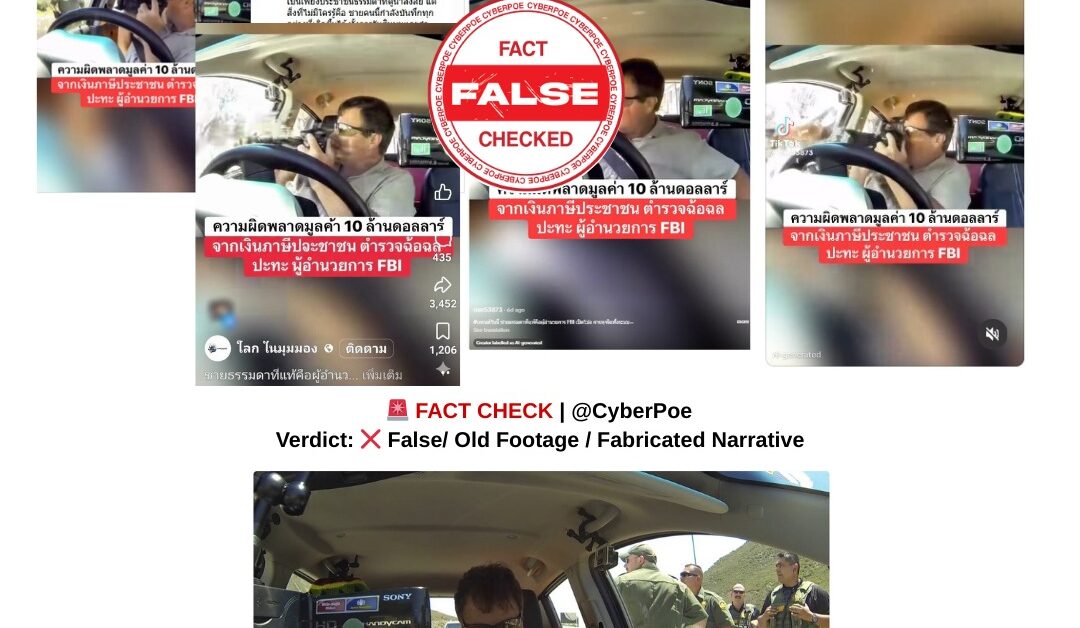
In January 2026, a sensational video began circulating widely across Thai-language social media platforms, rapidly gaining traction on TikTok[1] before spreading to Facebook,[2] Instagram,[3] and Threads.[4] The footage shows armed U.S. law enforcement officers smashing a car window at a roadside checkpoint and forcibly removing the driver. A dramatic Thai-language narration overlays the clip, claiming the man was none other than the director of the U.S. Federal Bureau of Investigation, operating undercover to expose widespread police corruption. According to the viral story, officers unknowingly arrested their own highest-ranking superior after discovering federal case files in his trunk that documented their alleged crimes.
The narrative was framed as a shocking revelation of systemic corruption within U.S. policing, portrayed through a cinematic arc of irony and justice. Some posts went further, drawing parallels to corruption concerns in Thailand and suggesting the video demonstrated how corrupt officials should be confronted. The authority associated with the FBI and the emotional intensity of the footage helped propel the claim far beyond its original audience.
Why the Story Resonated With Viewers
The claim found fertile ground in an environment where public concern over corruption is widespread. Thailand continues to face persistent challenges related to governance transparency, and public discourse frequently reflects frustration with entrenched corruption and lack of accountability. Against this backdrop, a story suggesting that even the most powerful law enforcement figure in the United States could be caught exposing corruption carried strong symbolic appeal.
The video itself amplified that appeal. The confrontation is visually intense, featuring armed officers, broken glass, and a tense standoff. Combined with a confident, authoritative voiceover and the invocation of the FBI director’s title, the narrative appeared credible to many viewers. Few questioned whether such an extraordinary scenario aligned with how U.S. law enforcement institutions actually operate.
CyberPoe’s Verification and Timeline Analysis
CyberPoe conducted a detailed investigation into the origins of the footage using reverse-image searches, keyframe analysis, and archival cross-referencing. This process quickly established that the video is not recent and has no connection to the FBI or any corruption investigation. Instead, the footage predates the viral claim by more than a decade.
The earliest verifiable source of the video is a YouTube upload dated September 7, 2014,[1] by a user named Robert Trudell. The clips circulating in 2026 are cropped, re-edited, and in some cases horizontally mirrored versions of this original upload, a common tactic used to obscure provenance and bypass basic verification methods. The timeline alone is sufficient to invalidate claims that the footage depicts events in 2026.
What the Video Actually Shows
The original video is titled “Robert Trudell rides into Pine Valley, California – US Border Patrol Checkpoint, Refuses Search.” According to its description and accompanying context, the incident occurred on May 31, 2013, at a U.S. Border Patrol checkpoint near Pine Valley, California. The footage documents a confrontation after Trudell refused to consent to a vehicle search. During the encounter, an officer broke the car window, removed Trudell from the vehicle, and conducted a search.
There is no indication in the original video, its description, or any contemporaneous reporting that the incident involved the FBI, a corruption probe, or any undercover operation. Trudell’s YouTube channel contains numerous similar videos documenting encounters with law enforcement, suggesting a pattern of deliberate recording rather than covert investigation
Implausibility of the FBI Director Narrative
Claims that the man in the video is the FBI director collapse under even minimal scrutiny. The individual does not resemble Kash Patel, the current FBI director, nor any former director. More importantly, the role of FBI director is a highly visible, Senate-confirmed position with extensive security protocols. There is no precedent, legal framework, or historical example of an FBI director personally conducting undercover roadside operations.
No credible U.S. media outlet, government statement, or court record supports the existence of a sting operation in which the FBI director was arrested by local officers to expose corruption. Such an event would constitute a major constitutional and political crisis and would be impossible to conceal or reduce to a viral social media clip.
Border Patrol Checkpoints and Legal Context
The checkpoint shown in the video aligns with standard U.S. Border Patrol operations. Under U.S. law, Border Patrol checkpoints are permitted within roughly 160 kilometers of national borders. At these locations, officers may briefly stop vehicles to inquire about citizenship and The checkpoint shown in the video aligns with standard U.S. Border Patrol operations. Under U.S. law, Border Patrol checkpoints are permitted within roughly 160 kilometers of national borders. At these locations, officers may briefly stop vehicles to inquire about citizenship and
How the False Narrative Was Manufactured
The viral claim relies entirely on fabricated narration layered over authentic but unrelated footage. By inventing elements such as secret federal files, undercover operations, and the arrest of the FBI director, the original context was completely erased. The real event a civil liberties confrontation at a border checkpoint was replaced with a fictional morality tale designed to provoke outrage and admiration.
This technique of recontextualization is a common disinformation strategy. It leverages the authenticity of real footage while attaching an entirely false storyline that aligns with viewers’ expectations or grievances.
Why This Misinformation Matters
Misrepresenting old civilian footage as evidence of high-level corruption undermines public understanding of how accountability and investigations actually occur. It promotes the illusion that systemic corruption is exposed through dramatic confrontations rather than through documented investigations, judicial processes, and oversight mechanisms. When such narratives cross borders, they also distort perceptions of foreign legal systems and institutions.
The case illustrates how emotionally compelling stories can override basic verification, particularly when they resonate with existing frustrations or political sentiments.
CyberPoe Conclusion
The video circulating in Thai-language posts does not show the FBI director exposing police corruption. It is decade-old footage recorded in 2013 at a U.S. Border Patrol checkpoint and publicly uploaded in 2014 by YouTuber Robert Trudell. There is no evidence of any undercover FBI operation or corruption exposé resembling the claims made online.
CyberPoe Verdict:
Decade-old civilian footage falsely rebranded as a high-level corruption revelation.
Context, timelines, and original sources remain essential to separating fact from fiction.
CyberPoe | The Anti-Propaganda Frontline 🌍