Project Info
Category
Date
Did Brazil Fell Amazon Rainforest to Build a Highway for COP30?
Claim and Context
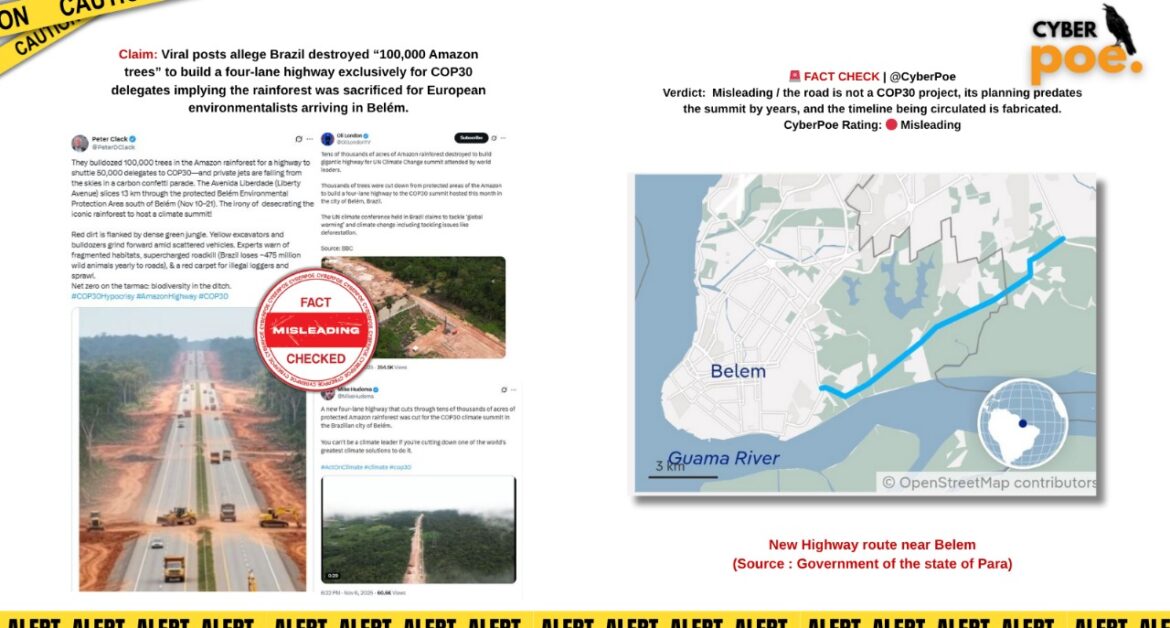
As world leaders, policymakers and climate experts gather in Belém, Brazil for COP30, a viral narrative has surged across social media: that Brazil allegedly destroyed sections of the Amazon rainforest to build a new four-lane highway exclusively for COP attendees. The claim has been amplified by major political figures and high-engagement accounts, including US President Donald Trump, who wrote that Brazil “ripped the hell out of the rainforest” to create a road for environmentalists attending the summit. Various commentators have echoed the sentiment, arguing that the supposed contradiction exposes hypocrisy within the global climate movement.
However, this simplified account omits critical context. The facts reveal a far more complex picture one that blends long-standing infrastructure ambitions, local political dynamics, and the optics of climate summits that are often weaponized to fuel anti-climate narratives.
Why the Narrative Became Viral
The highway in question Avenida Liberdade7 is indeed a four-lane, approximately 13.2-kilometer roadway near Belém. Construction has involved clearing sections of forest, which allowed visuals of felled trees and machinery to spread widely online. These images, juxtaposed with the timing of COP30, created fertile ground for claims of hypocrisy. Posts labeling the project a “scam” or “scandal” have collectively amassed millions of impressions, particularly on X and Truth Social.
The story regained momentum because it neatly aligns with a broader skepticism surrounding climate summits. Every year, critics highlight the emissions from travel, private jets, luxury accommodations, and heavy logistics involved in hosting COP events. Avenida Liberdade became the latest symbol turned into a viral exhibit of perceived environmental double standards.
But as investigations show, the claim misrepresents the origins and purpose of the highway.
The Real Timeline Behind Avenida Liberdade
Belém sits at the mouth of the Amazon River, serving as the gateway to the lower Amazon. Its primary access route, BR-316, suffers chronic congestion. Local authorities have discussed alternative routes into the city for more than two decades to ease traffic pressure, long before COP30 was awarded to Brazil.
The idea evolved into Avenida Liberdade, a plan officially announced in 2020. Public records, expert interviews, and government documents confirm that discussions surrounding the roadway stretch back to at least 2012. Construction began in June 2024 but has faced repeated delays due to protests, land concerns, and legal challenges.
Urban studies experts in Pará note that while the project pre-dates COP30, the upcoming summit created momentum and political justification to accelerate construction. This distinction matters. It means the highway is not an official COP30 development, but preparations for the conference helped move it higher on the local agenda.
This nuance is often intentionally omitted in viral posts.
Dissecting the BBC Controversy
Much of the renewed virality stems from a BBC investigation published earlier in 2025 under the headline: “Amazon forest felled to build road for climate summit.” The headline implied a direct causal link between the highway and COP30. After publication, Brazilian officials publicly rejected the connection, asserting that Avenida Liberdade does not belong to the list of 33 infrastructure projects planned specifically for the climate conference.
DW’s own inquiry found that the BBC relied on state government documents and an interview with Pará’s infrastructure secretary, Adler Silveira, who referenced the highway within a group of projects intended to modernize Belém for COP30. The BBC later provided a longer transcript supporting its interpretation.
An additional twist emerged when a state press release initially included Avenida Liberdade among COP-related projects. Shortly after the BBC article went live, that paragraph was removed from the official government website an edit captured in archived versions. This inconsistency within local authorities contributed to confusion and further fueled speculation.
Regardless, official documents from Brazil’s federal government make clear that Avenida Liberdade is not categorized as a COP30 project.
Environmental Status of the Construction Zone
The project’s environmental impact remains contentious. The highway cuts through an Environmental Protection Area (APA), a Brazilian classification permitting sustainable use under controlled regulation. The land is not pristine rainforest; the route follows a pre-cleared powerline corridor, visible in satellite imagery. The area also hosts existing infrastructure such as university facilities.
Even so, environmental experts warn that adjacent ecosystems including Utinga State Park may still face secondary consequences like noise, pollution, and urban encroachment.
Local communities have repeatedly protested, demanding proper consultation, compensation for seized land, and repairs to roads damaged by heavy machinery. These demonstrations briefly halted construction in October 2024 and again in July 2025.
These dynamics show that the project is real, controversial, and environmentally consequential but not created for COP30.
Why This Matters: The “Authenticity Gap” in Climate Politics
The viral narrative around Avenida Liberdade mirrors a broader communication challenge identified by climate researchers. A recent investigation by Eurovision News Spotlight, involving the analysis of 70,000 posts on X, describes an “authenticity gap” surrounding global climate conferences.
Critics often weaponize the visible carbon footprint of such summits private jets, motorcades, large delegations to undermine public trust in climate action. These optics overshadow the slower, technical, and less camera-friendly diplomacy that defines climate negotiations. Avenida Liberdade has become an easy emblem for this skepticism, regardless of its actual origins.
This is why accuracy matters. Misrepresenting the purpose of the highway does not just distort
Conclusion: What’s True and What’s Not
Trees were indeed cut to construct a highway near Belém. Avenida Liberdade is a real, long-controversial infrastructure project with genuine environmental implications. However, evidence shows that the highway was not conceived or initiated for COP30. Instead, its long-standing plans gained political urgency because of the summit an important but distinct reality.
The claim that Brazil “destroyed the Amazon for COP30” simplifies and distorts a complex issue. It blurs years of planning, governance contradictions, and infrastructure debates into a viral talking point designed to cast doubt on climate efforts.
The full picture demonstrates something different: a mix of old ambitions, new political timelines, and a global event whose optics make it vulnerable to disinformation
CyberPoe | The Anti-Propaganda Frontline 🌍