Project Info
Category
Date
Did the UK Government Announce “Cash Bonus” for Euthanasia
The Viral Claim
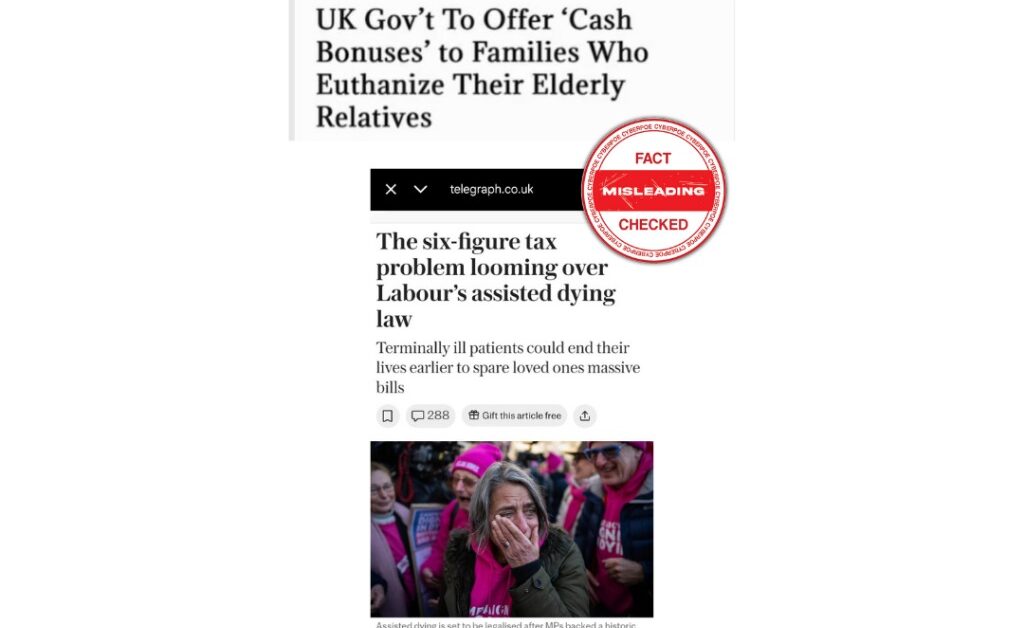
In early December 2024, social media platforms became flooded with a shocking claim: that the British government planned to offer “cash bonuses” to families who agreed to euthanise their elderly relatives. The story, published on December 5 by The People’s Voice a website already known for spreading sensational and misleading stories quickly caught attention. Facebook groups, fringe outlets, and certain X accounts amplified the headline, sparking waves of anger and confusion.
The narrative was designed to provoke a visceral reaction. It implied that assisted dying legislation was not only advancing in the UK but that the state was actively encouraging families to end the lives of elderly relatives for financial gain. However, a closer examination shows this claim is false. What circulated online is a distortion that fuses two unrelated topics: parliamentary debate on assisted dying and existing pension tax rules.
What the Assisted Dying Bill Actually Proposes
On November 29, 2024, the British parliament debated the Terminally Ill Adults (End of Life) Bill, which focuses on assisted dying in very specific circumstances. If passed, the legislation would grant mentally competent, terminally ill adults in England and Wales those medically assessed as having six months or less to live the legal right to choose an assisted death.
The proposed law includes strict safeguards. Two independent doctors must confirm eligibility, and the process is framed around medical oversight and patient consent. Importantly, the bill also places restrictions on involvement by individuals who stand to benefit financially from the patient’s death. This safeguard directly contradicts the viral claim: far from offering “cash bonuses,” the law is designed to prevent financial conflicts of interest in end-of-life decisions.
The bill has not yet passed into law and remains under parliamentary scrutiny. It may be amended, rejected, or reshaped, but nowhere in its current form is there any mention of financial incentives to families.
How Pension Rules Were Twisted into a False Narrative
The confusion likely stems from a December 4, 2024, Telegraph article. That piece discussed how assisted dying legislation, if passed, could intersect with pension tax regulations. Under current UK rules, pension beneficiaries inherit savings tax-free if the holder dies before the age of 75. If the death occurs after 75, beneficiaries are required to pay tax on the pension inheritance.
The Telegraph highlighted the potential for “uncomfortable dilemmas” should assisted dying become lawful. It raised ethical questions about whether financial considerations could influence family decisions. Crucially, however, it did not report any government plan to pay families or provide bonuses. It was a speculative discussion of existing tax structures not a policy announcement.
This nuanced analysis was then exaggerated by The People’s Voice, which reframed speculation about pension rules as though the government had unveiled a cash-for-euthanasia scheme. The leap from hypothetical ethical concern to fabricated headline demonstrates how misinformation outlets distort serious debates into sensational clickbait.
The Role of Disinformation Outlets
Fact-checkers, including Reuters, investigated the claim and found no evidence of an official government announcement. Neither parliamentary records nor UK government statements contain any reference to financial incentives for euthanasia. In fact, the very safeguards in the bill are designed to prevent those who could profit from a death from being part of the decision-making process.
This is not the first time The People’s Voice has amplified distortions. The outlet has a history of reframing complex policy debates into viral conspiracies, often exploiting emotional topics to drive traffic. By taking a sensitive issue like assisted dying and pairing it with financial fears, the outlet ensured rapid sharing across platforms even though the claim had no factual foundation.
Why Accuracy Matters
End-of-life care is among the most delicate ethical issues a society can face. Legislation on assisted dying touches questions of personal autonomy, medical responsibility, and moral boundaries. By falsely framing these debates as government schemes to pay for death, misinformation undermines serious discussion and fuels public mistrust.
Such distortions do not just mislead they can harden divisions, polarize public opinion, and distract citizens from the real issues under debate. Instead of discussing safeguards, patient rights, and medical oversight, the focus is shifted to fabricated outrage.
Verdict
The viral story that the UK government announced “cash bonuses” for families who euthanise elderly relatives is misleading and false. It originated in a speculative discussion about pension tax rules, was twisted by a misinformation outlet, and spread unchecked across social media.
The assisted dying bill under debate does not include any financial incentives, and it explicitly bars financially interested individuals from being decision-makers. The claim has no basis in parliamentary records, government announcements, or reliable reporting.
🔎 CyberPoe Reminder: Always verify shocking headlines by checking primary sources, such as official parliamentary documents and established news outlets. Sensationalism thrives on outrage. Truth thrives on evidence.
CyberPoe | The Anti-Propaganda Frontline