
Project Info
Category
Date
Ethiopia’s Letter to Eritrea Misrepresented as Demand to Withdraw From Assab
The Viral Claim
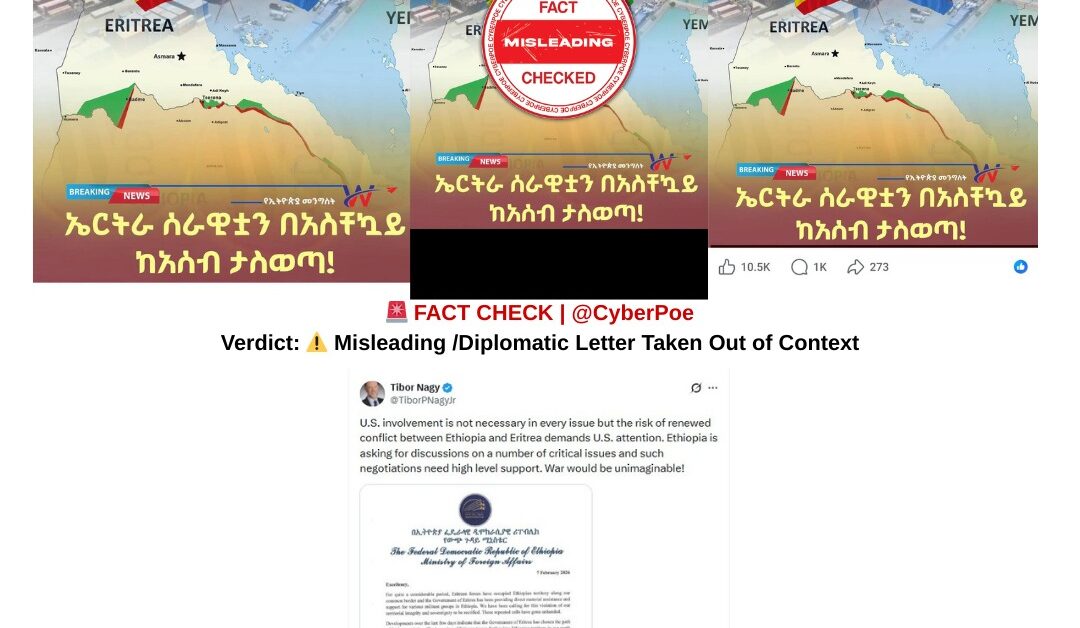
On February 8, 2026, Amharic-language posts began circulating widely on social media platforms including facebook[1], Instagram,[2] and X[3] claiming that Ethiopia had formally demanded Eritrea “immediately withdraw its troops from Assab port,” allegedly describing the Red Sea city as Ethiopian territory. The posts referenced a February 7 diplomatic letter in which Ethiopia accused Eritrea of a military incursion into its northeastern Tigray region. However, viral narratives suggested that Addis Ababa had gone further extending its demand to include Eritrean forces stationed in Assab and asserting ownership over the strategic port.
The allegation gained rapid traction amid renewed tensions between the two Horn of Africa neighbours. Given Ethiopia’s well-documented ambition to regain maritime access after becoming landlocked following Eritrea’s independence in 1993, the claim carried substantial geopolitical weight.[4] A formal declaration asserting Assab as Ethiopian territory would represent a major diplomatic escalation with potentially destabilising regional consequences.
Yet a review of the authenticated diplomatic correspondence shows that this interpretation does not reflect the actual content of the letter.
What the February 7 Letter Actually States
A copy of the February 7, 2026 letter, obtained and authenticated through Ethiopia’s Ministry of Foreign Affairs, clearly addresses allegations of Eritrean troop activity inside Ethiopia’s Tigray region.[1] In the communication, Ethiopian Foreign Affairs Minister Gedion Timotheos accuses Eritrea of conducting a “clear incursion in the northeast” and calls for the immediate withdrawal of Eritrean forces from Ethiopian territory. The demand is specific and geographically defined: it pertains to Tigray.
The letter does not instruct Eritrea to withdraw troops from Assab. It does not characterise Assab as Ethiopian territory. It does not contain language asserting sovereignty over the port.[1]
Instead, the document includes a separate passage expressing Ethiopia’s readiness to engage in “good faith negotiations” on outstanding bilateral matters. Among the issues listed is maritime access, described as “the issue of access to the sea through the port of Assab.”
The wording is diplomatically precise. It references negotiations concerning access to the port not ownership of it.
Access Versus Sovereignty
The distinction between negotiating access and asserting territorial control is not semantic; it is fundamental in international law and diplomacy.
A demand that Eritrea withdraw from Assab would amount to a direct claim over sovereign Eritrean land, representing a dramatic and confrontational policy shift. No such language appears in the letter.
By contrast, negotiating access to maritime facilities is a common diplomatic objective for landlocked states. Ethiopia has long sought diversified sea access arrangements, including agreements with Djibouti and exploratory discussions with other regional actors. Raising the issue of access within a negotiation framework is consistent with historical Ethiopian policy.
The viral posts appear to conflate two separate elements of the diplomatic exchange: Ethiopia’s demand that Eritrean troops withdraw from Tigray, and Ethiopia’s broader strategic interest in maritime access.[1] By merging these issues, the posts transform a call for border de-escalation into a territorial ultimatum.
Eritrea’s Response and Regional Context
In its February 9 response, Eritrea rejected Ethiopia’s allegations of troop incursions, describing them as “false and fabricated.” Notably, Eritrea’s reply did not reference any demand related to Assab, further indicating that no such claim was present in the Ethiopian communication.
The episode unfolds against a complex regional backdrop. Although Ethiopia and Eritrea normalised relations following years of hostility and cooperated during the Tigray conflict, their rapprochement has remained fragile. Maritime access has consistently been a strategic priority for Addis Ababa, but it has typically been framed in terms of negotiation and economic partnership rather than territorial revisionism. In volatile political environments, subtle shifts in diplomatic wording can carry major implications. Mischaracterising negotiation language as a declaration of ownership risks inflaming public sentiment and escalating mistrust.
CyberPoe Verdict
The claim that Ethiopia demanded Eritrea withdraw troops from Assab and declared the port Ethiopian territory is misleading.
Ethiopia’s February 7, 2026 letter calls for the withdrawal of Eritrean forces from Tigray and expresses willingness to negotiate maritime access through Assab. It does not demand Eritrean withdrawal from the port itself, nor does it assert sovereignty over Assab. The viral narrative conflates separate diplomatic issues and amplifies them into a territorial claim not reflected in the official text.
CyberPoe | The Anti-Propaganda Frontline 🌍