Project Info
Category
Date
Fact Check by CyberPoe: Viral “Egg Attack” Kidnapping Warning in South Korea Is a Recycled Hoax
Introduction
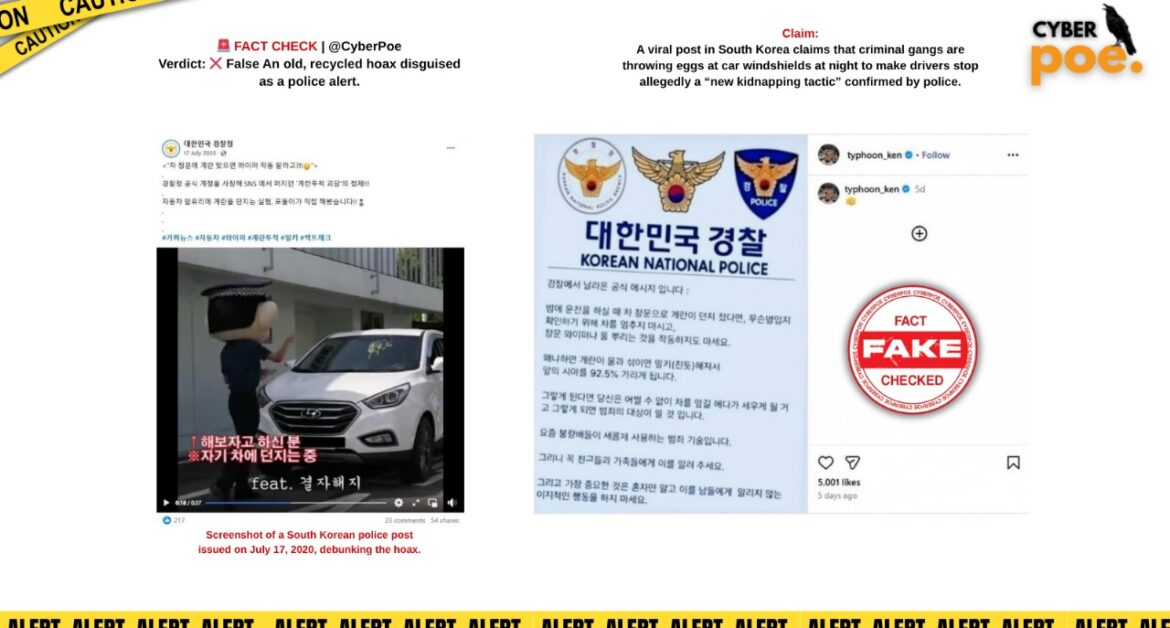
A viral post circulating on major social media platforms, including Instagram, TikTok, Facebook, and X, has reignited panic across South Korea. The claim suggests that criminal gangs are throwing eggs at car windshields during nighttime to force drivers to stop, allegedly as part of a new kidnapping tactic. The supposed warning, framed as an official police notice, claims that eggs mixed with water can reduce visibility by up to 92.5%, compelling drivers to halt and fall victim to abductions. However, an investigation by CyberPoe confirms this claim to be entirely false. It is not a new threat but rather a recycled internet hoax that has resurfaced multiple times over the past decade in various countries under different contexts.
Origins of the Claim
The fabricated post began circulating widely in early November 2025, gaining millions of views within days. The viral image, formatted to resemble an official police advisory, featured a national emblem and text written in formal Korean, warning citizens against wiping their windshields if struck by eggs. This misleading presentation led many users to believe it was a legitimate government warning. However, South Korean law enforcement agencies have clarified that no such alert was ever issued and that no official records or incident reports support this story.
Verification and Historical Background
CyberPoe’s investigation traced the earliest known version of this claim to 2017, when similar messages began circulating in North America and parts of Europe, warning of the same “egg attack” tactic. Over the years, the claim reappeared multiple times in 2018, 2020, and 2023 each time adjusted to local contexts to exploit public fear and insecurity. The pattern remains consistent: whenever societies face heightened anxieties about crime or abduction, the hoax returns with renewed virality. In past cases, police departments have publicly debunked the myth by demonstrating that eggs thrown at a windshield do not significantly impair visibility and can be easily cleaned off. The notion that eggs mixed with water could “blind” drivers is scientifically and practically untrue.
Current Context and Fear Amplification
The resurgence of this hoax in South Korea coincides with a period of heightened public anxiety following several genuine abduction cases reported in Asia, including the murder of a South Korean student in Cambodia and scam-related kidnappings across Southeast Asia. Misinformation often thrives in such climates of fear. By mimicking official sources and presenting dramatic scenarios, false warnings like this one exploit emotional vulnerability to amplify panic. The viral post also reflects the broader trend of fear-based misinformation spreading rapidly through social media ecosystems, where credibility is often determined by engagement rather than authenticity.
Police Response and Public Clarification
The National Police Agency of South Korea has firmly stated that it never issued any such alert and has no evidence to suggest that criminals are using eggs in abduction schemes. Law enforcement officials reiterated that no complaints, incident reports, or investigations have been filed in connection with these claims. In previous years, similar rumors prompted police departments in multiple countries to conduct field demonstrations, conclusively proving that egg splatters on windshields do not obstruct visibility to the degree claimed in viral posts.
Conclusion
The viral “egg attack” kidnapping warning circulating in South Korea is entirely fabricated. It revives a long-running global hoax designed to instill fear and attract attention by posing as an official safety alert. There is no credible evidence, police confirmation, or recorded incident to support the claim. The message serves as a reminder of how misinformation thrives in the digital age manipulating fear and exploiting public trust in authority. Citizens are advised to verify alarming claims before sharing them online, as spreading such misinformation only fuels unnecessary panic.
CyberPoe Rating: False An old, recycled hoax disguised as a police alert.
CyberPoe | The Anti-Propaganda Frontline 🌍