Project Info
Category
Date
Fake “Free Laptop” Scheme Uses Imposter Government Website to Target Malaysians
The Viral Claim and Its Rapid Spread
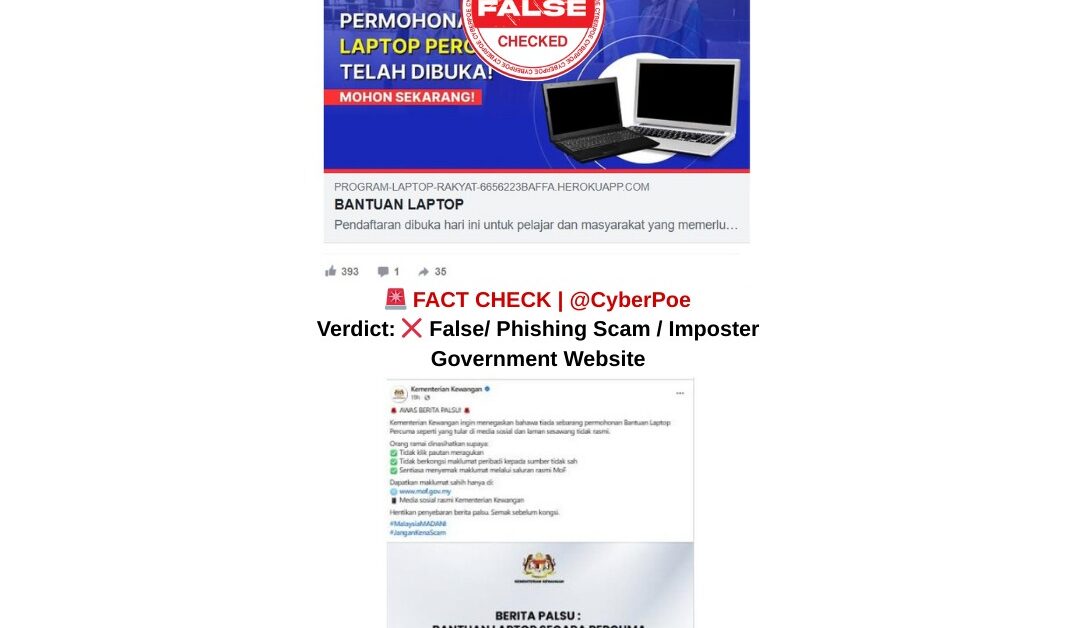
In early February 2026, social media platforms in Malaysia were flooded with posts claiming that the government had launched a “free laptop assistance” programme for low-income groups. A widely shared Malay-language Facebook post[1] dated February 5 described the initiative as a limited-time opportunity available exclusively to Malaysians. The messaging was carefully constructed to create urgency, encouraging users to apply immediately before quotas ran out.
The promotional graphics featured students using laptops, overlaid with official-looking symbols including the Malaysian coat of arms and “Malaysia Madani”[2] branding associated with Prime Minister Anwar Ibrahim’s policy framework. The visual presentation mimicked legitimate government announcements, giving the impression of authenticity. Embedded links directed users to websites resembling official portals, where visitors were prompted to enter personal information, including full names and telephone numbers, to complete their supposed applications.
Variations of the same advertisement quickly appeared across Facebook[3] and TikTok,[4] often using identical wording, layout, and imagery. The coordinated repetition amplified its credibility among unsuspecting users.
Official Response and Government Denial
Malaysia’s Ministry of Finance formally addressed the circulating claims on February 12 through its verified Facebook account.[1] The ministry explicitly labelled the laptop assistance posts as “fake news” and clarified that no such nationwide programme had been introduced.
The statement warned the public against clicking suspicious links or providing personal information to unauthorised websites.[2] It emphasised that legitimate government initiatives are always announced through official channels and verifiable platforms.
This denial is significant because financial assistance and subsidy programmes in Malaysia are typically accompanied by structured press releases, announcements through ministry websites, and coverage in mainstream media. No such parallel communication accompanied the alleged laptop scheme.
Technical Red Flags and Website Verification
Further examination of the websites linked in the viral posts reveals clear indicators of fraud. None of the URLs end with the official “.gov.my” domain suffix used by Malaysian government agencies.[1] The Malaysian government’s MyGovernment portal specifically advises citizens to verify authenticity by confirming that official websites use this domain.
Deputy Minister of Communications and Multimedia Teo Nie Ching has previously cautioned that websites claiming to represent government services without the “.gov.my” suffix are highly likely to be fraudulent. The absence of this domain marker alone raises serious doubts about the legitimacy of the laptop offer.
Additionally, the social media pages promoting the scheme were newly created between February 5 and 7, coinciding precisely with the campaign’s emergence. Genuine government programmes are not launched through freshly created, unverified social media accounts with no prior institutional footprint.
How the Scam Operates
The structure of the scheme follows a classic phishing model. Fraudsters replicate official branding to cultivate trust, pair it with emotionally appealing promises such as educational assistance, and add urgency by suggesting limited availability. This combination lowers users’ skepticism and increases the likelihood of immediate action.
Once redirected to the imposter website, individuals are asked to submit personal details. While initial forms may request only basic contact information, such data can be leveraged for targeted scams, identity theft, or further social engineering attempts. In many cases, harvested information is sold or reused in future fraudulent campaigns.
The deliberate misuse of government symbols and policy branding is central to the deception. By embedding familiar emblems and slogans, scammers attempt to bypass critical scrutiny.
Why This Misinformation Matters
Malaysia has previously experienced waves of online scams impersonating public assistance programmes, particularly during times of economic uncertainty. Fraudsters frequently exploit public interest in grants, subsidies, and student support initiatives.
In an era where website templates and graphic assets can be easily replicated, visual similarity is no longer sufficient proof of authenticity. Domain verification, cross-checking with official ministry statements, and confirmation through established government portals remain essential safeguards.
Unchecked, such scams not only expose individuals to financial and identity risks but also erode public trust in genuine government assistance programmes.
CyberPoe Verdict
The claim that the Malaysian government has launched a free laptop assistance programme through the circulating websites is false. The Ministry of Finance has publicly denied the existence of such a scheme. The linked websites lack the official “.gov.my” domain suffix and display characteristics consistent with phishing operations.
This is a fabricated offer designed to harvest personal information under the guise of public assistance. Verification through official government channels remains the most reliable defense against such digital deception.
CyberPoe | The Anti-Propaganda Frontline 🌍