Project Info
Category
Date
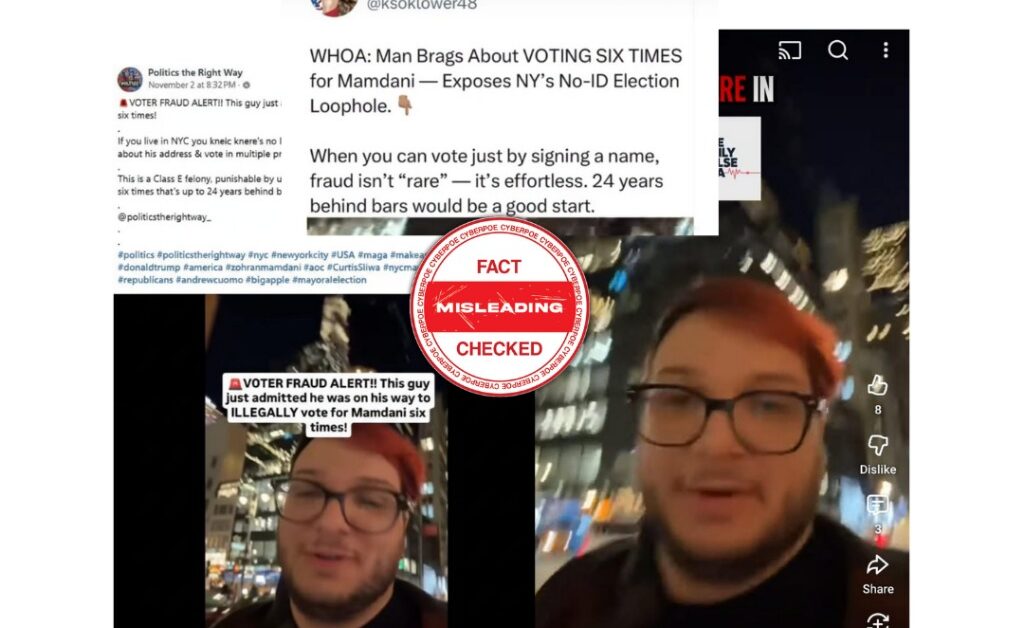
False claim of NYC voter fraud admission in viral video
Analysis and Verification
The viral video in question originated from the verified TikTok account “Play in Traffic,” a comedy and parody group known for producing absurdist content and internet skits. The original post, uploaded on October 29, 2025, was captioned “Or seven times,” referencing the long-running “6-7 meme” that circulates widely on meme forums and TikTok communities. This meme typically exaggerates numerical repetition as a form of ironic humor. The video was never intended to depict an actual confession of voter fraud, but instead, to parody online conspiracy culture and political exaggeration.
Shortly after the video went viral, the same creators posted a follow-up clip mocking those who took the post seriously, including a caption that read: “When I purposefully spread misinformation over the internet.” Despite the self-referential tone of the account and its well-established comedic nature, the clip was quickly reposted by politically motivated accounts, particularly on X and Truth Social, where it was reframed as real evidence of election manipulation.
A detailed review by CyberPoe’s verification team found no record of any voter fraud case involving Zohran Mamdani or multiple voting in New York City related to this election. The video lacks critical indicators of authenticity no identifiable polling station, timestamp, or corroborating footage and exhibits the hallmarks of a meme video, including deliberate exaggeration and ironic tone.
Election Integrity and Safeguards in New York City
Contrary to the viral narrative, voting multiple times in New York City elections is nearly impossible due to stringent electoral safeguards. Each voter’s identity is cross-checked in real time through an electronic poll book system that updates immediately upon voting. Absentee ballots are tracked separately, preventing duplication, while affidavit ballots undergo additional verification to confirm eligibility. Poll watchers representing multiple parties oversee the process at every stage, making fraudulent duplication of votes practically infeasible.
According to Susan Lerner, Executive Director of Common Cause New York, “There are multiple security measures ensuring that no individual can vote more than once at any polling site or elsewhere.” Historical data further supports this statement: since 1982, the Heritage Foundation’s Election Fraud Database has documented only two verified duplicate-voting cases in New York a negligible figure across millions of ballots cast.
Context and Political Background
The viral claim must also be understood within a larger context of political disinformation. Zohran Mamdani, a Muslim progressive Democrat, has been a recurring target of coordinated smear campaigns and Islamophobic misinformation throughout his political career. The “six votes” video aligns with a broader trend of discrediting minority and left-leaning candidates through fabricated allegations of election misconduct. By exploiting humor out of context, misinformation networks amplify narratives that undermine trust in democratic processes and marginalize specific political figures.
CyberPoe’s investigation confirms that this case mirrors past patterns of digital manipulation, where satirical or humorous content is stripped of its context and reframed as genuine evidence of wrongdoing. This tactic, often used in election cycles, contributes to widespread confusion among voters and erodes confidence in electoral systems.
Conclusion
The viral video claiming to show a New York voter confessing to casting multiple ballots for Zohran Mamdani is entirely false. The footage originated as a satirical TikTok post, later distorted and spread as genuine evidence of voter fraud. There are no credible reports, official records, or investigations validating the claim. Moreover, New York’s election infrastructure includes robust safeguards that make such actions virtually impossible.
CyberPoe concludes that the clip is a clear example of satirical content misrepresented as factual evidence, contributing to misinformation around democratic processes. The incident highlights the importance of verifying the source and context of online material before drawing conclusions or sharing politically charged content.
CyberPoe | The Anti-Propaganda Frontline