Project Info
Category
Date
False Images Circulated After Minnesota ICE Shooting Misidentify Unrelated Women
Overview of the Viral Claim
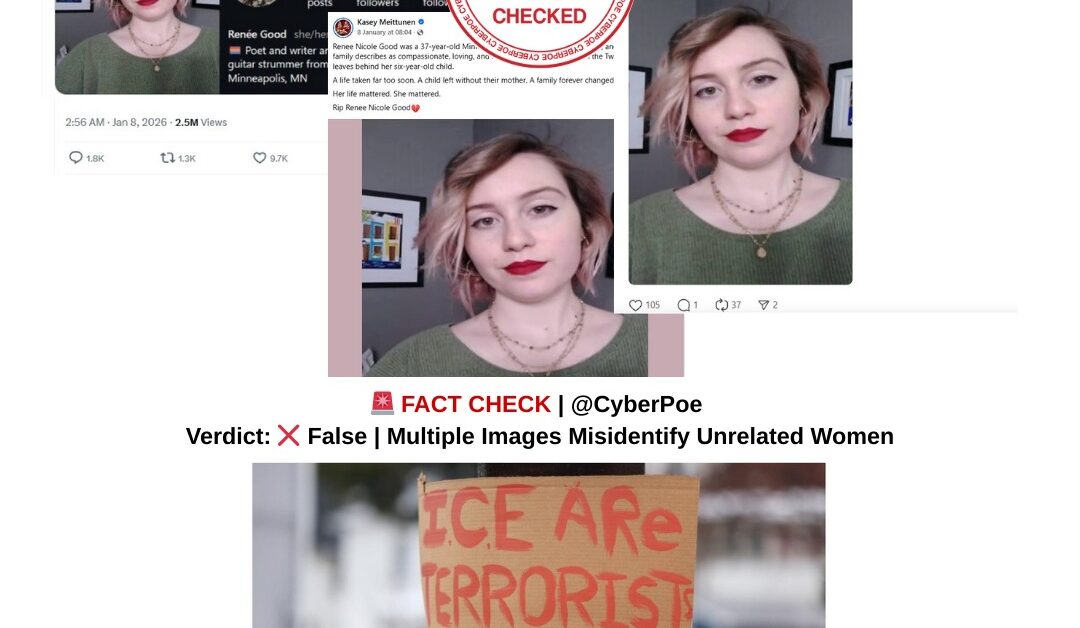
In the aftermath of the fatal shooting of Renee Nicole Good,[1] a 37-year-old Minnesota mother killed during an encounter with a U.S. Immigration and Customs Enforcement agent on January 7, 2026, social media platforms were quickly flooded with images claiming to show the victim. As news of the incident spread, users across X,[2] Facebook[3] and Threads[4] rushed to attach a face to the name, sharing photographs accompanied by emotional tributes, protest messaging and political commentary. Several of these images went viral within hours, becoming central to online narratives surrounding the shooting. However, a detailed verification confirms that multiple widely shared photographs do not depict Renee Nicole Good at all, but instead show at least two unrelated women who were wrongly identified and falsely linked to the tragedy.
How the Misinformation Took Hold
The rapid spread of misidentified images followed a familiar pattern seen after high-profile deaths. In moments of shock and grief, online communities often attempt to humanize victims by circulating photographs, even before official images are released. In this case, the urgency to respond emotionally and politically outpaced verification. One particularly viral image, first widely shared on January 7, portrayed a smiling woman described as Good and labeled a “dedicated wife and mother.”[1] The image was reposted thousands of times and even appeared on protest placards during demonstrations in Chicago. As it gained symbolic value, few users questioned its authenticity, allowing the false identification to become deeply embedded in the public conversation.
CyberPoe’s Verification and Source Tracing
CyberPoe conducted a thorough verification using open-source methods, including reverse-image searches, archival research and cross-referencing academic and media records. This process revealed that the most widely shared image was not of Renee Nicole Good. Instead, it depicted Gabriela Szczepankiewicz, a writer and former student at Old Dominion University. The origins of the confusion trace back to an April 1, 2020 Facebook post [1] by Old Dominion University’s English department announcing winners of its College Poetry Prize. That post featured photographs of both Szczepankiewicz and Good side by side. At the time,
Szczepankiewicz received an undergraduate honorable mention, while Good was named the undergraduate winner under her former name, Renee Macklin. Years later, that archival association resurfaced out of context, leading online users to mistakenly attribute Szczepankiewicz’s photo to the Minnesota shooting victim.
The Impact on Gabriela Szczepankiewicz
Academic records and interviews confirm that Gabriela Szczepankiewicz graduated in 2021 with degrees in creative writing and English and has no connection whatsoever to the January 2026 ICE incident. Despite this, her image became the most recognizable face associated with the tragedy online. The consequences extended beyond simple misidentification. Extremist and troll accounts began manipulating the falsely attributed image using artificial intelligence tools, producing sexualized fabrications and graphic edits referencing police violence. Some of these manipulations were created using newly introduced image-generation features in Elon Musk’s Grok AI. Experts warned that such actions not only spread misinformation but also dehumanize real individuals, subjecting them to harassment and psychological harm despite having no link to the event.
A Second False Identification
Separate viral posts[1] claimed to show Renee Nicole Good pictured with her children. These images, however, belonged to Renee Paquette, a Canadian television host and former WWE personality. The photos originated from Paquette’s personal Instagram account, including a 2023 International Women’s Day post and other family images. Paquette publicly corrected the false attribution herself, commenting under one viral post to clarify that the images were of her and expressing condolences to Good’s family. Despite this direct correction, the images continued to circulate, highlighting how viral misinformation often persists even after being publicly debunked by those affected.
What Verified Images Show
Authentic photographs of Renee Nicole Good were later published by verified news outlets, including the Minnesota Star Tribune, and appeared at memorials held in her honor in Minneapolis. These confirmed images do not match the viral photos shared earlier. Records show that Good, also known academically as Renee Macklin Good, graduated from Old Dominion University in December 2020 with a degree in English. She was previously married to Timmy Ray Macklin Jr., who died in 2023, and was the mother of two children. These verified details emerged gradually, underscoring how premature speculation and image-sharing filled the initial information gap.
Why This Case Matters
The misidentification of Renee Nicole Good’s image illustrates how quickly misinformation can override accuracy during emotionally charged events. Grief, political polarization and algorithm- driven virality combined to turn unrelated individuals into symbols of a tragedy they had no connection to. Once images became embedded in protest culture and online discourse, corrections struggled to reach the same audiences. The addition of AI-generated manipulations further escalated the harm, demonstrating how emerging technologies can amplify misinformation and personal abuse at unprecedented speed.
Conclusion
CyberPoe’s investigation confirms that multiple viral images circulated after the Minnesota ICE shooting do not depict Renee Nicole Good. Instead, they falsely show Gabriela Szczepankiewicz and Renee Paquette, both unrelated to the incident. The case highlights the dangers of unverified image sharing, particularly during moments of collective shock and anger. It serves as a reminder that real people often become collateral damage when online narratives prioritize speed and emotion over verification. Accurate reporting, careful source checking and restraint in sharing visuals remain essential to prevent further harm in such situations.
CyberPoe | The Anti-Propaganda Frontline