Project Info
Category
Date
False Narrative Recycles 2024 Protest Footage as Alleged 2026 Celebrations in Venezuela
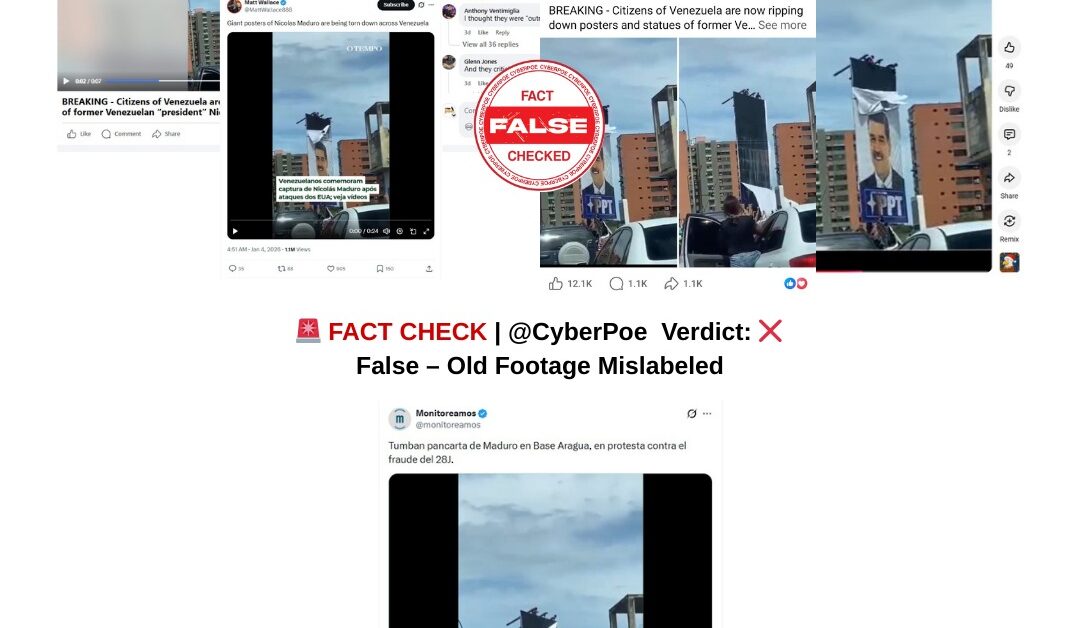
A viral video circulating on international social media platforms in January 2026 claims to show Venezuelan citizens tearing down a large Nicolás Maduro campaign banner in nationwide celebrations following his alleged capture and removal from power. The clip, widely shared on X,[1] Facebook[2] and Instagram[3], depicts a crowd dismantling a street banner bearing Maduro’s image. Posts presenting the footage assert that it was recorded immediately after reports of a January 3, 2026 US Special Forces raid in Caracas,[4] and that it represents public jubilation at the end of Maduro’s rule. Because the visuals appeared emotionally powerful and authentic, many users accepted and amplified the claim as real-time evidence of unified celebrations inside Venezuela. However, digital verification confirms that the footage is old and is being deliberately misrepresented to fit a new political storyline.
Why the Narrative Appeared Convincing
The acceptance of the claim was driven largely by context rather than by proof. News of the alleged 2026 military operation created global shock and intense curiosity about how ordinary Venezuelans were reacting. In such moments, reliable on-the-ground reporting is often limited, and audiences turn to social media for instant confirmation. The dramatic scene in the video seemed to fill that need. Viewers unfamiliar with Venezuela’s political symbols or recent history assumed that tearing down a pro-government banner must have occurred after the reported raid. The claim also aligned with what many international observers expected to see: visible signs that the public had rejected Maduro once he was removed from power. These psychological and informational gaps made it easier for outdated visuals to be passed off as breaking news. The video looked genuine, and that surface-level authenticity helped conceal the deeper falsehood about its origin.
CyberPoe’s Verification and Timeline Analysis
CyberPoe undertook a systematic forensic review of the viral clip to determine when and where it was actually recorded. Investigators extracted still frames from multiple moments in the video and conducted reverse image searches across social media archives and open-source databases. This process uncovered identical copies of the same footage uploaded on July 29, 2024[1], more than a year before the events now claimed. The earlier versions were shared in protest compilations and local Venezuelan news reports at the time. The existence of the clip in 2024[2]digital records conclusively disproves the assertion that it depicts reactions to developments in January 2026. No credible evidence links the video to the alleged capture of Maduro or to any incident occurring in early 2026. The timeline reconstruction alone exposes the claim as false.
True Context of the Footage
The authentic background of the video is connected to Venezuela’s disputed presidential elections held on July 28, 2024. In the days that followed, protests erupted across several Venezuelan cities as opposition supporters challenged the official announcement declaring Maduro the winner.[1] Demonstrators rejected the results as fraudulent and expressed their anger by targeting campaign material associated with the ruling political coalition. The viral clip originates from that period of unrest. Protesters can be seen pulling down a street banner marked with the acronym “PPT,” referring to Patria Para Todos, a political organization that openly supported Maduro’s 2024 candidacy. Far from celebrating the government, the crowd in the video was protesting against it. The presence of the PPT acronym is a clear contextual marker confirming that the scene belongs to 2024 electoral turmoil. The footage therefore shows political dissent from a previous year, not nationwide celebrations in 2026.
Absence of Corroboration From 2026 Events
A detailed review of verified reporting from Venezuela after the alleged 2026 raid further undermines the viral interpretation. International agencies documented a politically fragmented environment in Caracas during the first week of January 2026. On January 5, 2026, rallies supporting Maduro were held in parts of the capital, while Delcy Rodríguez was sworn in as interim president amid institutional transition. Demonstrations did occur, but they were divided and reflected competing political loyalties. None of those documented events involved citizens dismantling campaign banners in the manner shown in the viral clip. No Venezuelan media outlet or independent journalist placed this specific footage in January 2026. The lack of any credible match between the video and real incidents from 2026 confirms that the clip was being recycled solely to exaggerate public reaction and manufacture legitimacy for the “ouster celebration” narrative.
How the Video Was Misused
This case reflects a classic technique of modern propaganda: context abuse. Misleading accounts did not create new footage; they simply took a genuine video from 2024 and attached it to a sensational 2026 claim. By stripping the material of its historical background and pairing it with emotionally charged captions, propagandists attempted to construct the illusion that Venezuelans everywhere were celebrating Maduro’s downfall. The tactic relies on the fact that many viewers rarely verify dates, original uploads or political symbols. Old but real visuals are powerful tools for manipulation when audiences do not know how to check their origins. The deliberate mislabeling of this clip follows that well-established pattern.
Why Accurate Context Matters
The danger of such misinformation extends beyond a single video. During sensitive geopolitical moments, recycled visuals can distort international understanding and mislead audiences attempting to follow events responsibly. They create false impressions of unity, chaos or celebration that may not exist. In Venezuela’s case, political realities in 2026 were complex and contested, and no single clip could legitimately represent nationwide reaction. Presenting old protest footage as new celebrations undermines authentic reporting and contributes to confusion at a global level. The incident highlights the importance of independent verification and careful examination of digital timelines before accepting viral claims at face value.
Conclusion
The viral video said to depict January 2026 celebrations in Venezuela following Nicolás Maduro’s alleged capture is verified to be unrelated and outdated. CyberPoe’s forensic analysis confirms that the clip originated from protests connected to the disputed July 2024 elections and has been falsely rebranded to fit a new political narrative. No credible Venezuelan or international source places this footage in 2026, and chronological records clearly trace it to 2024. The claim is therefore false, representing an intentional misuse of authentic but old visuals.
CyberPoe | The Anti-Propaganda Frontline 🌍