Project Info
Category
Date
Images Showing Duterte With Epstein Are Manipulated
The Claim
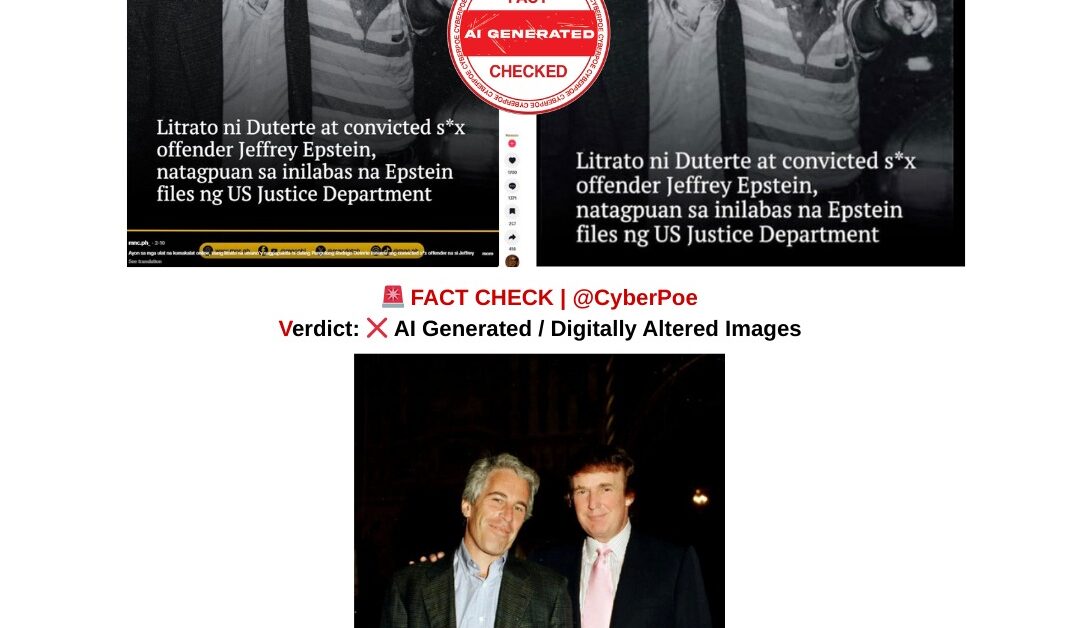
In February 2026, shortly after the US Department of Justice released another tranche of documents linked to Jeffrey Epstein, social media posts began circulating images that purportedly showed former Philippine president Rodrigo Duterte posing with the convicted sex offender. One widely viewed TikTok post[1] claimed the photo had been “found in the Epstein files released by the US Justice Department,” pairing the caption with an image of a younger Duterte standing closely beside Epstein, his hand resting on Epstein’s shoulder.
Additional images from the same account appeared to show the two men engaged in conversation. The posts spread rapidly across TikTok and Facebook,[2] accumulating hundreds of thousands of views and prompting users to speculate about Duterte’s alleged connection to Epstein. Some commenters treated the visuals as proof of wrongdoing, despite the absence of corroborating documentation.
The timing of the claim coincided with renewed public scrutiny following the DOJ’s document release. While the files contain references to numerous public figures, inclusion in the archive does not itself imply misconduct. In Duterte’s case, mentions reportedly consist of news articles from major US publications that were forwarded to Epstein, not records of meetings or correspondence between the two men. The viral images, however, are not authentic.
What CyberPoe Verified
Reverse image searches reveal that Epstein’s likeness in the manipulated photos was extracted from a well-documented Getty Images portrait taken at Mar-a-Lago in Florida on February 22, 1997.[1] The original photograph, captured by Davidoff Studios, shows Epstein standing beside Donald Trump. In the authentic version, Duterte does not appear.
In the altered images circulating online, Trump’s figure has been replaced with a younger image of Duterte. The Duterte figure itself closely resembles archival photographs from the early 1990s, when he served as mayor of Davao City in the Philippines. A Reuters image from that era shows Duterte wearing a similar striped shirt and hairstyle.
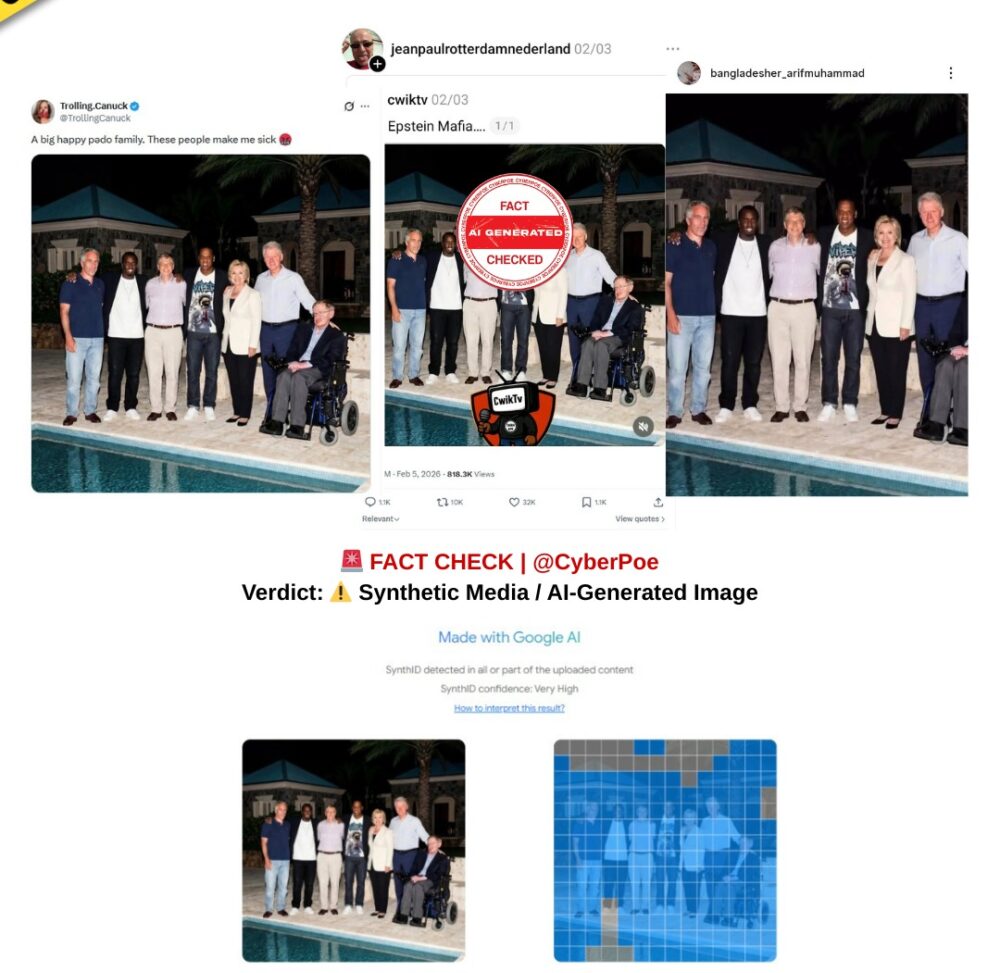
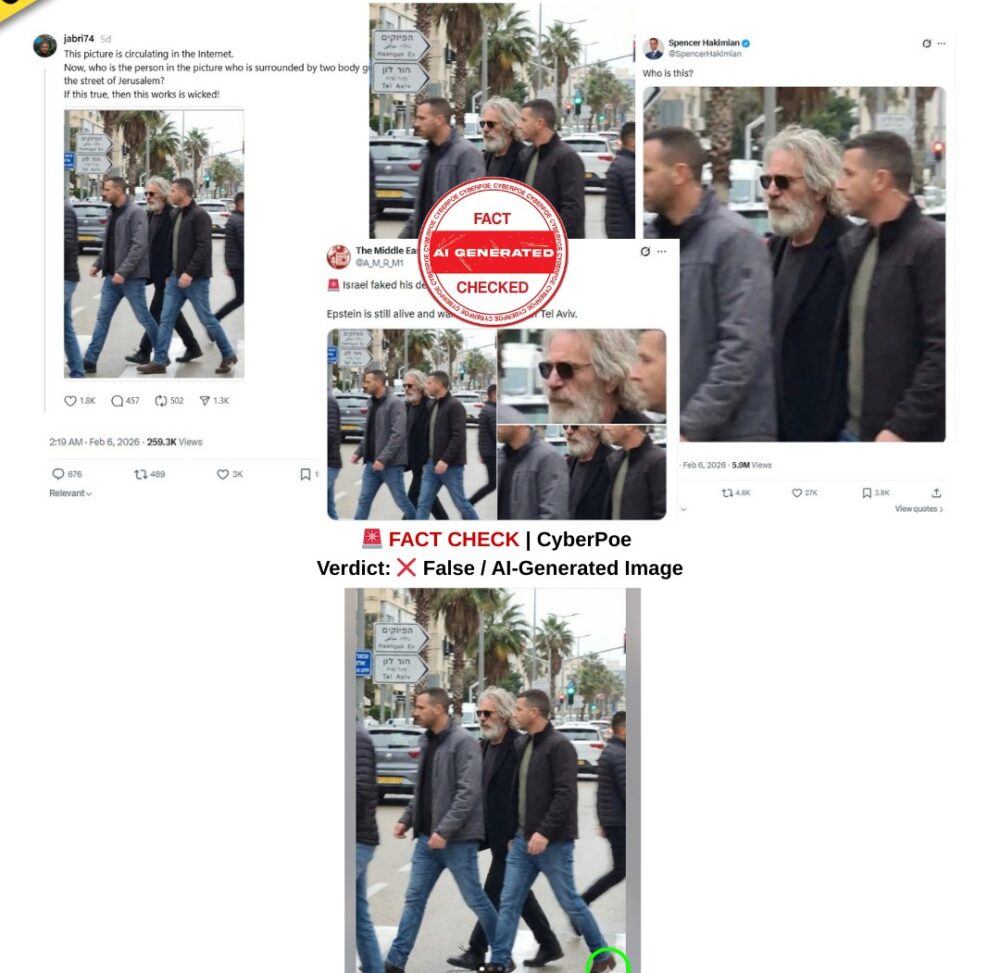
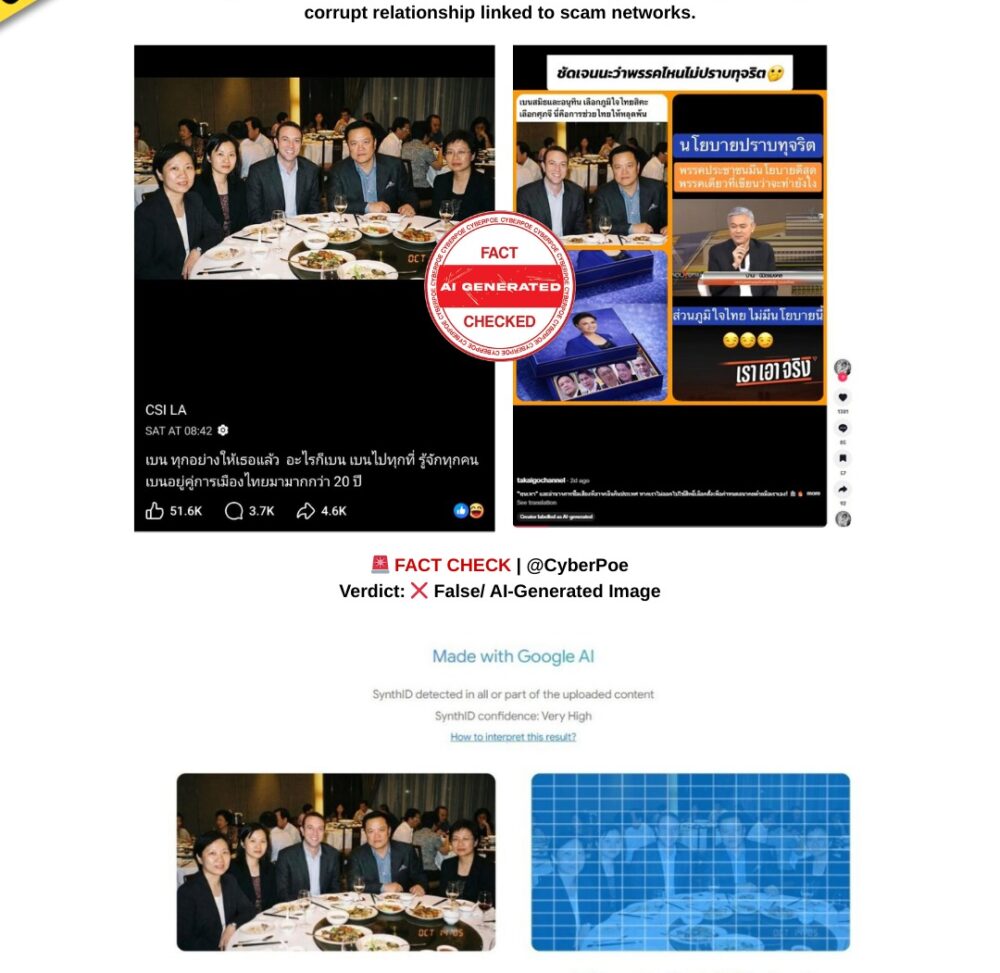
The compositing is not seamless. Visual inconsistencies strongly indicate the use of AI-based editing tools. In one version of the fabricated image, Duterte appears to have six fingers on one hand a common artifact associated with AI-generated or AI-manipulated visuals. Hand distortions are among the most frequent technical flaws in synthetic imagery.
Additional irregularities appear in the hair details and proportions. Across different versions of the viral images, Duterte’s haircut changes subtly in ways inconsistent with a single photograph. In one instance, he appears with a bowl-style cut; in others, his hair has a more natural layered appearance. Lighting and shadow alignment between the two figures also appear mismatched, suggesting digital compositing rather than an original capture.
Context of the DOJ Release
The renewed attention stems from the US government’s release of millions of pages tied to Epstein’s network.[1] These files have previously documented social, professional and financial associations between Epstein and a range of political figures, business executives and celebrities. However, mere mention of a name in the archive does not establish culpability or personal involvement in criminal conduct.
In Duterte’s case, references reportedly consist of emailed news clippings from outlets such as The New York Times and The Washington Post. There is no verified photographic or documentary evidence placing Duterte in Epstein’s presence.
The manipulated images exploit the heightened visibility of the document release, pairing a real historical photograph of Epstein with archival imagery of Duterte to construct a misleading visual narrative.
The Role of AI Manipulation
The fabrications display hallmarks of AI-assisted editing: anatomical distortions, inconsistent lighting, and subtle blending errors. Such tools make it increasingly easy to swap subjects into existing photographs while retaining realistic textures and backgrounds.
By using a legitimate Getty portrait as the base layer, the altered image gains superficial credibility. Viewers familiar with Epstein’s social circles may recognize the setting but not immediately detect the substitution.
This tactic reflects a broader pattern in misinformation campaigns, where authentic archival material is digitally altered to imply relationships or events that never occurred.
CyberPoe Verdict
The images purporting to show Rodrigo Duterte with Jeffrey Epstein are digitally altered. Epstein’s likeness was taken from a 1997 Getty Images photograph with Donald Trump, while Duterte’s image was inserted from unrelated archival photos. Visual inconsistencies, including anatomical distortions, indicate AI-assisted fabrication. There is no verified evidence that Duterte posed for photographs with Epstein
CyberPoe | The Anti-Propaganda Frontline 🌍