Project Info
Category
Date
Old AI-Likely Clip Falsely Shared as Iranian Strike on USS Abraham Lincoln
The Claim
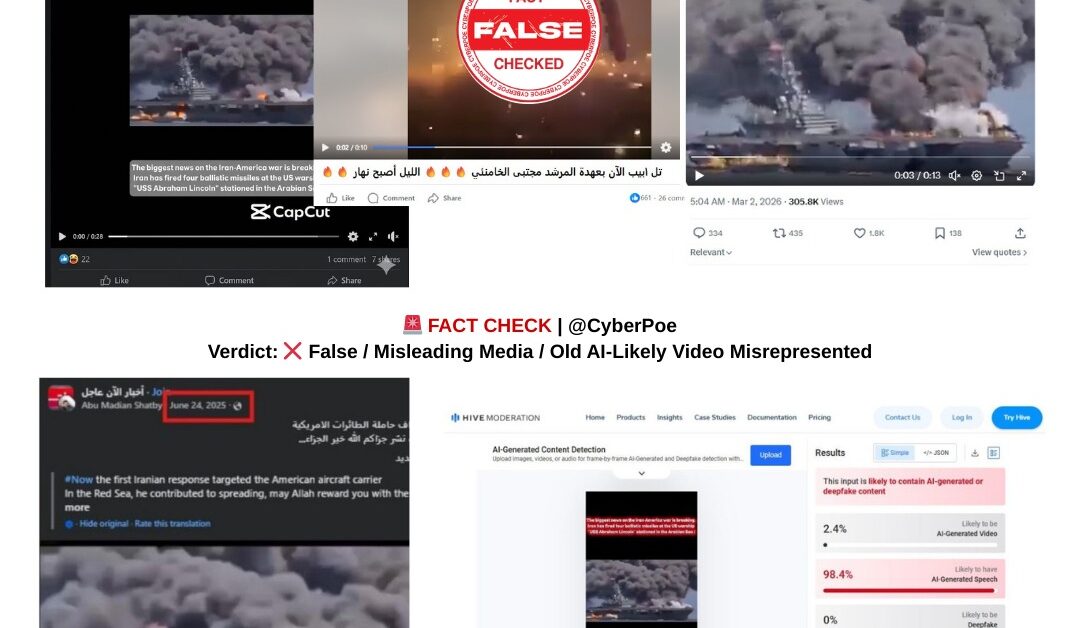
A dramatic video circulating across social media platforms[1] in early March 2026 claims to show the U.S. aircraft carrier USS Abraham Lincoln engulfed in flames after being struck by Iranian ballistic missiles. The footage spread widely on Facebook,[2] Instagram[3] and X,[4] often accompanied by captions stating that Iran had successfully targeted the American warship during escalating regional tensions following U.S. Israeli strikes inside Iran.
Several posts accompanying the clip claimed that the Islamic Revolutionary Guard Corps (IRGC) fired four ballistic missiles at the carrier while it was stationed in the Arabian Sea. The posts framed the alleged strike as part of Iran’s retaliation after the February 2026 military escalation that reportedly killed Iranian Supreme Leader Ayatollah Ali Khamenei and several senior officials.
The viral video shows a large aircraft carrier burning intensely while thick plumes of smoke rise into the sky. Because the imagery appears dramatic and realistic at first glance, many users online shared the clip as evidence that Iran had managed to hit a major U.S. naval asset.
The video quickly spread across multiple languages, including Arabic, Malay, Spanish, French and Burmese, helping amplify the narrative that Iran had successfully attacked an American aircraft carrier during the conflict.
However, closer verification shows that the footage does not depict a real attack on the USS Abraham Lincoln.
What CyberPoe Verified
Shortly after the claim began circulating online, U.S. Central Command (CENTCOM) publicly addressed the reports that the aircraft carrier had been struck.
In a statement posted on X, CENTCOM rejected the claim outright, stating:
“The Lincoln was not hit. The missiles launched didn’t even come close.”[1]
Despite this official denial, the video continued to spread widely across social media as supposed proof of the strike.
A reverse image search using key frames from the circulating clip reveals that the footage predates the current conflict entirely. The same video can be traced to a Facebook post published on June 24, 2025, more than eight months before the March 2026 escalation involving Iran, the United States and Israel.[1]
This timeline alone contradicts the claim that the footage shows a recent Iranian attack on the carrier.
Signs the Video Is Not Authentic
Further analysis of the video reveals several visual inconsistencies that raise questions about its authenticity and suggest that the clip may be digitally generated or manipulated.
In one section of the ship, flames appear to be burning intensely, yet no smoke is visible rising from the fire. In real-world fires especially those occurring on large vessels combustion would produce significant smoke. The absence of realistic smoke behavior is a common indicator of synthetic or digitally altered footage.
Another anomaly involves the movement of the flames, which appear to follow repetitive looping patterns. Instead of behaving like natural fire that changes shape and intensity continuously, the flames in the video move in a uniform and predictable manner, resembling digitally animated effects.
Lighting in the clip also appears inconsistent. The fire does not interact realistically with the ship’s surface or surrounding structures, another detail that suggests the imagery may not originate from real footage.
To further examine the video, it was analyzed using Hive Moderation’s AI detection system, a tool designed to identify synthetic or deepfake media by examining pixel-level patterns and motion behavior.[1]
The analysis determined that the clip is “likely to contain AI-generated or deepfake content.”
Context Behind the Viral Claim
The misleading video emerged shortly after Iran’s Revolutionary Guards announced on March 1 that they had launched missiles targeting the USS Abraham Lincoln in the Gulf region.
Iranian state television later suggested that drones fired by the IRGC had struck the carrier, but no verified footage or operational evidence was provided to support the claim. In the absence of confirmed imagery, dramatic but misleading videos can quickly fill the information vacuum during fast-moving geopolitical crises. Social media posts often attach unrelated or fabricated visuals to real-world events, creating the illusion of proof.
CyberPoe Verdict
The viral video claiming to show Iranian missiles striking the USS Abraham Lincoln is old and likely AI-generated. The clip was circulating online as early as June 2025, long before the current escalation, and contains visual inconsistencies typical of synthetic media.
Additionally, U.S. Central Command confirmed that the aircraft carrier was not hit, directly contradicting the claim spreading online.
CyberPoe Verdict ❌ False Context