Project Info
Category
Date
Old Earthquake Videos Misused as Footage of the 2025 Cebu Quake
The Claim
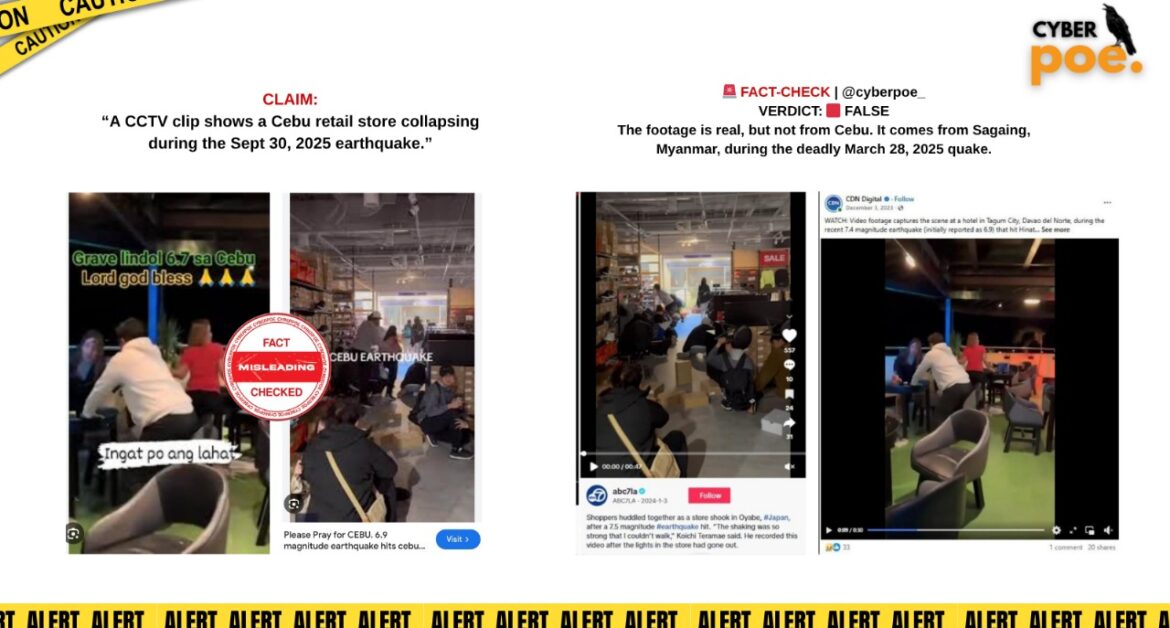
In the aftermath of the magnitude-6.9 earthquake that struck Cebu, Philippines, on September 30, 2025 killing at least 72 people social media platforms were flooded with dramatic videos claiming to show the destruction in real time. Posts on Facebook, TikTok, and X (formerly Twitter) circulated clips of bars, retail stores, and shops violently shaking, with captions such as “Boycott DPWH look at Cebu roads destroyed in the 6.9 earthquake” and “Strongest tremor, everything destroyed in Cebu.” These viral posts quickly amassed thousands of shares, adding to the shock and panic already surrounding the disaster.
However, a closer investigation reveals that none of these viral videos were actually filmed in Cebu. Instead, they were recycled from earlier earthquakes in the Philippines’ Mindanao region (2023) and Japan (2024).
The Context
The Philippines sits on the Pacific “Ring of Fire,” a zone notorious for frequent and often devastating seismic activity. Earthquakes are common, and unfortunately, so is the spread of misinformation during such disasters. In the digital age, the speed of content sharing often outpaces fact-checking, and recycled disaster footage is regularly misattributed to new events.
While the Cebu quake itself was tragic and destructive, online opportunists exploited the moment to amplify shock value by attaching unrelated footage. Such tactics not only misinform the public but also hinder effective disaster response by creating confusion about the scale and location of the damage.
Video Verification
Clip 1: The Tagum City Bar Shaking Mindanao, 2023
One of the most widely shared videos showed a rooftop bar shaking violently as patrons tried to remain calm. A reverse image search traced this footage back to December 2, 2023, when a powerful magnitude-7.4 earthquake struck Hinatuan in Surigao del Sur. Local news outlets such as CDN Digital and SunStar Davao confirmed that the video was filmed in a hotel bar in Tagum City, Davao del Norte. The viral Cebu clip was directly lifted from this 2023 footage, proving it was unrelated to the 2025 disaster.
Clip 2: Shelves Swaying in a Store Japan, 2024
Another viral video depicted shoppers running for safety as store shelves swayed and goods tumbled to the floor. This footage was not from Cebu but from Japan’s devastating New Year’s Day earthquake on January 1, 2024. Major outlets including ABC7LA and the Noto Earthquake & Tsunami Archive published the same video, confirming that it was recorded in Oyabe, Toyama Prefecture, during the magnitude-7.5 quake that killed more than 400 people.
Why It Matters
The misuse of old disaster footage is not just harmless exaggeration it can have dangerous consequences. In moments of crisis, accurate information is essential for guiding emergency responses and maintaining public trust. Misinformation, on the other hand, can fuel unnecessary panic, divert attention away from verified rescue efforts, and spread confusion about the actual scale of the disaster.
By falsely linking unrelated videos from Mindanao, Japan, and Myanmar to Cebu, online actors created a distorted narrative of the quake’s impact. Such practices undermine the credibility of real reporting and disrespect the victims of both the Cebu quake and the earlier tragedies whose footage was misappropriated.
The Verified Reality
The Cebu earthquake of September 30, 2025, was indeed powerful and deadly, claiming at least 72 lives and causing widespread destruction. But the viral videos do not depict Cebu at all. Instead, they originate from:
- Mindanao, Philippines (2023 quake in Tagum City)
- Japan (2024 New Year’s Day quake in Toyama Prefecture)
None of these videos have any connection to the Cebu disaster, despite being circulated as real footage from the event.
Verdict
❌ False / Misleading
The viral clips being shared online are not from the Cebu earthquake of 2025. They are recycled from unrelated disasters in the Philippines and Japan.
At CyberPoe, our reminder is simple: Disasters demand verified information, not sensationalism. Always double-check original sources and, when in doubt, run a reverse image search before sharing content.
CyberPoe | The Anti-Propaganda Frontline