Project Info
Category
Date
The Truth Behind Claims of U.S. Tariff Exemptions for ASEAN States
Introduction
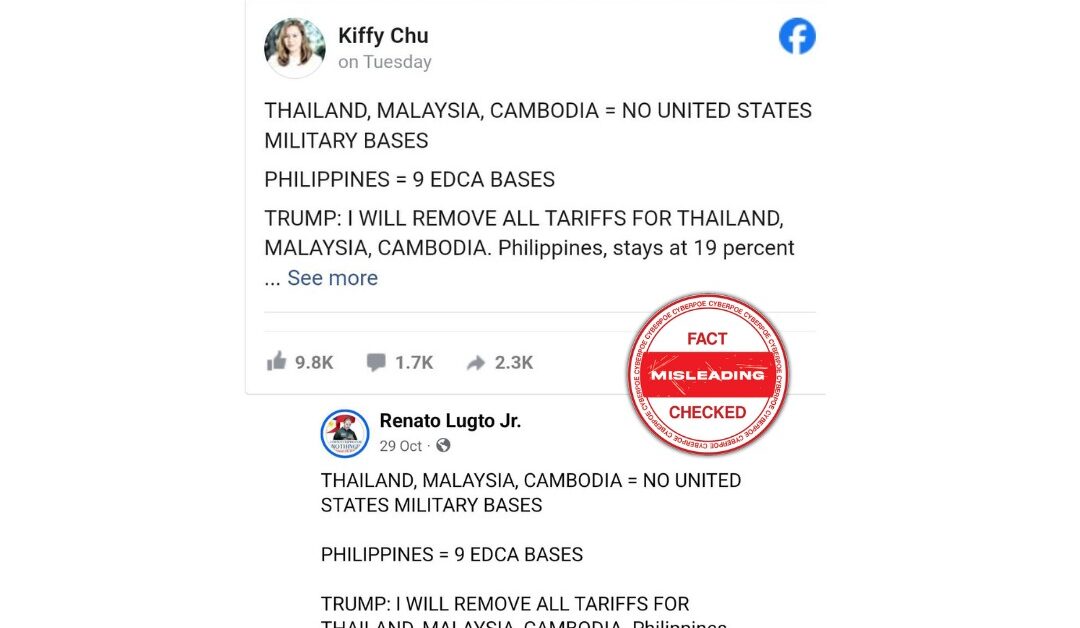
A widely circulated narrative on social media alleges that former U.S. President Donald Trump removed all tariffs for Thailand, Malaysia, and Cambodia following the ASEAN Summit, while maintaining a 19% tariff rate on Philippine goods. The claim has generated debate, particularly in Manila, where commentators framed it as evidence of Washington sidelining the Philippines despite security cooperation under the Enhanced Defense Cooperation Agreement (EDCA). A detailed review of official documents, trade releases, and diplomatic communiqués reveals that this narrative is fundamentally false and rooted in a misreading of recent sector-specific agreements.
Origins of the False Narrative
The controversy emerged from partisan accounts interpreting post-Summit announcements as sweeping trade concessions. These posts portrayed the ASEAN discussions as resulting in full tariff removal for three regional states Thailand, Malaysia, and Cambodia—while the Philippines allegedly received nothing. This framing quickly spread across digital platforms, amplified by political influencers who framed the issue as a diplomatic slight. Examination of the actual U.S. announcements demonstrates that none of the three countries received blanket preferential treatment, nor were their baseline tariff structures altered. The original tariff matrix remains intact, contradicting the viral version of events.
Scope and Reality of the Agreements
The United States signed narrowly tailored agreements with Malaysia and Cambodia focusing on strategic goods, critical minerals, and specific investment channels. These arrangements were limited in scale, technical in nature, and did not amend the underlying tariff system that governs U.S. imports from these countries. The 19% baseline tariff band applied to their exports remains unchanged. Thailand’s engagement was similarly narrow, consisting of exemptions linked to a framework agreement covering a restricted set of Thai export categories. The Thai arrangement is not a free-trade pact and does not resemble comprehensive tariff liberalisation. The misconception stems from selective interpretation of sectoral exemptions, which were never intended to apply across all product lines.
Expert Interpretation and Broader Context
Trade specialists summarise these developments as minor, sector-specific amendments rather than any form of large-scale tariff reform. Only Singapore holds a markedly different tariff position with the United States, benefiting from longstanding high-value cooperation that places its average rate near 10%. Other ASEAN states, including Laos and Myanmar, remain in significantly higher tariff bands exceeding 40%, underscoring the diversity of U.S. trade relationships in the region. The idea that Malaysia, Thailand, and Cambodia suddenly achieved zero-tariff access contrasts sharply with this established and highly differentiated landscape.
Position of the Philippines in U.S. Trade Policy
Contrary to the narrative circulating online, the Philippines was neither sidelined nor penalised. Earlier in 2025, Washington lowered tariffs on a select group of Philippine goods by one percent following a bilateral meeting between Trump and President Ferdinand Marcos Jr. Trade officials in Manila have stated repeatedly that further negotiations are in progress and that tariff discussions operate independently of security agreements such as EDCA. The assumption that military basing arrangements directly influence tariff rates reflects a misunderstanding of how U.S. trade architecture is structured. Trade reform typically requires congressional involvement, lengthy negotiation cycles, and sector-specific legal review none of which align with claims of rapid, unilateral tariff elimination.
Conclusion
The assertion that Thailand, Malaysia, and Cambodia received blanket tariff exemptions from the United States, while the Philippines continued to face a uniform 19% tariff, does not withstand scrutiny. The agreements announced after the ASEAN Summit were targeted, limited, and narrowly technical, with no resemblance to comprehensive free-trade access. The viral comparison that sparked the controversy is a product of selective framing rather than accurate interpretation of trade policy. The factual record shows no evidence of discrimination against the Philippines and no sweeping advantage granted to its regional neighbours. The narrative remains a misleading distortion of modest adjustments that fall far short of the dramatic claims circulating online.
CyberPoe | The Anti-Propaganda Frontline 🌍