
Project Info
Category
Date
The Truth Behind the Virtual Rahul Gandhi “Mystery Women”
Introduction
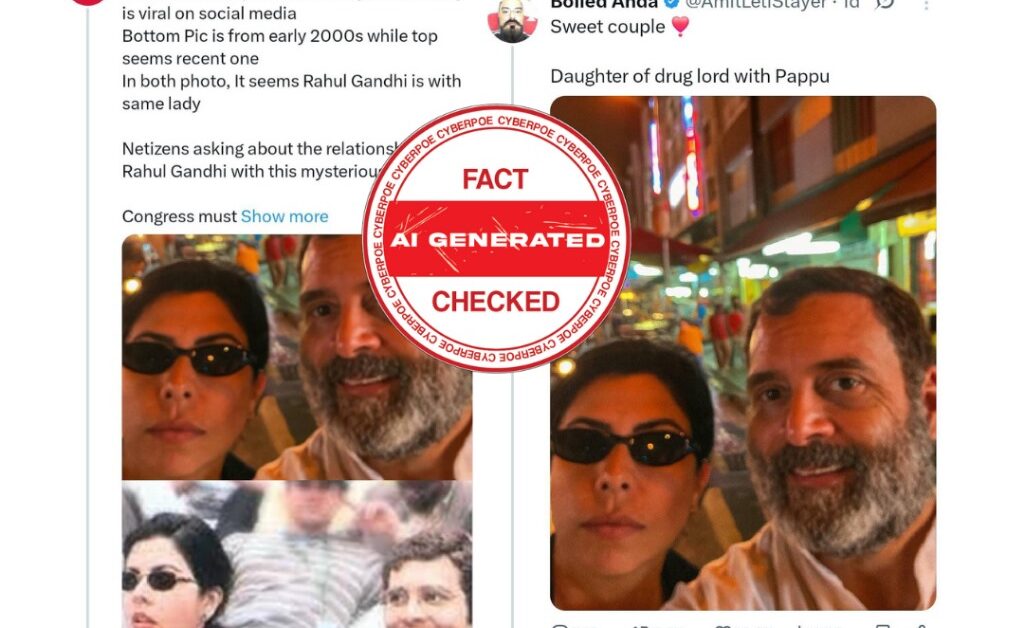
A series of viral posts across X, Facebook, and WhatsApp have resurfaced alleging that Congress leader Rahul Gandhi was spotted with the same “mystery woman” in the early 2000s and again in recent years. The implication, strongly suggested by captions and commentary, is that Gandhi maintained a hidden personal relationship spanning two decades. The photos have spread rapidly, gaining traction among political critics and fueling speculation. Yet, when examined closely, the claim proves to be false. The images are digitally manipulated and consistent with a long-standing pattern of disinformation campaigns that target prominent Indian political figures.
The Viral Photos and Their Initial Reception
The images circulating online purport to show Gandhi in casual settings with an unidentified woman. One image is claimed to be from the early 2000s, while another is presented as a recent picture. On the surface, the photos appear plausible, especially given Gandhi’s frequent appearances in informal and travel contexts. However, the key point that triggered suspicion among observers is that the woman in both images looks exactly the same across two decades. Her facial features, hairstyle, and apparent age remain unchanged, which is biologically implausible and raises the first red flag that the images may not be authentic.
Expert Analysis of the Images
Professional analysis begins with close visual inspection. The alleged “recent” photo shows inconsistencies in lighting and shading when compared to Gandhi’s appearance. The contours of the woman’s face appear unnaturally sharp against the background, while Gandhi’s face blends more naturally with the environment. Image analysts point out that this is a common result of digital superimposition, where an imported face or figure does not fully integrate with the existing photograph.
Moreover, magnification of the photos reveals telltale signs of manipulation. Blending lines around the woman’s chin and neck show pixel-level distortions, while the shadows on her features do not align with the light source illuminating Gandhi. These anomalies indicate the use of editing software or AI-based tools such as face-swap applications, which have become increasingly sophisticated but still leave behind subtle artifacts detectable upon close scrutiny.
Verification by Independent Fact-Checkers
Independent fact-checking organizations, including Alt News, India TV, and DFRAC, have previously investigated similar viral photos linking Gandhi to unidentified women. Their findings consistently demonstrate that these images are morphed, AI-generated, or otherwise manipulated. In this specific case, reverse image searches link portions of the background and body features to unrelated photos available online, suggesting that only the faces were digitally swapped.
It has been noted that such claims resurface cyclically, often in the run-up to elections or major political developments. The recurrence of the “mystery woman” theme shows that this is not an isolated incident but rather part of a deliberate strategy to use fabricated personal-life scandals as political ammunition.
Absence of Corroborating Evidence
A key principle in fact-checking is the search for corroborating evidence. Authentic photographs of public figures are usually available across multiple credible sources, especially when spanning decades. Yet, in this case, no mainstream media outlets, photo archives, or parliamentary records contain these images. They exist solely on social media platforms and anonymous WhatsApp forwards, a clear indication that they do not originate from legitimate public documentation. The absence of official or credible acknowledgment further undermines the claim’s authenticity.
The Role of Digital Manipulation in Political Disinformation
The Rahul Gandhi “mystery woman” photos fit into a larger trend of digital manipulation being weaponized in political contexts. With the increasing availability of AI-driven editing tools, creating believable but fake visuals has become easier than ever. Such tools allow disinformation actors to fabricate personal narratives that resonate emotionally with audiences, often proving more viral than fact-based political debate. In India, Gandhi has been a repeated target of such campaigns, reflecting efforts to undermine his credibility through spectacle rather than substantive critique.
This tactic works by exploiting the human tendency to respond strongly to personal scandal. When political figures are framed in compromising or mysterious situations, the controversy spreads rapidly regardless of its truth. Even when debunked, the initial impression lingers, a phenomenon known in media studies as the “continued influence effect.” Thus, manipulated images are powerful tools in the arsenal of those seeking to discredit political opponents.
Why the Claim is False
After thorough examination, the conclusion is clear. The images suggesting Rahul Gandhi has been photographed with the same woman across a twenty-year span are digitally manipulated. They exhibit technical flaws such as unnatural blending, inconsistent lighting, and pixel distortions. Independent fact-checkers have traced similar images to manipulated sources and confirmed the absence of credible supporting evidence. Most importantly, the implausibility of unchanged physical appearance over decades exposes the claim as manufactured.
Conclusion
The viral photos of Rahul Gandhi with a “mystery woman” are not authentic, but rather products of digital fakery designed to generate controversy. They represent a broader pattern of disinformation that exploits AI and image manipulation tools to target political figures with fabricated personal-life scandals. No credible evidence supports the narrative, and credible fact-checkers have confirmed the manipulation.
This episode underscores the need for digital literacy and skepticism in the age of viral misinformation. Social media users must learn to question sensational visuals, demand corroboration from credible outlets, and recognize the strategies employed by disinformation actors. At CyberPoe, our final word remains consistent: the claim is false, the photos are manipulated, and the narrative is a deliberate attempt to mislead. Always verify before sharing.
CyberPoe | The Anti-Propaganda Frontline