
Project Info
Category
Date
The Viral Claim That Japan Is Revoking 42,000 Visas From Chinese Nationals Is Entirely False
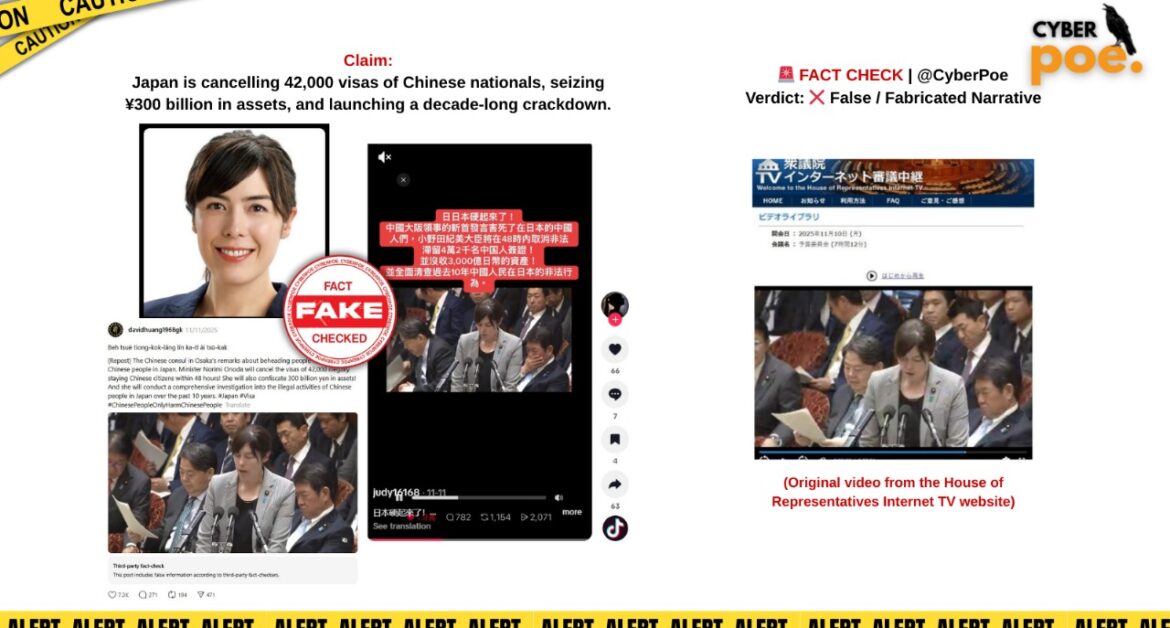
A video clip featuring Japan’s Minister Kimi Onoda has recently triggered a wave of sensational claims across social media platforms, particularly on Threads, TikTok, Facebook, and Instagram. The posts allege that Japan has begun a sweeping crackdown on Chinese nationals, including the cancellation of 42,000 visas within 48 hours, the confiscation of assets worth 300 billion yen, and the launch of a decade-long investigation targeting Chinese residents living or operating “illegally” in the country. The narrative spread rapidly, feeding into the heightened tensions between Tokyo and Beijing, and was amplified by accounts eager to frame Japan as taking an unprecedented hard line on foreign nationals. However, a closer examination reveals a completely different reality, as the claims do not align with the contents of the video, official government policy, or actual immigration statistics.
How the Misleading Narrative Emerged
The misinformation originated from a parliamentary clip taken from Japan’s House of Representatives Budget Committee session on November 10. The video features Minister Onoda responding to questions from lawmakers, and in its authentic context, the topic under discussion was related to national security concerns surrounding the purchase of land by foreign nationals. The viral posts isolate only a few seconds of the footage, stripping away the surrounding context and pairing the visuals with fabricated subtitles and exaggerated captions. The doctored messaging suggests that Onoda announced a mass expulsion effort targeted specifically at Chinese citizens, presenting the minister’s remarks as if they were part of an immigration enforcement directive. This reinterpretation spread swiftly, because many viewers encountered the clip without any connection to the official parliamentary transcript or broadcast, allowing the manipulated narrative to dominate public perception.
What the Parliamentary Clip Actually Addresses
The original session, available on Japan’s official Diet video archive, clarifies the true substance of the minister’s remarks. At approximately six hours and twenty-nine minutes into the session, Minister Onoda discusses land ownership regulations, explaining that the Japanese government is reviewing existing frameworks and considering adjustments to ensure national security is preserved in areas of strategic importance. She notes concerns surrounding the purchase of land by foreign nationals in sensitive regions, such as those near military installations or critical infrastructure. Her comments revolve around policy studies, potential regulatory strengthening, and the safeguarding of territorial control. Notably, there is no mention whatsoever of visas, deportations, asset seizures, or investigations into Chinese nationals. The entire parliamentary exchange confines itself to legal and administrative issues concerning land ownership, rather than immigration enforcement or residency status.
Why the Viral Numbers Collapse Under Scrutiny
The figure of 42,000 visa cancellations is presented in the viral posts as if it were an official statistic, but Japan’s immigration data paints a completely different picture. The Immigration Services Agency’s most recent public figures show that around 6,252 Chinese nationals were overstaying visas as of July 2025. This number is far from the inflated 42,000 figure used in the false narrative and in no way reflects any mass enforcement operation. There have been no press briefings, policy memos, cabinet statements, or immigration notices suggesting a wave of expulsions or an emergency directive targeting Chinese residents. The idea that Japan would confiscate 300 billion yen worth of assets without any legal foundation or due process contradicts the country’s regulatory structure and would require extraordinary parliamentary scrutiny. No such process exists, nor has one been proposed.
The Political Climate That Enabled the Rumour
The falsehood gained traction during a period of diplomatic friction between Japan and China. A controversial online post by China’s Consul General in Osaka triggered public backlash in Japan, followed by sharp comments from Prime Minister Sanae Takaichi regarding foreign interference and national sovereignty. This charged environment created a fertile backdrop for exaggerated claims to flourish, especially among users eager to interpret Japan’s internal debates as decisive action against perceived external threats. Social media algorithms amplified the posts further because of their dramatic framing, emotional appeal, and the geopolitical rivalry narrative they invoked. The combination of selective editing, sensational claims, and a tense bilateral climate created a perfect storm for disinformation to spread rapidly.
What the Evidence Clearly Shows
The comprehensive review conducted by CyberPoe confirms that the entire narrative of mass visa cancellations is unsupported by any factual basis. Minister Onoda’s comments were focused exclusively on land ownership regulation, not immigration policy. There is no legal directive that targets Chinese nationals, no emergency visa policy, and no state-ordered asset seizure operation. The video used in the viral posts is genuine, but its meaning has been distorted through deliberate misinterpretation and misleading overlays. The core allegations whether relating to 42,000 cancelled visas, billion-yen confiscations, or decade-long investigations do not appear in any official record or credible news source, nor are they consistent with Japan’s governance processes.
Conclusion
The claim that Japan has initiated mass visa cancellations targeting Chinese nationals is entirely false. The narrative was constructed through selective editing, misinformation, and the exploitation of ongoing political sensitivities. The evidence from parliamentary records to immigration statistics shows no connection between the minister’s remarks and the sweeping allegations made in viral posts. Japan’s government has not launched any deportation programme, asset seizure operation, or targeted investigation of Chinese residents. What circulated online was a manipulated interpretation of routine parliamentary debate, repackaged into a dramatic but wholly fictional narrative.
CyberPoe | The Anti-Propaganda Frontline 🌍