The Viral Claim That Misled Thousands
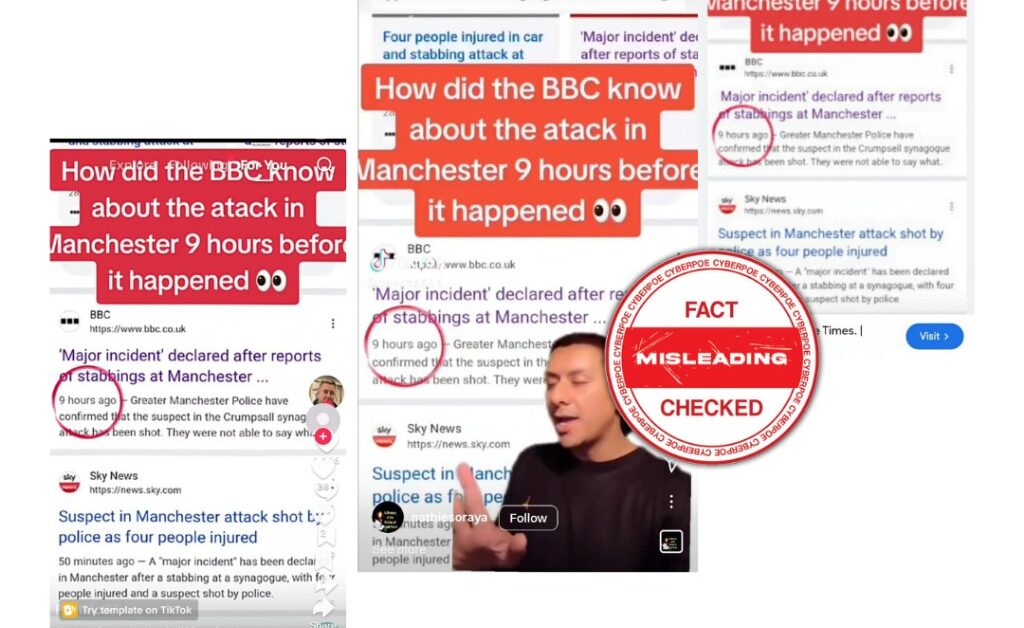
A viral post circulating across Facebook, X (formerly Twitter), and Telegram claims that the BBC published news about the Manchester synagogue attack nine hours before it actually happened. The post features a screenshot of a Google search result showing a BBC article timestamped hours before the tragic incident, with captions such as “BBC posted about the Manchester attack 9 hours before it happened?! Wtf?!”
The image quickly gained traction, feeding into long-standing conspiracy narratives that accuse mainstream media of “foreknowledge” or “scripted reporting.” Within hours, the claim became a trending topic in disinformation circles, falsely suggesting that the BBC was complicit in manipulating news events.
However, a detailed investigation by CyberPoe’s OSINT and verification team found the claim to be entirely false, rooted in a Google timestamp error rather than any editorial malpractice by the BBC.
What Actually Happened: The Real Timeline of Events
The verified timeline of the Manchester synagogue attack paints a very different picture from the viral claims.
At 9:31 a.m. BST on October 2, 2025, Greater Manchester Police received an emergency call reporting an armed attack at the Heaton Park Hebrew Congregation Synagogue in Crumpsall. The attacker, identified as Jihad Al Shamie, tragically killed two worshippers Adrian Daulby (53) and Melvin Cravitz (66) before being shot dead by police officers responding to the scene.
Roughly 50 minutes later, at 10:21 a.m. BST, BBC News published its first live update on the incident through its Live Blog service, followed by a push notification at 10:26 a.m. BST, confirming police presence and casualties.
A BBC spokesperson later confirmed the sequence of reporting, stating:
“BBC News started reporting the unfolding events of the attack at 10:21 BST several minutes after we became aware that police were dealing with an incident at the synagogue.”
Archived versions of BBC’s live blog, verified by CyberPoe through timestamp tracking and digital archive tools, clearly show the first entry timestamped 10:20–10:21 a.m. BST, fully consistent with official police reports.
There is no evidence of any article or headline published prior to the attack.
Why the Timestamp Looked Wrong: The Google Metadata Glitch
The viral claim originated not from BBC’s website, but from a Google Search timestamp error a well-documented technical issue that can misrepresent the publication time of webpages.
According to Google’s Search Console Help Center, timestamp discrepancies can occur when:
- The page contains multiple date references or time zones.
- Structured data (metadata) on the webpage lists multiple “datePublished” or “dateModified” entries.
- Cached or archived versions of the page are indexed by Google at earlier times.
A Google spokesperson addressed the issue in a prior clarification, explaining:
“Timestamps in search results may be inaccurate if the website lists an incorrect time zone or includes multiple dates on the same page.”
In this specific case, BBC’s live blog likely contained multiple date entries due to rolling updates a standard practice in live coverage. When Google indexed an older cached version, it displayed the earlier timestamp in search results, creating the illusion of pre-reporting.
CyberPoe’s verification found that when the same BBC article is accessed directly without relying on Google’s cached snippet the timestamp accurately shows 10:21 a.m. BST, confirming post-event publication.
BBC’s Official Response and Editorial Integrity
Following the viral claim, BBC News reaffirmed that its coverage began only after police were alerted to the synagogue attack. The newsroom’s internal workflow aligns with standard journalistic verification practices: receiving information from emergency services, confirming with on-ground reporters, and then publishing updates.
The BBC’s spokesperson emphasized:
“Our reporting began once we confirmed the ongoing police response. Any suggestion that the BBC had advance knowledge of the attack is categorically false.”
CyberPoe’s analysis of BBC’s live blog archive shows consistent editorial timestamps across all updates, reaffirming that the first post appeared roughly 50 minutes after the first police alert leaving no room for pre-event publication or manipulation.
Disinformation Tactics: Exploiting Technical Glitches
This is not the first time timestamp errors have been exploited to push false narratives. Disinformation networks often seize upon such technical irregularities like metadata bugs, caching errors, or reposted content to frame conspiratorial stories that undermine media credibility.
By misrepresenting a search engine display bug as a “smoking gun,” such narratives aim to erode public trust in independent journalism, fuel anti-media sentiment, and distract from verified facts about real-world tragedies.
In this instance, the claim about BBC’s early reporting is not just misleading it’s a deliberate manipulation of context, using a glitch to promote the illusion of conspiracy.
Why This Fact-Check Matters
In an era where digital misinformation spreads faster than official investigations, fact-checking technical claims has become crucial. Screenshots especially those taken from Google or social platforms can be deceptive when stripped of context.
The Manchester synagogue attack was a tragic event, and using it to spread conspiracy theories dishonors the victims and misleads the public. Fact-checking such claims is not merely about defending a media organization it’s about preserving public trust in verifiable truth.
CyberPoe’s Final Assessment
After reviewing all available evidence including police records, BBC archives, and Google metadata behavior CyberPoe concludes that the claim is false.
Police Alert: 9:31 a.m. BST
BBC First Report: 10:21 a.m. BST
Cause of Misinformation: Google timestamp error in search result snippet
The viral claim suggesting that BBC reported on the attack “nine hours before” it happened is entirely baseless and technically explainable.
Claim Rating: 🟥 MISLEADING
Reason: Misinterpretation of a Google timestamp caused by cached metadata.
The CyberPoe Takeaway
This case is a textbook example of how misinformation spreads through partial evidence and technical ignorance. Every viral screenshot should be questioned every timestamp, cross-checked.
Stay skeptical. Verify before you share.
Follow @CyberPoe_ for daily, OSINT-based investigations into misinformation, propaganda, and cyber deception.
CyberPoe | The Anti-Propaganda Frontline