Project Info
Category
Date
Trump’s Wind Turbine Post and the Misidentified Bird Image
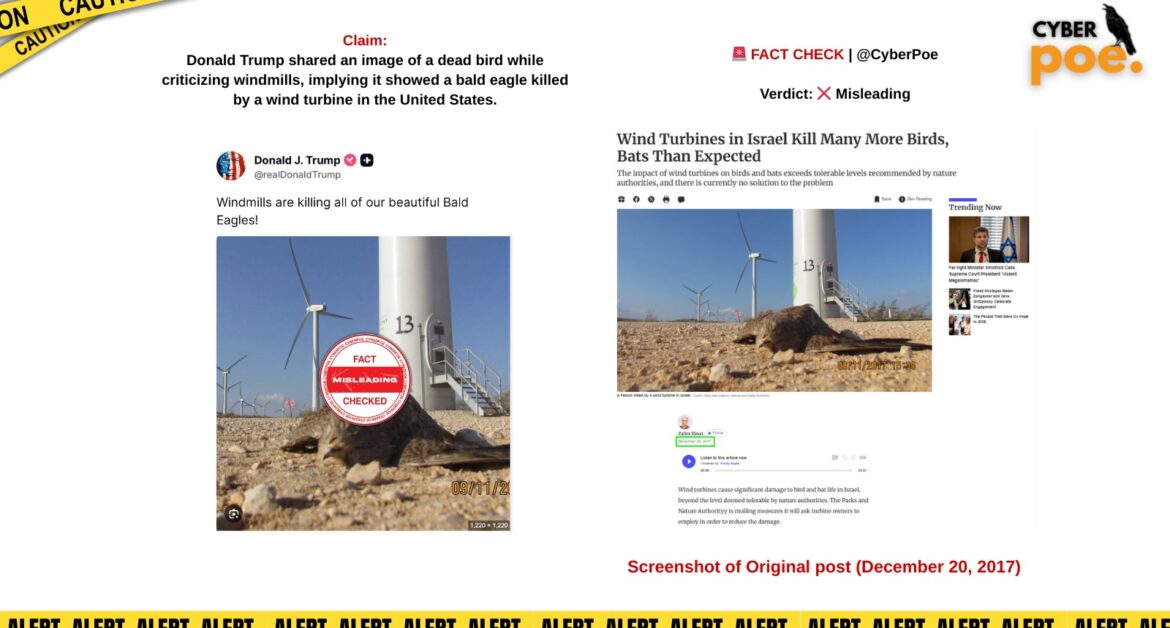
A recent social media post by former U.S. President Donald Trump reignited debate over wind energy after he shared an image of a dead bird while criticizing windmills. The post strongly implied that the bird shown was a bald eagle killed by a wind turbine in the United States. Given the symbolic importance of the bald eagle and the sensitivity of environmental policy debates, the image quickly gained traction online and was cited as visual “proof” of wind energy’s harm to wildlife. A closer examination, however, shows that the claim rests on a misidentified and miscontextualized photograph.
Origin of the Viral Image
CyberPoe’s verification traced the image back to its original source through reverse image searches and archival media records. The photograph first appeared in a 2017 report published by Haaretz, an Israeli newspaper[1], which documented bird fatalities near the Sirin wind farm in northern Israel. The image was never associated with the United States, nor was it presented as evidence of bald eagle deaths. Its reuse years later, stripped of geographic and contextual information, fundamentally altered its meaning.
Species Identification and Scientific Reality
Wildlife experts and ornithologists familiar with the image have consistently identified the bird as either a lanner falcon or a common kestrel. Both species are raptors native to the Middle East and parts of Europe. They are significantly smaller than bald eagles and have distinct physical characteristics, including different wing shapes, plumage patterns, and coloration. No credible conservation authority, ornithological database, or wildlife agency has ever classified the bird in the image as a bald eagle. The misidentification appears to stem from visual assumption rather than scientific assessment.
How Context Was Lost and Misused
When Donald Trump shared the image, it was presented without any reference to its origin, location, or species identification. This lack of context allowed the photo to be interpreted as evidence from within the United States and to be emotionally linked to the national symbol of the bald eagle. Such visual framing can be powerful, especially on social media, but it also increases the risk of misinformation when images are detached from their original reporting purpose.
The Broader Issue of Wind Turbines and Bird Deaths
Concerns about wind turbines affecting bird populations are not imaginary. According to estimates from the U.S. Fish and Wildlife Service, wind turbines in the United States are responsible for approximately 140,000 to 679,000 bird deaths annually.[1] These figures include a variety of species, including some raptors. However, bald eagle fatalities linked to wind energy remain comparatively rare and are subject to strict federal oversight under the Bald and Golden Eagle Protection Act. Any confirmed eagle death typically triggers investigation and potential penalties.
Environmental scientists also emphasize that wind turbines account for a small fraction of overall human-related bird mortality. Buildings, vehicles, power lines, and domestic cats collectively cause millions of bird deaths each year. This broader context is essential for informed policy discussions but is often missing from viral posts that rely on emotionally charged imagery.
Political Reaction and Online Response
The misidentified image quickly drew criticism from journalists, conservationists, and political figures. Officials from California Governor Gavin Newsom’s office publicly pointed out that the bird was neither a bald eagle nor from the United States. Social media users and experts highlighted the irony of using an Israeli raptor image in an American energy debate, while others mocked the lack of basic fact-checking. Supporters of Trump argued that the broader concern about wind turbines harming birds remains valid, but fact-checkers stressed that arguments lose credibility when supported by incorrect evidence.
Why Accuracy Matters in Environmental Debate
Environmental policy debates require precision, especially when they intersect with wildlife protection laws and national symbolism. Misusing images not only misinforms the public but also undermines legitimate concerns that deserve serious attention. When inaccurate visuals are used to support policy positions, they distract from evidence-based discussions and can polarize audiences unnecessarily.
Conclusion
The image shared by Donald Trump does not depict a bald eagle and does not originate from a U.S. wind farm. It is a photograph from a 2017 Israeli news report showing a different raptor species entirely. While bird deaths associated with wind turbines are a real and documented issue, this particular image does not support claims about bald eagles or U.S. renewable energy infrastructure. Accurate sourcing, proper identification, and contextual integrity remain essential for credible public discourse. CyberPoe concludes that the claim is misleading due to misidentification and misuse of an out-of-context image.
CyberPoe | The Anti-Propaganda Frontline 🌍