Project Info
Category
Date
Viral “Abandoned Baby in Bayugan” Claim Uses Old Photos From 2020
Introduction
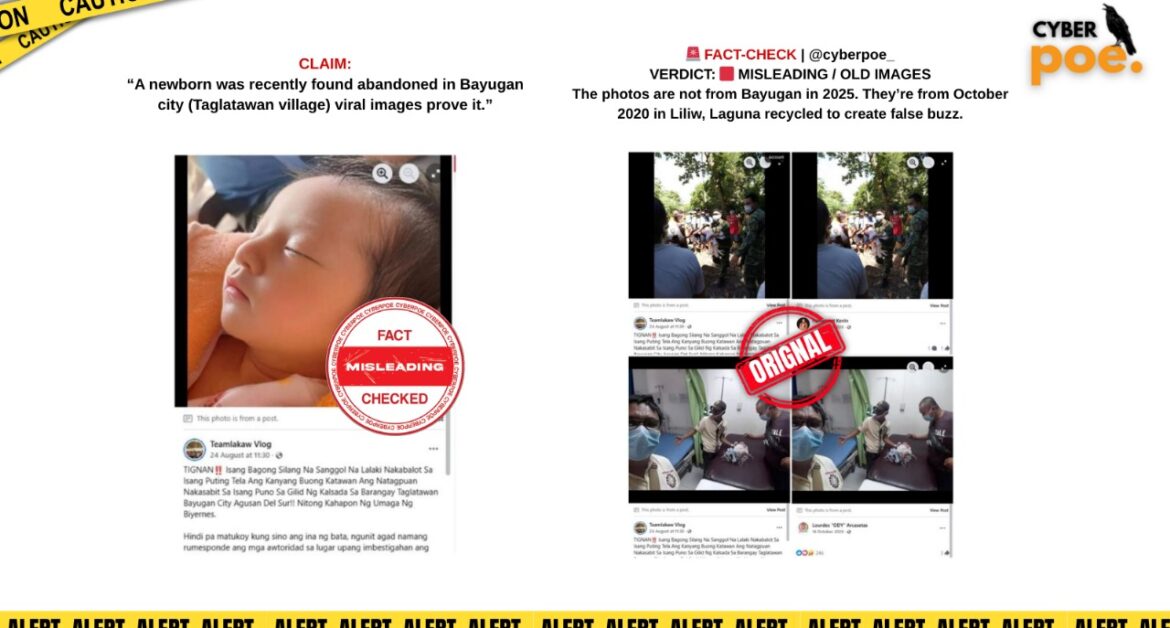
In late August 2025, social media platforms across the Philippines were flooded with posts claiming that a newborn had been discovered abandoned in Bayugan City, Agusan del Sur. The posts, many of which circulated on Facebook and TikTok, included a collage of disturbing images showing an infant wrapped in cloth and being tended to by bystanders. These images quickly went viral, accompanied by captions insisting they were proof of a new case of child abandonment in Taglatawan village. However, a detailed investigation reveals that the claim is misleading. The images are not recent, nor are they from Bayugan. Instead, they originate from an entirely different case in October 2020 in the town of Liliw, Laguna, over 1,000 kilometers away.
Official Responses from Authorities
Bayugan City’s local government was quick to respond to the viral rumors. On August 29, 2025, officials released a statement labeling the circulating posts as “false and baseless,” urging residents not to spread unverified information. This denial was reinforced by the Philippines’ National Authority for Child Care (NACC), which condemned the misuse of old images of foundlings for the purpose of social media engagement. In an August 27 statement, the NACC described the practice as harmful, exploitative, and disrespectful to the dignity of the child, emphasizing that such false narratives divert public attention from real child protection issues.
Tracing the Origins of the Images
To verify the authenticity of the photos, reverse image searches were conducted on the viral collage. The results clearly point to October 16, 2020, when a newborn was discovered abandoned in Liliw, Laguna. At the time, local broadcasters and officials, including the town’s then-mayor, shared the images on Facebook to document the incident. National news outlets such as News5 and GMA also reported on the case using the same photographs. One of the close-up images included in the 2025 viral collage even appeared on a Vietnamese news site in 2021, further proving that the visuals have circulated internationally for years and are in no way connected to Bayugan.
How the Disinformation Spread
The recycling of old photographs with new captions is a common disinformation tactic on social media. In this case, the Bayugan narrative gained traction because it tapped into strong emotional responses the sight of an abandoned newborn is guaranteed to provoke outrage, sympathy, and widespread sharing. Unfortunately, this pattern is not unique. Across Southeast Asia, social media users have repeatedly been misled by old or out-of-context images of vulnerable children, which are repackaged as breaking news to generate clicks, attention, and viral engagement.
The Broader Impact of False Narratives
Beyond misleading the public, the circulation of these manipulated narratives has serious social consequences. First, it creates unnecessary panic and confusion within communities, particularly in small towns where rumors can spread rapidly. Second, it exploits the vulnerability of real children whose images are shared without context or consent. Third, it undermines legitimate child welfare processes. When communities are distracted by fake incidents, authorities are forced to spend valuable resources debunking false claims instead of focusing on actual cases of neglect and abandonment. As the NACC noted in its condemnation, this cycle is abusive not only to the children involved but also to the wider public who deserve accurate information.
How the Verification Was Done
The fact-checking process involved several steps. Reverse image searches were carried out using key photographs from the viral collage, leading to their original appearance in 2020 posts from Laguna. These findings were cross-checked with archived local news reports that confirmed the date and location of the incident. Official statements from Bayugan City officials and the NACC further clarified that no such recent discovery had taken place in Bayugan. By aligning these three layers of verification image tracing, archival research, and official confirmation it became evident that the 2025 claim was entirely fabricated.
Conclusion
The claim that a newborn was recently discovered abandoned in Bayugan City is false. The images used to support this narrative are recycled from a 2020 incident in Liliw, Laguna, and have been repeatedly reused online in misleading contexts. Local authorities and national child welfare institutions have debunked the claim, highlighting the dangers of spreading unverified content. This case is another example of how emotional imagery can be weaponized to mislead audiences and manipulate online conversations.
At CyberPoe, we emphasize the importance of verification before sharing. Old images should never be repurposed to create false narratives, especially when they involve vulnerable children. As this case demonstrates, disinformation not only spreads confusion but also exploits those who are least able to protect themselves. The public is urged to practice digital responsibility: always verify, never assume.
CyberPoe | The Anti-Propaganda Frontline 🌍