Project Info
Category
Date
Viral Bridge-Collapse Video Miscaptioned as Indonesian Disaster Footage
Introduction
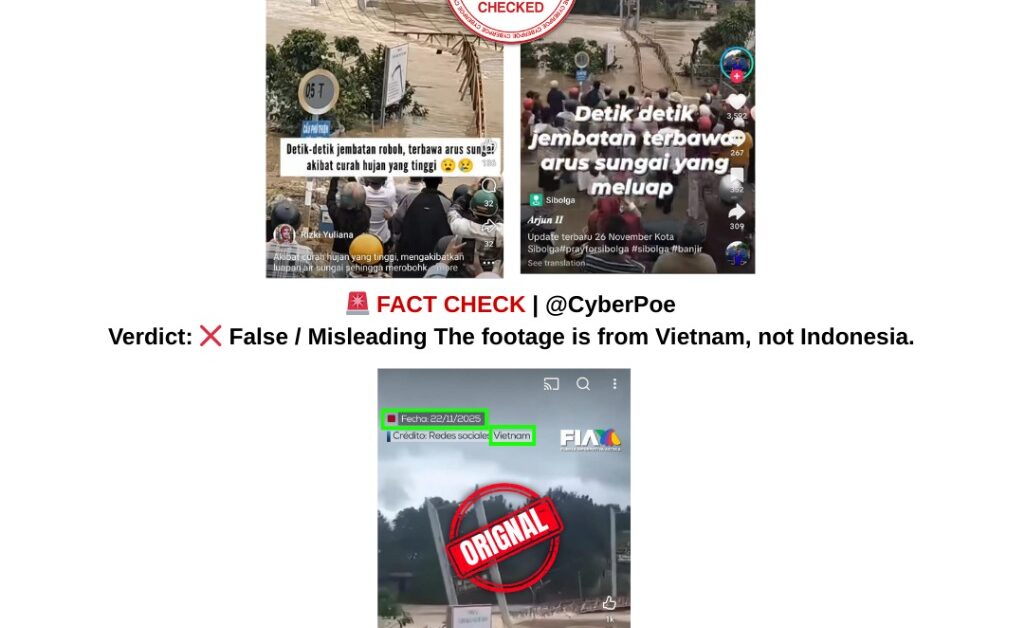
As Indonesia grappled with one of its deadliest flood seasons in recent years, social media platforms became saturated with emotional testimonies, raw images of destruction, and pleas for help. In the midst of this heightened environment, a dramatic video emerged from Tiktok [1]and Facebook[2] claiming to show a suspension bridge in Sibolga, Sumatra collapsing under the pressure of extreme river overflow. The timing of the video’s circulation paired with the public’s desperation for real-time updates allowed it to gain massive traction. However, CyberPoe’s verification reveals that the footage does not originate from Indonesia at all. Instead, it comes from central Vietnam, recorded days earlier during a separate flood crisis. This investigation unpacks how the video was miscaptioned, why it spread so rapidly, and what dangers such misattribution poses during humanitarian emergencies.
Tracing the Origin of the Footage: From Sumatra Claims to Vietnam Reality
The first step in CyberPoe’s verification process involved examining the earliest known upload of the viral clip. While Indonesian users shared the footage on November 26, asserting that it showed a bridge in Sibolga being swept away, a reverse video search revealed evidence to the contrary. The original footage was posted on November 22, 2025[1] four days before the Indonesian version appeared by Vietnamese users documenting a major flood in Lam Dong Province.
The bridge in the video bears unmistakable textual identifiers. Road signage clearly reads the Vietnamese phrase “CẦU PHÚ THIÊN. DÀI 120m. RỘNG 2m,” indicating the name Phu Thien Bridge along with its length and width. These details align precisely with publicly available geographic and administrative data of the Phu Thien suspension bridge, located above the Da Nhim River in Lam Dong, Central Vietnam. Google Street View imagery captured in 2022 provides a near-perfect structural match to the bridge seen collapsing in the viral footage, confirming that the physical characteristics including cable layout, deck size, nearby terrain, and railing type are identical.
This verification places the video firmly and undeniably in Vietnam, not in Indonesia as claimed by the viral posts.
Visual and Geospatial Confirmation Through Independent Sources
Beyond visual identifiers, CyberPoe cross-checked the footage with Vietnamese news reports, which had already begun circulating the original video on national television on November 22. These reports documented the extensive flooding that struck Lam Dong, causing numerous landslides and damaging infrastructure. Several Vietnamese broadcasts presented the bridge collapse from multiple angles, including footage recorded by local residents positioned at different vantage points. The presence of these corroborating angles rules out the possibility of the video being an Indonesian event misreported by Vietnamese media. It reinforces the fact that the structure and terrain captured in the video belong exclusively to the Lam Dong region.
Furthermore, none of the bridges in or near Sibolga, Sumatra resemble the Phu Thien Bridge. Indonesian civil engineering authorities confirmed that while a number of bridges across Sumatra suffered severe strain or partial damage during the catastrophic monsoon, no structure resembling a narrow pedestrian suspension bridge matching Phu Thien’s dimensions collapsed on the date claimed in the viral posts.
Why Indonesia’s Crisis Created a Breeding Ground for Misinformation
To understand why this misattribution was so readily believed, one must consider the scale and emotional weight of Indonesia’s late-November floods. More than 800,000 people were displaced, entire districts were submerged, and over 950 lives were lost, with hundreds more unaccounted for. Public frustration escalated due to limited communication, slow rescue operations, and widespread infrastructural breakdown. In such moments, visual footage becomes a primary channel for conveying urgency and channeling collective grief.
The viral bridge-collapse video played directly into this emotional landscape. Its dramatic visuals swinging cables, collapsing decks, and residents shouting in alarm were interpreted as further evidence of governmental failure. The fact that the clip was real but simply from another country made it even more believable, as the disaster scenario mirrored the unfolding reality in Sumatra.
Misinformation thrives in chaos. The urgency of the moment often leads users to share any compelling content that seems to reflect the scale of the crisis. Algorithms amplify these narratives, pushing emotionally charged posts to massive audiences and overshadowing attempts at correction. This creates a cycle where foreign footage is repeatedly repurposed during domestic emergencies, distorting public understanding of real events.
The Consequences of Misattributed Disaster Footage
Misleading disaster visuals do more than simply misinform. They distort public perception of the crisis’s scale, undermine trust in genuine reports, and fuel political narratives that may not reflect reality. In the case of Indonesia’s floods, the miscaptioned footage amplified anger toward government agencies while simultaneously diverting attention from verified, locally captured documentation that needed visibility for relief mobilization.
False visuals also complicate the work of emergency response units. When misinformation spreads faster than verified updates, it becomes harder for citizens to know which areas are at risk, where assistance is required, and which warnings are authentic. This confusion can prolong the crisis, endanger communities, and hamper collective recovery efforts.
Conclusion: CyberPoe’s Verdict
The viral video claiming to show a bridge in Sibolga collapsing during Indonesia’s November 2025 floods is not from Indonesia. It is real footage, but from Vietnam’s Phu Thien Bridge, recorded on November 22 during a separate natural disaster. Misattributing foreign footage during an active domestic crisis is misleading, harmful, and contributes to the broader problem of crisis-era misinformation. CyberPoe continues to urge users to verify sources before sharing dramatic visuals, especially in moments when factual accuracy directly impacts public safety.
CyberPoe | The Anti-Propaganda Frontline 🌍