Project Info
Category
Date
Viral Claims of Nicolás Maduro’s Capture and a U.S. Military Operation in Venezuela
The Viral Narrative and Its Rapid Spread
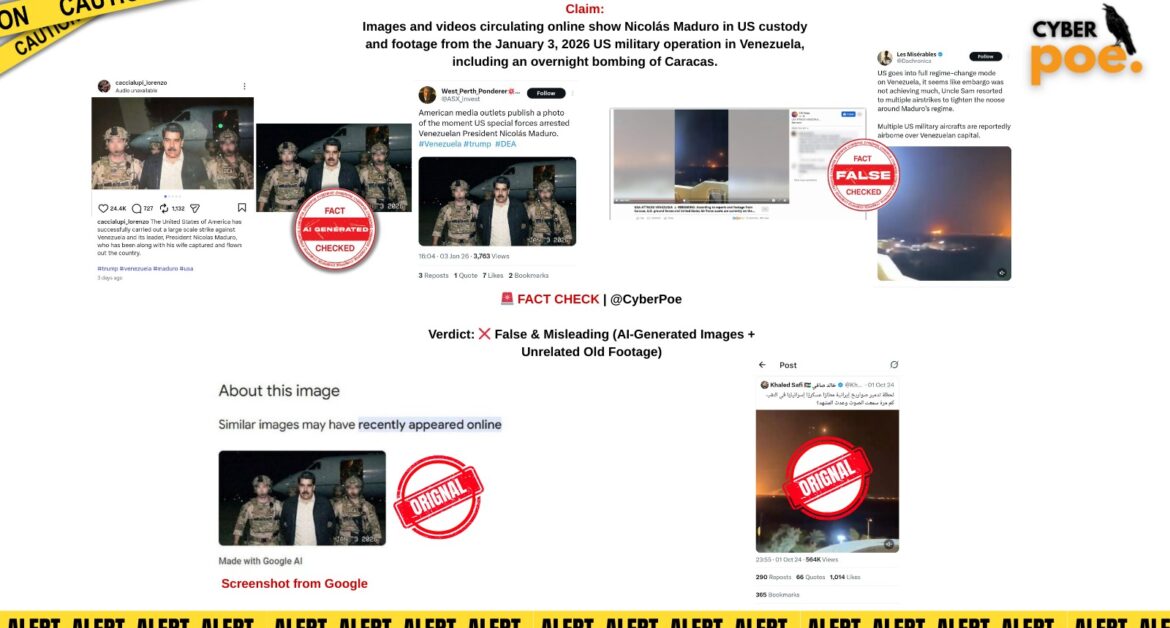
In early January 2026, social media platforms Including X[1], Instagram[2] and Facebook[3] were inundated with dramatic images and videos claiming to show Venezuelan leader Nicolás Maduro in U.S. custody following an overnight military operation in Venezuela. The posts alleged that American Special Forces had carried out a covert raid on January 3, capturing Maduro and his wife, Cilia Flores, and launching aerial bombardments over Caracas. These visuals were presented as leaked or suppressed evidence, often accompanied by sensational captions asserting that mainstream media was hiding the “truth.” In a highly polarized geopolitical environment, the content spread rapidly across X, Facebook, and Telegram, reaching millions within hours.
The emotional weight of the claims played a significant role in their virality. Years of strained relations between Washington and Caracas made the scenario feel plausible to many audiences. The inclusion of arrest imagery and night-time explosions reinforced the perception of authenticity, even though no official confirmation accompanied the visuals at the time of their circulation.
CyberPoe’s Collective Verification Process
CyberPoe conducted a comprehensive, collective fact-check of the most widely shared images and videos associated with these claims. This verification process combined reverse image searches, open-source intelligence techniques, timeline analysis, and advanced AI forensic tools. The objective was to determine whether any of the circulating visuals genuinely documented a U.S. military operation in Venezuela or the detention of Nicolás Maduro.
The findings were clear and consistent across multiple verification methods. None of the viral images or videos accurately depict events from January 3, 2026. Instead, they represent a mixture of AI-generated content and unrelated footage taken from entirely different contexts and time periods.
The AI-Generated Image of Maduro in Custody
One of the most prominent visuals purported to show Nicolás Maduro surrounded by U.S. soldiers shortly after his arrest. At first glance, the image appeared realistic enough to convince casual viewers. However, deeper forensic analysis revealed decisive evidence of fabrication. Google’s Gemini system detected a SynthID digital watermark embedded in the image. SynthID is a technology used to invisibly mark content generated or modified by Google’s artificial intelligence models, allowing reliable identification of AI-generated media.
Beyond the watermark, visual inconsistencies further undermined the image’s credibility. Maduro appears noticeably younger, with darker hair and facial features inconsistent with verified photographs of him from 2025 and 2026. Uniform details and lighting also display subtle anomalies commonly associated with synthetic imagery. Taken together, these indicators confirm that the image was not captured during a real military operation but was artificially created.
Misleading Videos of Alleged Bombing in Caracas
Alongside the fake arrest image, several videos circulated claiming to show U.S. airstrikes over Caracas during the alleged operation. CyberPoe traced these clips through reverse video searches and metadata analysis. The results show that the footage predates January 2026 and originates from unrelated conflicts outside Venezuela. In some cases, the videos were previously published[1] years earlier and later re-captioned to fit the new narrative.
Fire and explosion visuals are frequently reused in misinformation campaigns because they evoke fear and urgency. In this instance, recycled footage was deliberately paired with false claims to manufacture the illusion of a large-scale military assault on Venezuela’s capital.
Authentic Imagery and the Contrast With Viral Fakes
An authentic image of Nicolás Maduro was later released through U.S. President Donald Trump’s official Truth Social account. That verified photograph shows Maduro blindfolded and wearing a jumpsuit aboard the USS Iwo Jima. The clear provenance and official sourcing of this image stand in stark contrast to the earlier viral visuals. This comparison further underscores that the widely shared arrest image was synthetic and not part of any official release.
Why This Misinformation Matters
The misuse of AI-generated images and recycled footage during moments of geopolitical tension poses serious risks. Such content can distort public understanding, inflame political sentiments, and undermine trust in credible information sources. When fabricated visuals are accepted as evidence, they can shape narratives faster than facts can catch up, particularly during breaking news situations.
This case also highlights a broader trend in modern disinformation tactics. Advances in generative AI have made it easier to produce convincing fake imagery at scale, blurring the line between reality and fabrication. Without careful verification, even experienced audiences can be misled.
Final Assessment
The claim that viral images and videos show Nicolás Maduro in U.S. custody and footage from a January 3, 2026 U.S. military operation in Venezuela is false and misleading. The arrest image is AI-generated, confirmed by embedded SynthID watermarks and visual inconsistencies, while the alleged bombing videos are unrelated old footage repurposed to deceive. CyberPoe’s verification establishes that none of the circulating visuals reliably document the events they claim to show.
As AI-generated misinformation becomes more sophisticated, this case serves as a reminder of the importance of verifying sources, timelines, and visual evidence before accepting or sharing dramatic claims especially during moments of international crisis.
CyberPoe | The Anti-Propaganda Frontline 🌍