Project Info
Category
Date
Viral Dog-Rescue Images During Thailand’s Floods Are AI-Generated
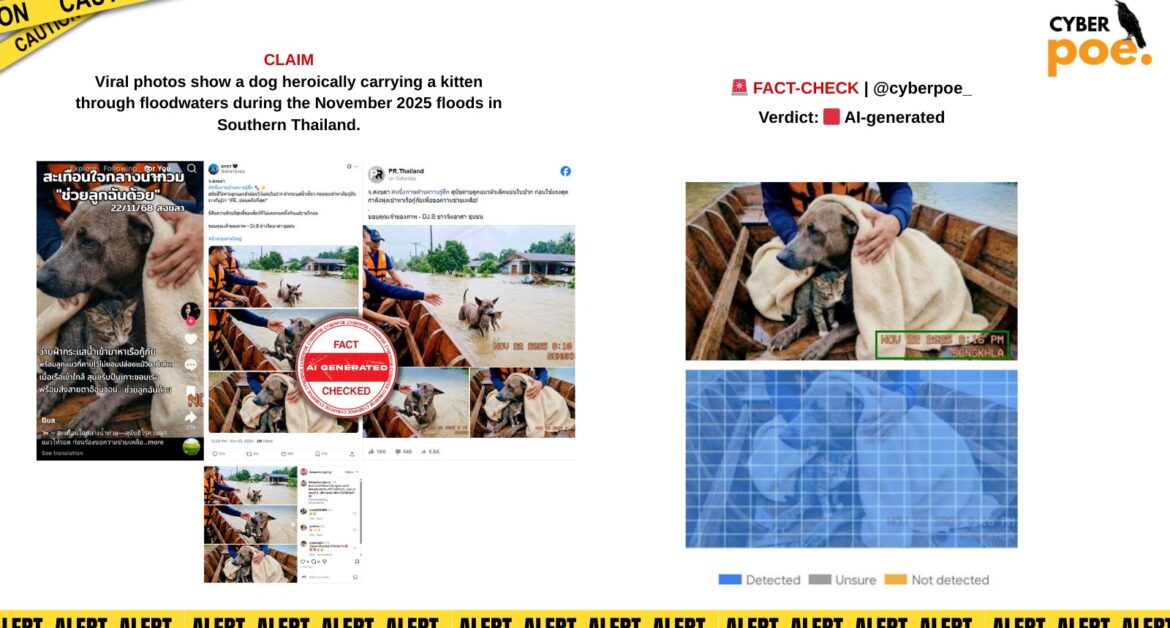
In late November 2025, southern Thailand experienced severe flooding that caused widespread destruction, claiming the lives of over thirty people and displacing more than 1,200 residents, particularly in Songkhla province. The disaster prompted an outpouring of online attention, with numerous social media users sharing images and videos purportedly depicting heroic rescues. Among the most widely circulated visuals were heartwarming images showing a dog carrying a kitten through the floodwaters toward a rescue boat. These posts, which appeared on Facebook, Instagram, X, TikTok, and Threads, quickly amassed millions of reactions and shares, creating the impression of an extraordinary, real-life story of courage and compassion amid natural calamity. However, a thorough investigation by CyberPoe reveals that the images are not authentic and were artificially generated using Google’s AI tools.
Verification and AI Detection
CyberPoe’s verification process involved multiple layers of cross-platform analysis, reverse-image searches, and digital forensics. All three viral images were flagged as AI-generated by Google itself. A reverse-image search traced the visuals back to files explicitly labeled with the tag “Made with Google AI,” confirming that the content was produced using a generative model rather than captured in real life. Additionally, Google’s SynthID Detector, a tool introduced in 2025 to identify synthetic media through embedded digital watermarks, verified that these images were artificially created. The presence of these watermarks confirms the use of generative AI technology and rules out the possibility that the photos represent actual events on the ground.
Visual Inconsistencies Indicate Fabrication
Further examination of the images highlights a number of inconsistencies typical of AI-generated content. For instance, one of the buildings in the scene appears to have multiple front doors, an architectural impossibility, while the water levels in several frames are clearly mismatched. The dog carrying the kitten appears to float above the water level in a way inconsistent with realistic physical dynamics. Moreover, one of the images features a timestamp reading “8:10 PM,” yet the scene clearly depicts daylight conditions. Such visual artifacts are characteristic of current limitations in generative AI, where models sometimes produce elements that violate real-world logic or consistency.
Original Post Acknowledgement of AI Creation
Interestingly, the initial post that introduced these images to social media explicitly acknowledged their artificial nature. AFP identified a now-deleted upload from November 22, 2025, in which the creator stated that the images were generated using AI. Despite this disclaimer, the visuals quickly spread across multiple platforms stripped of any attribution or context, causing many users to interpret them as genuine depictions of a canine rescue amid flooding. The rapid virality of the images underscores how AI-generated content can easily be mistaken for authentic media, especially when paired with emotionally compelling narratives.
Context of the Real Flooding Events
While the dog-and-kitten story is fabricated, the flooding that swept southern Thailand in November 2025 was a genuine natural disaster. Songkhla province, among other areas, experienced record rainfall leading to extensive flooding that resulted in loss of life, property damage, and widespread evacuations. Official reports indicate more than thirty fatalities and over 1,200 residents displaced. Government agencies, volunteer organizations, and media outlets provided continuous updates on rescue efforts. Notably, none of the official sources reported any incident resembling the dog-assisted rescue depicted in the viral images. There is no verified eyewitness account, photo, or video that corroborates the AI-generated visuals, further confirming that they do not reflect real events.
The Spread of Misinformation
The circulation of these AI-generated images highlights a growing problem in online information ecosystems. Heartwarming or emotionally charged content is often shared rapidly, regardless of its authenticity, particularly during crises. In this case, the images capitalized on the real suffering caused by floods to generate engagement, leading to widespread misinformation. Digital forensics experts note that AI-manipulated imagery can lend false credibility to fictional narratives, especially when combined with real-world events, creating the perception that extraordinary occurrences are happening when they are entirely fabricated.
Conclusion
CyberPoe’s analysis confirms that the viral dog-rescue photos from Thailand’s November 2025 floods are false and AI-generated. They do not depict any actual rescue event, and their spread has contributed to the amplification of misinformation during a humanitarian crisis. While the flooding itself was real and tragically destructive, no credible evidence supports the narrative of a dog carrying a kitten through floodwaters. The use of AI-generated imagery in this context serves as a cautionary example of how synthetic media can manipulate public perception and underscores the importance of relying on verified and authenticated content during emergencies. CyberPoe advises social media users to critically evaluate emotionally compelling visuals and prioritize information from trusted sources, particularly during natural disasters.
CyberPoe | The Anti-Propaganda Frontline 🌍