Project Info
Category
Date
Viral “Philippines Typhoon” Flood Video Actually from Florida (2022)
Introduction
A dramatic video showing massive waves engulfing a coastal neighborhood has gone viral across Facebook, TikTok, and X (formerly Twitter), with captions claiming it depicts the devastating impact of a recent typhoon in the Philippines. The footage, which appears to show entire homes being swept away by violent floodwaters, has sparked fear and confusion online, particularly as the country continues to recover from Typhoon Bualoi and Tropical Storm Matmo.
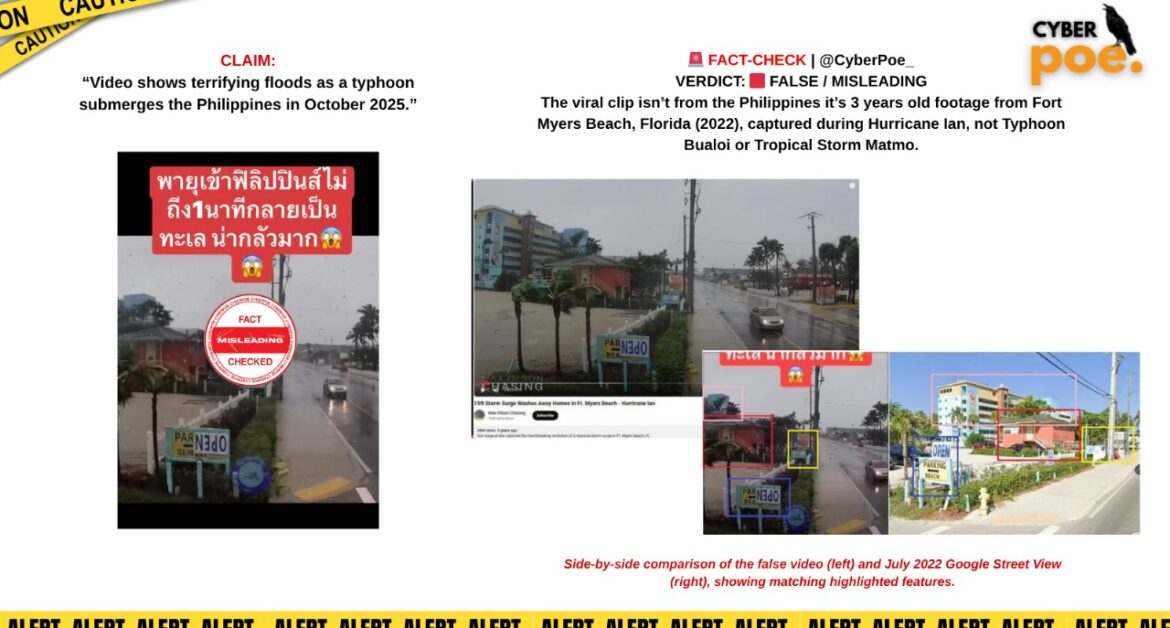
However, an in-depth investigation by CyberPoe’s Open-Source Intelligence (OSINT) team reveals that the video has no connection to the Philippines or any 2025 storm event. In reality, it was filmed in Fort Myers Beach, Florida, during Hurricane Ian in September 2022. The claim is false and misleading, relying on recycled disaster footage to exploit a real humanitarian crisis for engagement and panic.
The Viral Claim
The misleading video began circulating in early October 2025, accompanied by captions in Thai and Filipino that read, “Storm hits the Philippines. Within a minute, the place turned into the sea. So scary.” The clip quickly amassed thousands of shares, coinciding with real reports of destruction and flooding caused by Typhoon Bualoi across several provinces in the Philippines.
The emotional timing of the post made it believable. As news of genuine flooding spread, social media users assumed the video reflected current events. Within hours, it had been reposted by multiple accounts on Facebook and TikTok, many of which had previously shared disaster-related misinformation.
OSINT Investigation and Verification
CyberPoe’s OSINT team conducted a detailed forensic analysis to uncover the origin of the viral video. Using reverse image search and frame-by-frame comparison, investigators traced the footage to a YouTube video uploaded on September 29, 2022, by Max Olson, a well-known American storm chaser.
The original video, titled “15ft (4.5 metre) Storm Surge Washes Away Homes in Ft. Myers Beach — Hurricane Ian,” matched the viral clip in every detail. Buildings, street layouts, and even distinctive palm trees seen in the footage aligned perfectly with imagery from Estero Boulevard, Fort Myers Beach, when compared through Google Earth and Street View archives from mid-2022.
Further verification through weather archives confirmed that the water surges and wind conditions visible in the video were consistent with Hurricane Ian’s Category 4 impact on Florida, not with Typhoon Bualoi’s landfall pattern in the Philippines.
The Context: Hurricane Ian’s 2022 Devastation
Hurricane Ian struck Florida on September 28, 2022, with wind speeds exceeding 240 kilometers per hour, ranking as one of the deadliest and most destructive hurricanes in recent U.S. history. The storm caused catastrophic flooding, tore apart entire neighborhoods, and led to at least 156 fatalities across the country.
The viral clip was originally captured by Max Olson as part of his storm-chasing documentation of Ian’s 15-foot storm surge that devastated Fort Myers Beach. His footage gained significant international attention at the time and was featured by major media outlets including Good Morning America, The Washington Post, and Reuters.
What was once authentic evidence of a U.S. natural disaster has now resurfaced in manipulated form to mislead global audiences about events thousands of miles away.
How the Video Was Misused
The same Hurricane Ian video has repeatedly reappeared online under false contexts, a phenomenon known as “crisis recycling.” CyberPoe’s investigation found that this clip has been reused in multiple unrelated weather events since 2022. It was previously labeled as footage from “Hurricane Helene” in September 2024, and later as “Hurricane Milton” in October 2024. In 2025, it has once again been weaponized as supposed evidence of Typhoon Bualoi’s destruction in the Philippines.
Crisis recycling exploits emotional vulnerability during emergencies. When people are searching for information and empathy, recycled visuals can easily go viral because they appear authentic and dramatic. This manipulation not only spreads misinformation but also undermines trust in legitimate media reporting and official disaster alerts.
The Real Situation in the Philippines
While Typhoon Bualoi and Tropical Storm Matmo did cause genuine destruction across parts of the Philippines, including Samar, Leyte, and the Bicol region, no official footage or imagery from local authorities matches the viral video. The Philippine Atmospheric, Geophysical and Astronomical Services Administration (PAGASA) and the National Disaster Risk Reduction and Management Council (NDRRMC) confirmed that while heavy rains and flooding occurred, the locations shown in the viral clip are inconsistent with any affected Philippine area.
Moreover, architectural features, road markings, and signage in the video such as Western-style beachfront homes and distinct American infrastructure further confirm its U.S. origin.
Why This Matters
Disinformation during natural disasters can have severe real-world consequences. False visuals not only sow confusion but can also divert public attention from legitimate emergency updates and humanitarian appeals. In moments of crisis, misinformation spreads faster than facts, amplifying fear and distrust among already vulnerable communities.
By misrepresenting past disasters as current ones, bad actors exploit grief and chaos to generate online engagement, often at the expense of truth. Such viral manipulations diminish trust in credible media, undermine rescue coordination, and distort the reality of ongoing tragedies.
CyberPoe Conclusion
After a comprehensive forensic review, CyberPoe concludes that the viral video claimed to show flooding in the Philippines during Typhoon Bualoi is false. The footage was filmed in Fort Myers Beach, Florida, during Hurricane Ian in 2022 and has been repeatedly repurposed across multiple online misinformation campaigns.
There is no evidence linking the video to any 2025 storm event in the Philippines. The viral claim represents a clear case of digital deception through recycled disaster footage, illustrating how easily misinformation can exploit global crises.
Final Word
In an era of constant digital noise, old footage often resurfaces to tell new lies. Natural disasters are moments when people seek information and empathy — not manipulation. Verifying content before sharing is not just good practice; it is a civic responsibility in the fight against misinformation.
Stay informed, stay critical, and always question the source before you share.
CyberPoe | The Anti-Propaganda Frontline