Project Info
Category
Date
Viral Video of “Cambodia Blaze” Misattributed Footage Actually from Vietnam
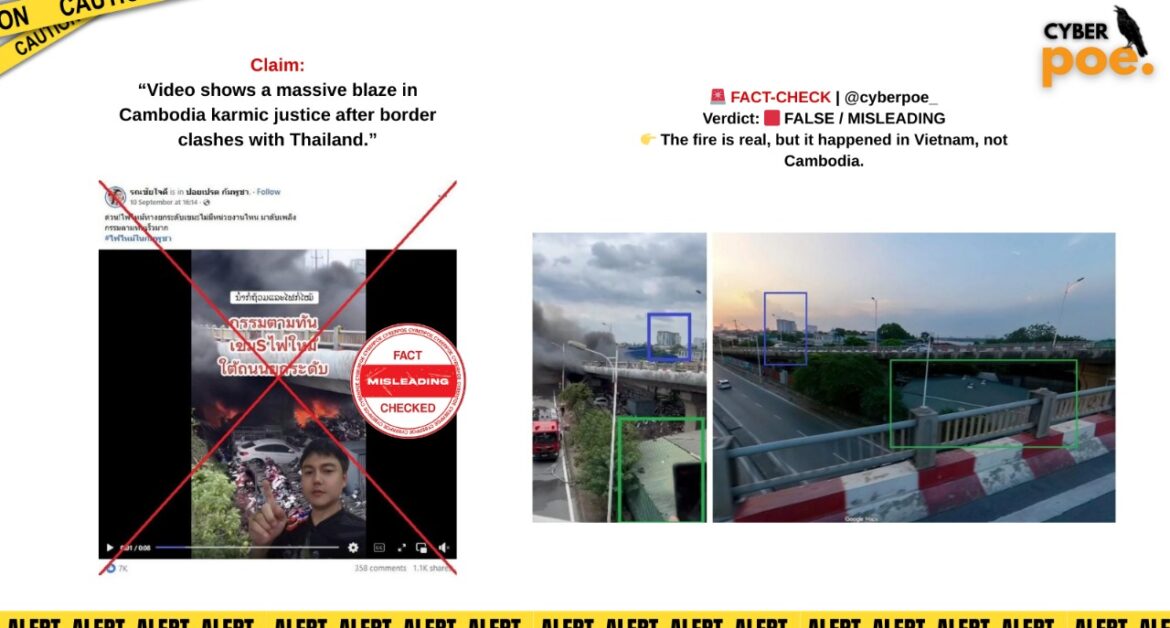
Misinformation thrives in times of crisis, particularly when regional rivalries and political tensions dominate the headlines. In late August 2025, a viral video spread rapidly across social media platforms, claiming to show a massive blaze in Cambodia. Partisan pages framed it as “karmic justice” for the deadly border clashes between Thailand and Cambodia earlier in July. The narrative quickly gained traction on TikTok, Facebook, and YouTube, feeding into pre-existing hostility between communities.
However, a closer examination reveals the claim to be false. While the fire depicted in the video is real, it did not occur in Cambodia. Instead, the footage shows a devastating blaze in Hanoi, Vietnam, that broke out on August 30, 2025. This fact-check unpacks what really happened, how the misinformation spread, and why context is crucial in understanding such disinformation campaigns.
🔎 What Really Happened: The Hanoi Blaze
The viral clip depicts enormous flames erupting beneath an elevated bridge, with hundreds of vehicles engulfed in fire. At first glance, the video appears alarming, and without proper verification, it was easy for misinformation peddlers to frame it as a Cambodian incident.
In reality, the footage was traced back to Hanoi, Vietnam, under the Vinh Tuy Bridge. On August 30, 2025, a massive fire broke out at a parking lot situated under the bridge, torching more than 500 motorbikes. The blaze caused significant property damage, though emergency services acted swiftly to contain the fire and prevent casualties.
Local Vietnamese media outlets extensively covered the incident, confirming the exact location and timing. The authorities later reported that the fire likely originated from an electrical short circuit, which quickly spread due to the dense concentration of parked motorbikes. Importantly, no link whatsoever exists between this blaze and the Cambodia–Thailand border tensions.
🎥 The Viral Video: Misuse and Manipulation
The fire footage first surfaced on TikTok, uploaded with Vietnamese-language captions specifying the date and location. Local users on Facebook also shared additional angles of the blaze, further corroborating its origin.
A reverse image and video search reinforced this evidence. Still images from the clip matched the Google Maps street view of the Vinh Tuy Bridge, confirming that the viral visuals were indeed taken in Hanoi.
Despite this evidence, the video was rapidly stripped of its original context and repurposed with misleading captions. The false claim that the footage was from Cambodia spread widely on regional social media networks, deliberately designed to provoke outrage and mockery in the wake of border tensions.
🌐 Who Spread the Disinformation?
The misattributed clip was not an accidental mistake; it was deliberately weaponized. Several types of accounts were at the center of its spread:
- Thai-language Facebook pages framed the blaze as “karma for Cambodia,” presenting the fire as cosmic retribution for July’s violent clashes.
- TikTok and YouTube reels recycled the same footage, stripped of original captions, often edited with sensationalist music and misleading subtitles.
- Partisan propaganda networks seized on the video to fuel animosity, particularly by linking it to the July 2025 border incident that left over 40 people dead.
These actors thrive on exploiting tragedy, not on reporting facts. By presenting unrelated disasters as evidence of political or moral justice, they not only distort reality but also inflame regional tensions.
📌 Context Matters: Border Clashes and Online Propaganda
The broader context of this misinformation wave is essential. In July 2025, violent border clashes between Cambodia and Thailand resulted in more than 40 fatalities and reignited long-standing territorial disputes. In the aftermath, nationalist rhetoric surged on both sides.
This environment created fertile ground for disinformation campaigns. Old or unrelated disaster footage was repeatedly recycled and relabeled to mock the opposing side. For example:
- Cambodian users circulated unrelated videos of Thai accidents to ridicule Thailand.
- Thai users, in turn, shared disaster clips from unrelated countries but labeled them as Cambodian misfortune.
This trend illustrates how digital propaganda ecosystems operate in Southeast Asia, where social media becomes a battleground for national pride and political hostility. Multiple fact-checking organizations have already debunked several similar cases in recent months, highlighting the systematic exploitation of tragedies for partisan narratives.
✅ Conclusion: The Truth Behind the Blaze
After careful verification, the claim that a massive blaze occurred in Cambodia is proven to be false and misattributed. The viral video indeed depicts a real fire, but it happened in Hanoi, Vietnam, on August 30, 2025, not in Cambodia. The incident had no connection to the Cambodia–Thailand border conflict, despite efforts by partisan networks to link the two events.
This case serves as a reminder of the toxic power of misinformation. By exploiting unrelated disasters, propagandists not only distort truth but also deepen hostility among already divided communities. Consumers of digital content must remain vigilant: always question sensational claims, seek verification from credible sources, and resist the urge to share unverified content.
At CyberPoe, we stand on the frontline of anti-propaganda efforts. Our mission is to expose, debunk, and counter disinformation ensuring that facts, not falsehoods, shape the global conversation.
CyberPoe | The Anti-Propaganda Frontline 🌍