Project Info
Category
Date
Viral Video of “Charlie Kirk’s Assassin Escaping” is Misattributed
The assassination of conservative activist Charlie Kirk in Utah on September 11, 2025, has sparked an avalanche of speculation, conspiracy theories, and misinformation online. Within hours of the tragedy, a video clip of a man running through a parking lot went viral across X, Facebook, Instagram, and Telegram. Countless users claimed it showed Kirk’s killer fleeing the crime scene. However, a thorough investigation reveals that this video has no connection to Kirk’s assassination and is, in fact, footage from an entirely unrelated incident in Reno, Nevada, weeks earlier.
The Claim and Its Virality
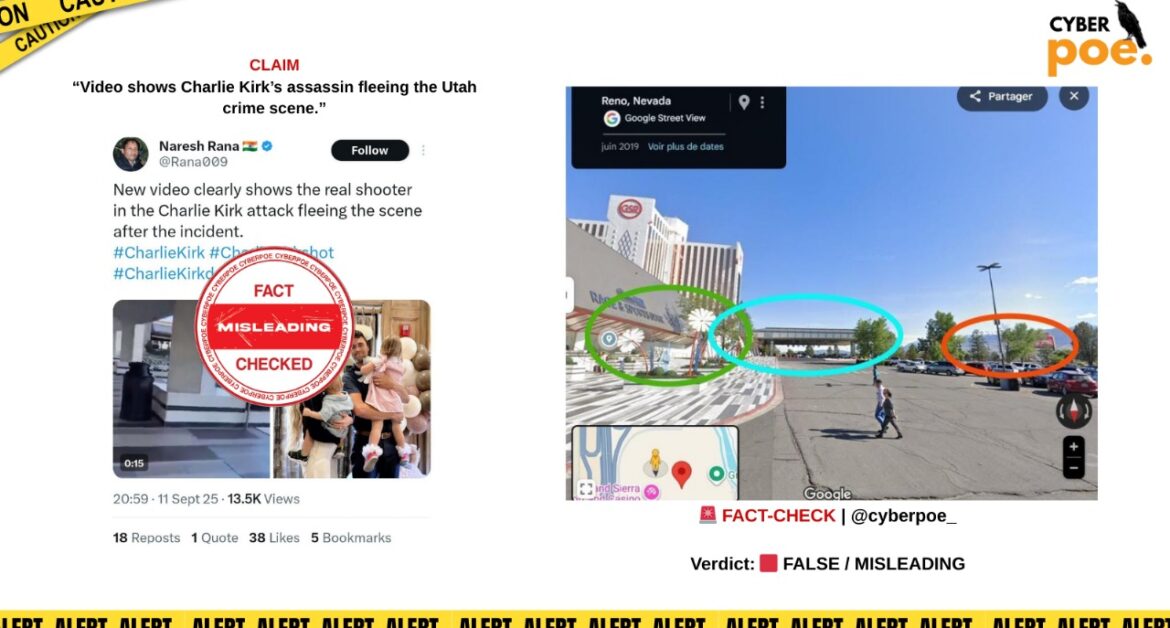
As news of Charlie Kirk’s killing broke, social media was flooded with unverified content. One of the most widely circulated posts featured a short video of a man sprinting across a dimly lit parking lot while police sirens echoed in the background. Many captions suggested that the clip depicted Kirk’s assassin escaping immediately after the Utah shooting. The narrative spread rapidly, amplified by politically charged accounts and conspiracy-driven groups. Within 24 hours, the video had been viewed millions of times, further complicating an already tense political environment.
Investigative Verification
Digital forensic analysis quickly cast doubt on the claim. Using the InVID-WeVerify plugin, researchers traced the earliest appearance of the footage back to late July 2025. A YouTube upload dated July 29 described the video as showing the aftermath of a shooting at the Grand Sierra Resort & Casino in Reno, Nevada. The title and description matched reports from U.S. media at the time, confirming the clip’s origin.
This conclusion was further supported by official sources. The Reno Police Department had posted a press briefing and dashcam footage of the incident on its verified YouTube channel. Visual comparisons established that the parking lot structures, signage, and lighting in the viral clip were identical to the Reno casino location, not the Utah neighborhood where Kirk was killed.
The Reno Shooting Context
The Reno incident occurred on July 28, 2025, when 32-year-old Dakota Hawver opened fire in the Grand Sierra Resort’s parking lot. The attack killed three people and injured several others before police engaged the gunman. Hawver was fatally shot during the confrontation and pronounced dead at a nearby hospital hours later.
At the time, the incident drew national headlines, but its footage resurfaced only after Kirk’s assassination, misleadingly reframed as evidence of the Utah suspect’s escape. Importantly, the Reno gunman’s death eliminates any possibility of a connection between him and Kirk’s killing.
Why the Claim is False
Several key factors expose the claim as false. First, the video predates Kirk’s assassination by six weeks, making it temporally impossible for the two events to be linked. Second, the location and context are entirely different—Reno, Nevada versus Utah. Third, the suspect in the Reno case is deceased, whereas U.S. authorities continue to pursue active leads in Kirk’s case.
Despite these facts, the viral spread of the misattributed video underscores how quickly crime footage can be manipulated, stripped of context, and repurposed for disinformation.
The Broader Problem of Mislabelled Footage
The misattribution of violent incident videos is not a new phenomenon. In the age of real-time virality, older footage from unrelated countries or cities is often resurfaced during breaking news events. Such content is shared not only by uninformed users but also by opportunistic accounts that thrive on chaos and outrage.
In Kirk’s case, the danger lies in how false narratives can fuel conspiracy theories surrounding a politically sensitive assassination. Mislabelled content can distort public understanding, distract from legitimate investigative efforts, and damage trust in authentic evidence of wrongdoing.
Why It Matters
The assassination of a public figure is a grave event that demands sober reporting and responsible information sharing. When misleading content infiltrates the narrative, it risks inflaming tensions, polarizing communities further, and undermining justice. For investigators, the spread of false leads can complicate evidence gathering and open the door to speculation that obscures the truth.
For ordinary users, falling prey to such misinformation fosters distrust in media, institutions, and even legitimate eyewitness accounts. In this environment, fact-checking and digital literacy are not optional they are essential safeguards against disinformation.
Lessons in Digital Verification
This case offers important lessons in how to identify misattributed content. Viewers should examine contextual clues in videos, such as signage, uniforms, or license plates, which often reveal a mismatch with the claimed location. Reverse-image or reverse-video searches, using tools like InVID or Google Lens, can trace earlier appearances of footage. Cross-checking with credible news sources and official law enforcement channels further helps verify authenticity.
The Reno casino video bore multiple identifiable markers: the recognizable “Grand Sierra Resort” parking lot, Reno Police uniforms, and public records confirming the July 28 attack. These details were sufficient to debunk the false claim linking it to Kirk’s assassination.
Conclusion
The viral spread of the Reno casino video, falsely labeled as showing Charlie Kirk’s assassin, highlights the corrosive impact of misattributed content in moments of crisis. While the emotional shock of Kirk’s assassination created fertile ground for misinformation, careful digital verification proves that the viral video is unrelated, predating the incident and depicting a different crime entirely.
As disinformation continues to weaponize visuals in the digital era, the responsibility falls on both users and platforms to approach viral content with skepticism. By pausing, verifying, and sharing responsibly, society can resist the manipulation of tragedy for clicks and conspiracy.
CyberPoe | The Anti-Propaganda Frontline 🌍