Project Info
Category
Date
Viral Video Shows Russian Su-27 Intercepting NATO F-15 Over Ukraine
Introduction
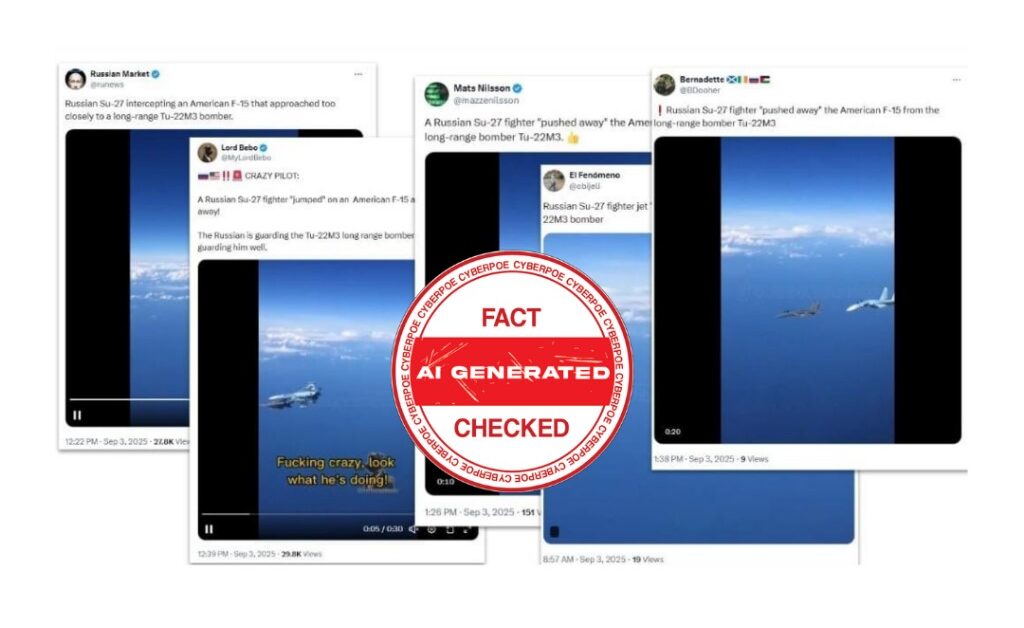
A video that has recently gone viral across X (formerly Twitter) and other social media platforms claims to show a dramatic aerial encounter between a Russian Su-27 fighter jet and a NATO F-15 attempting to approach a Tu-22M3 bomber over Ukraine. The clip has been shared widely as if it depicts a real-world incident from the ongoing Russia-Ukraine conflict. However, after detailed verification, CyberPoe confirms that the video is not genuine footage of an aerial interception. Instead, it originates from the popular military simulation video game War Thunder. This is yet another example of how old or digitally generated content is recycled and weaponized on social media to mislead audiences and shape perceptions of the war.
The Origins of the Video
The footage in question first surfaced on TikTok in July 2024, over a year before it began trending again in September 2025. The original post carried the watermark of a TikTok account dedicated to aviation and gaming content. Importantly, the caption explicitly stated that the sequence was created within War Thunder, a widely played simulation game known for its realistic depictions of military aircraft, naval vessels, and ground vehicles. The caption read: “🔥 A Russian Su-27 intercepting NATO F-15 trying to get closer to a Tu-22m3. #su27 #su27flanker #warthunderaviation #aviation”. Despite this clear indication of its origins, when the clip was reposted across X and other platforms in September 2025, the context was stripped away, and it was presented as if it captured recent, authentic events over Ukraine.
Why the Video is Misleading
The primary issue with this viral clip is the deliberate or careless removal of its original context. While War Thunder prides itself on delivering realistic visuals and flight physics, it remains a game, not a source of authentic war footage. Anyone familiar with aviation video games would recognize the digital rendering, but to casual viewers scrolling quickly through social feeds, the scenes may appear convincing, especially when paired with captions claiming real-world authenticity. By omitting the TikTok watermark and caption, those reposting the video exploited this realism to mislead audiences.
This pattern of misrepresentation is not new. Since the beginning of the Russia-Ukraine conflict, there have been repeated instances of old footage, video game content, or even movie clips being recycled as supposed evidence of current battlefield events. Such fabrications often go viral quickly, as sensational war footage tends to gain high traction online. Once circulated widely, these clips are difficult to retract, even when fact-checks are published to debunk them.
Historical Pattern of Video Game Footage Being Used as “Evidence”
The use of War Thunder and similar games as sources of so-called “evidence” is part of a broader disinformation trend. Throughout 2022–2025, multiple cases have been documented where clips from video games like War Thunder, Arma 3, and DCS World were passed off as real war footage. In early 2023, for example, footage from Arma 3 was circulated as proof of Ukrainian air defense systems downing Russian missiles. Similarly, War Thunder scenes have previously been rebranded to depict tank battles and aerial dogfights allegedly taking place in Ukraine. Each time, the goal has been the same: to exploit the visual realism of modern games and to mislead viewers about the reality of the conflict.
These fabrications serve multiple purposes. They create confusion among ordinary audiences, muddy the information environment, and sometimes even reach mainstream news outlets before being debunked. The Russia-Ukraine war, fought not only on the ground but also in the digital and informational spheres, has been particularly vulnerable to such manipulations. Viral videos, regardless of authenticity, can sway opinions, boost propaganda narratives, and reinforce biases among those predisposed to believe them.
The Role of Social Media in Amplifying Misinformation
The case of the Su-27 and F-15 clip highlights how social media platforms act as accelerants for misinformation. A video originally shared as gaming content in July 2024 would likely have remained obscure if not for opportunistic actors who stripped it of context and repurposed it in September 2025 as “breaking” footage. Once posted with a misleading caption, it spread rapidly through reposts, shares, and quote-tweets, many of which further amplified the false claim.
The speed of this spread reflects how quickly misinformation can outpace fact-checking. Platforms like X, TikTok, and Facebook reward content that provokes emotional reactions such as shock, awe, or outrage. Clips depicting dramatic dogfights between advanced jets naturally attract attention, and without prominent fact-checking labels, many viewers will take them at face value.
Fact Why -Checking Matters
Debunking such claims is vital not only to uphold the truth but also to safeguard the credibility of real journalism and authentic documentation of the war. Every time a fabricated clip goes viral, it diverts attention away from verified reporting and creates skepticism even about genuine footage. For researchers, journalists, and policymakers trying to understand the war, this “fog of misinformation” makes analysis more difficult. For ordinary audiences, it erodes trust in all sources, fostering an environment where disinformation can thrive.
CyberPoe emphasizes the importance of digital literacy in such contexts. Viewers should be trained to question sensational content, verify the origins of videos, and cross-check claims before believing or sharing them. Recognizing watermarks, checking upload dates, and identifying gaming-style graphics can often expose fakes within seconds. Fact-checking organizations, meanwhile, must continue to call out these attempts at deception, even if they appear trivial, because their cumulative effect on the information environment is profound.
Conclusion
The viral video claiming to show a Russian Su-27 intercepting a NATO F-15 near a Tu-22M3 bomber over Ukraine is not authentic. It is War Thunder video game footage originally posted to TikTok in July 2024, later stripped of its context and reshared widely in September 2025 as if it were real. This episode underscores a recurring problem in the digital age: the recycling of gaming or old content to manufacture false narratives about ongoing conflicts.
As the Russia-Ukraine war continues, it is crucial for both audiences and media outlets to exercise caution and verify sources before amplifying sensational claims. Social media may accelerate the spread of misinformation, but vigilant fact-checking and digital literacy can serve as effective defenses. CyberPoe remains committed to exposing such fabrications and ensuring that audiences have access to verified, factual information rather than manipulated illusions.
CyberPoe | The Anti-Propaganda Frontline