Project Info
Category
Date
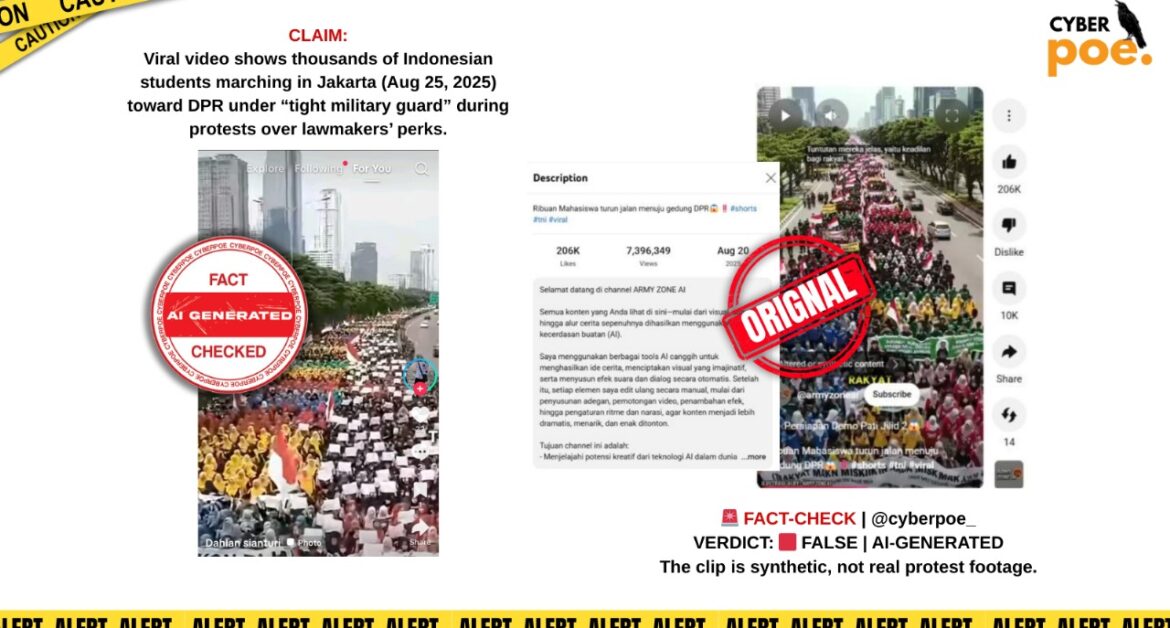
Viral video shows thousands of Indonesian students marching in Jakarta (Aug 25, 2025) toward DPR under “tight military guard” during protests over lawmakers’ perks.
The Claim
A viral video circulating on social media claims to show thousands of Indonesian students marching in Jakarta on 25 August 2025 toward the DPR building under heavy military guard. The posts describe the event as part of a wave of student-led protests against lawmakers’ extravagant perks. At first glance, the footage appears dramatic and convincing, but a closer investigation reveals the clip is AI-generated and does not depict any real protest march.
Context: Real Protests vs Fake Footage
It is important to begin with what actually happened in Indonesia. On 25 August, protests did break out in Jakarta and several other cities after outrage over legislators’ lavish benefits. The situation escalated tragically when a Brimob police vehicle struck and killed 21-year-old Affan Kurniawan. His death intensified the unrest, which by the end of the week had left at least six people dead nationwide. The demonstrations grew so intense that President Prabowo Subianto was eventually forced to announce cuts to lawmakers’ perks in an attempt to calm public anger.
In other words, the political unrest was real, the anger was real, and the casualties were real. What was not real, however, was the viral marching video that many users believed documented the protests.
Evidence of AI Manipulation
CyberPoe, together with AFP’s digital verification team, investigated the viral footage using open-source forensic tools. A reverse image search quickly traced the video to a YouTube channel called Army Zone AI, which uploaded the same clip on 20 August 2025 five days before the protests began. The channel explicitly labels its content as “AI-generated military simulations.”
Closer inspection of the video itself revealed the classic signatures of synthetic imagery:
- Unreadable text: Banners supposedly written in Indonesian contained gibberish letters and distorted characters that made no linguistic sense.
- Facial anomalies: Protesters’ faces appeared warped, with strange asymmetries and occasional unnatural blurring.
- Glitching vehicles: Trucks and police cars in the footage seemed to flicker or morph in unrealistic ways, with wheels failing to align with the road surface.
These flaws are hallmarks of current AI video-generation tools, which still struggle to render complex crowds and text consistently.
Verified Reality on the Ground
Although the AI video was fake, the protests themselves were not. Verified footage from Jakarta and other cities, captured by journalists and citizen reporters, confirmed mass demonstrations, clashes with police, and genuine scenes of violence. Independent media and rights groups documented the tragic death of Affan Kurniawan, as well as several other casualties that followed.
This case underscores the risk of misinformation during fast-moving political crises: authentic events become mixed with fabricated content, making it harder for the public to distinguish fact from fiction.
The Bigger Picture: Deepfakes in Protest Coverage
The viral AI protest video is not just a curiosity it is part of a worrying trend. Deepfakes and synthetic clips are increasingly deployed to amplify unrest, confuse audiences, and manipulate perceptions of political events. In this case, fabricated visuals of students marching under “tight military guard” risked exaggerating the scale of protests, spreading fear, and eroding trust in legitimate reporting.
For protesters and journalists alike, the stakes are high. Disinformation can delegitimize real grievances, discredit genuine eyewitness footage, and even be weaponized by authorities or agitators to justify harsher crackdowns.
Bottom Line
The viral video of Indonesian students marching in Jakarta on 25 August 2025 is false an AI-generated fabrication traced to a simulation channel on YouTube. While genuine protests and tragic violence did occur that week, the specific clip is synthetic and does not document reality.
This fact-check highlights a crucial lesson: in the era of generative AI, protest footage should never be taken at face value. Always verify suspicious clips with reverse image searches, forensic tools, and trusted reporting sources.
🚨 Don’t let AI replace reality.
📌 The protests were real.
📌 The viral student march video was not.
CyberPoe | The Anti-Propaganda Frontline
We track the truth. Everywhere.