Project Info
Category
Date
Were Manila Protesters Paid To Incite Voilence
The Viral Claim
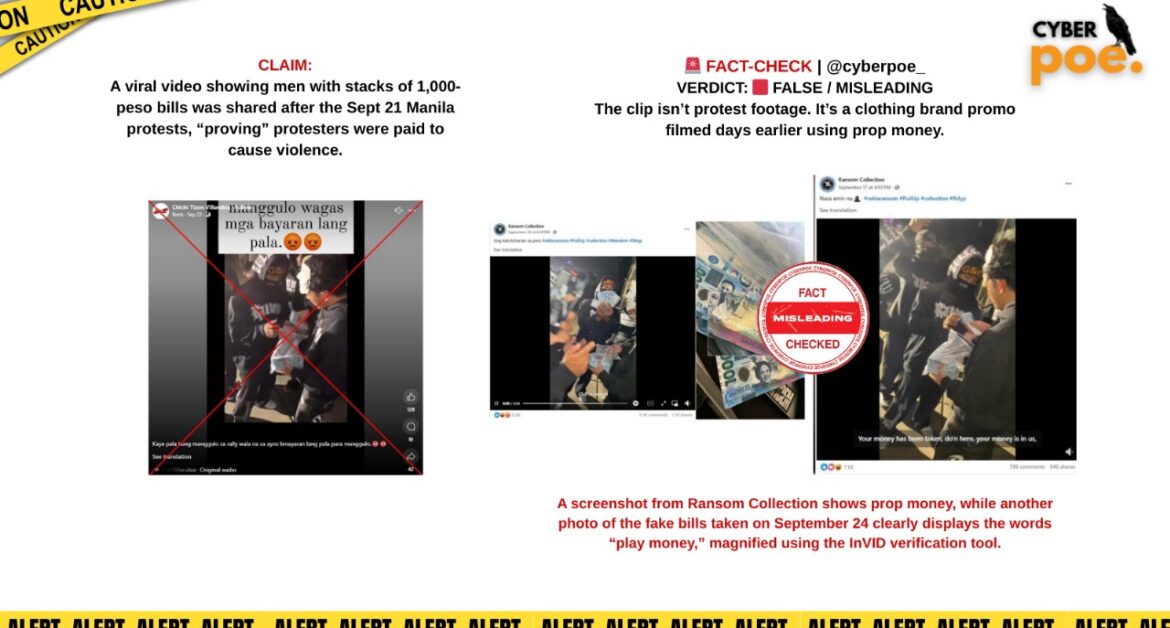
In the aftermath of the anti-corruption rallies in Manila on September 21, 2025, social media became flooded with a sensational video. The clip showed young men holding thick bundles of cash, flaunting them to the camera. Captions in both Tagalog and English declared: “So that’s why the protesters were so violent they were paid to cause chaos.”
The framing was clear. The protesters were not ordinary citizens exercising their rights but hired actors with pockets full of dirty money. Within hours, the footage had been shared across Facebook, X (Twitter), and even WhatsApp groups, quickly gaining traction among audiences already polarized by Philippine politics.
Tracing the Evidence
At CyberPoe, we put the claim under the OSINT lens. A reverse image search of the viral clip pointed us away from Manila’s streets and toward a very different source: a TikTok promotional video for a clothing brand.
Frame-by-frame comparison revealed striking differences. The viral clip lacked any protest setting. Instead, it showed a studio-like background, no chanting crowds, no police barricades, and no protest signs. The bills themselves supposedly Philippine pesos had mismatched dimensions, blurred print, and paper-like quality. In short, they were prop money, the kind commonly used in advertisements and low-budget music videos.
The conclusion? The footage was staged for commercial effect long before the September rallies, not captured during them.
Media Verification
To cross-verify, we checked mainstream coverage of the September 21 rallies. Local outlets such as Rappler, Inquirer, and Vera Files reported on the demonstrations extensively. Their footage showed largely peaceful gatherings that only turned chaotic later, when clashes erupted between police and a small group of masked individuals. Nowhere in the documented reports was there evidence of protesters being handed cash to participate.
Fact-checking organizations in the Philippines also debunked the claim, confirming the viral video’s commercial origins. The so-called “proof” was nothing more than recycled online content opportunistically reframed as evidence of corruption.
The Disinformation Playbook
This case is not an isolated incident it is a textbook example of how recycled footage is weaponized in today’s information wars. The aim is not necessarily to convince, but to plant doubt. By suggesting that demonstrators were paid, disinformation actors weaken the legitimacy of the protests and sow suspicion among citizens.
It also fits into a broader trend of content laundering, where non-political videos from ads, pranks, or foreign events are relabeled and injected into sensitive political contexts. This tactic has been seen in India, Bangladesh, and Latin America, where clips of unrelated riots or marketing campaigns were presented as “local evidence” of unrest.
The ultimate goal is psychological: to erode trust in genuine civic mobilization, to delegitimize grievances, and to polarize already divided societies.
The Verdict
❌ False.
The viral video does not show Manila protesters being paid to incite violence. The footage comes from a clothing brand advertisement using fake bills as props. No credible evidence supports the claim that demonstrators in the September 21 rallies received money to stage unrest.
CyberPoe Final Word
This incident underlines a harsh truth: in the age of algorithmic virality, disinformation often travels faster than truth. Ordinary citizens scrolling through their feeds see dramatic visuals and instantly connect them to breaking news, without questioning the source. By the time fact-checks emerge, the falsehood has already shaped perception.
At CyberPoe, our mission remains clear: to cut through recycled lies, track the digital fingerprints, and return clarity to the public space. Manila’s protesters were not mercenaries of chaos they were citizens exercising their democratic right. The viral video was nothing more than a staged marketing clip hijacked for political gain.
⚡ Always cross-verify. Always question the narrative.
Follow @cyberpoe_ The Anti-Propaganda Frontline.